## Diagram: Framework for AI Application and Evaluation across Scientific Domains
### Overview
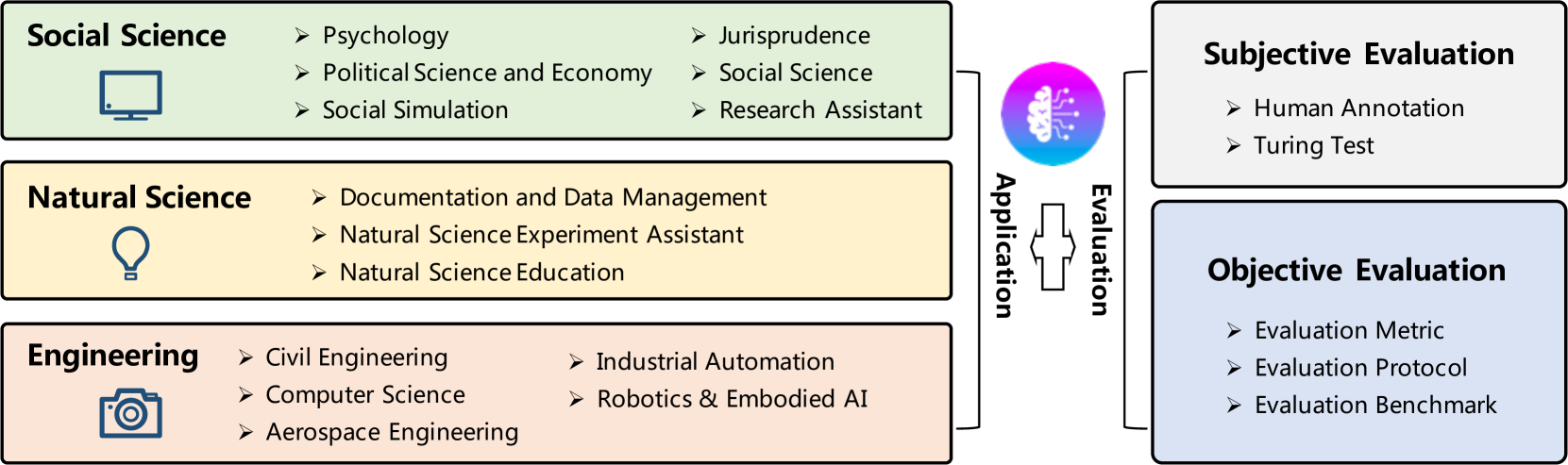
This image is a conceptual diagram illustrating the relationship between various scientific and engineering domains and the methodologies used to evaluate AI applications within them. The diagram is structured as a tripartite flow: application domains on the left, a central processing/bridging hub, and evaluation categories on the right. It uses color-coded blocks, icons, and bulleted lists to categorize information.
### Components/Axes
The diagram is organized into three main horizontal regions:
1. **Application Domains (Left Column):** Three stacked, rounded rectangular blocks.
* **Top (Light Green):** Social Science
* **Middle (Light Yellow):** Natural Science
* **Bottom (Light Peach/Tan):** Engineering
2. **Central Bridge:**
* **Icon:** A circular gradient (purple to blue) containing a white brain silhouette with circuit-like nodes.
* **Text Labels:** Vertical text "Application" (left of the center) and "Evaluation" (right of the center).
* **Symbol:** A horizontal double-headed arrow between the vertical text labels.
* **Brackets:** Large curly brackets group the three left-side blocks toward the center and the two right-side blocks toward the center.
3. **Evaluation Methodologies (Right Column):** Two stacked, rounded rectangular blocks.
* **Top (Light Grey):** Subjective Evaluation
* **Bottom (Light Blue):** Objective Evaluation
### Content Details
#### 1. Social Science (Top-Left Block)
* **Icon:** A stylized computer monitor.
* **Sub-categories (Bulleted List):**
* Psychology
* Political Science and Economy
* Social Simulation
* Jurisprudence
* Social Science
* Research Assistant
#### 2. Natural Science (Middle-Left Block)
* **Icon:** A stylized lightbulb.
* **Sub-categories (Bulleted List):**
* Documentation and Data Management
* Natural Science Experiment Assistant
* Natural Science Education
#### 3. Engineering (Bottom-Left Block)
* **Icon:** A stylized camera (DSLR type).
* **Sub-categories (Bulleted List):**
* Civil Engineering
* Computer Science
* Aerospace Engineering
* Industrial Automation
* Robotics & Embodied AI
#### 4. Subjective Evaluation (Top-Right Block)
* **Sub-categories (Bulleted List):**
* Human Annotation
* Turing Test
#### 5. Objective Evaluation (Bottom-Right Block)
* **Sub-categories (Bulleted List):**
* Evaluation Metric
* Evaluation Protocol
* Evaluation Benchmark
### Key Observations
* **Domain Breadth:** The diagram covers a wide spectrum of human knowledge, from the "soft" social sciences to "hard" engineering, suggesting a universal framework for AI.
* **Evaluation Dichotomy:** Evaluation is strictly divided into "Subjective" (human-centric) and "Objective" (metric-centric) approaches.
* **Centrality of AI:** The brain/circuit icon in the center serves as the nexus, indicating that AI technology is the medium through which these domains are applied and subsequently evaluated.
* **Visual Hierarchy:** Bold headers for each block clearly define the primary categories, while smaller text and arrow-head bullets (>) denote specific applications or methods.
### Interpretation
This diagram likely serves as a high-level taxonomy for a research paper or technical report concerning Large Language Models (LLMs) or AI Agents. It demonstrates how AI is not merely a tool for computer science but is being integrated into diverse fields like Jurisprudence and Aerospace Engineering.
The relationship suggested is one of **reciprocal development**:
* **Application:** AI is tailored to meet the specific needs of different sciences (e.g., acting as a "Research Assistant" in Social Science or an "Experiment Assistant" in Natural Science).
* **Evaluation:** The success of these applications must be measured. The diagram suggests that while some aspects can be measured with hard "Benchmarks" (Objective), others—particularly those involving human-like reasoning or social interaction—require "Human Annotation" or the "Turing Test" (Subjective).
The inclusion of "Social Science" as both a main category and a sub-item within the Social Science block might indicate a recursive or foundational role for general social scientific principles within the broader application of AI to that field. The double-headed arrow in the center implies that the process is iterative: evaluation results likely inform further application development.