## Grouped Bar Chart: AUROC by Representation Type and Hallucination Category
### Overview
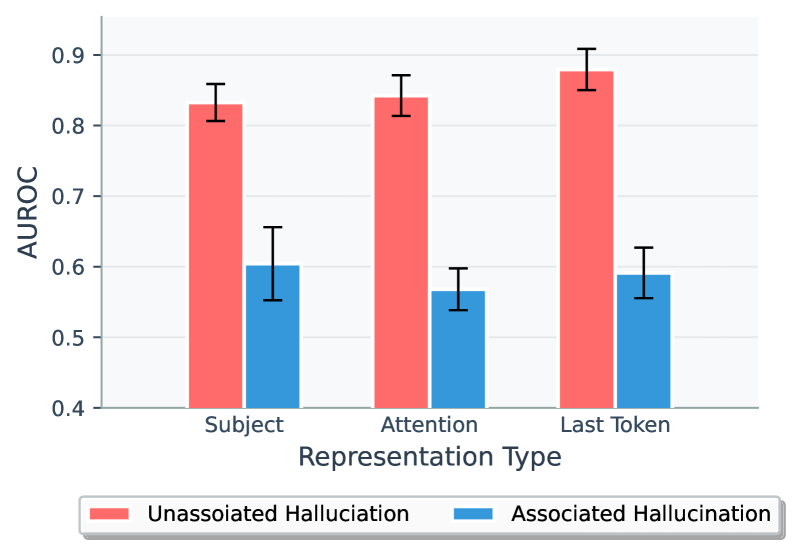
This is a grouped bar chart comparing the Area Under the Receiver Operating Characteristic curve (AUROC) performance metric for two different types of hallucinations ("Unassociated" and "Associated") across three different model representation types ("Subject", "Attention", and "Last Token"). The chart includes error bars for each data point.
### Components/Axes
* **Chart Type:** Grouped bar chart with error bars.
* **X-Axis (Horizontal):**
* **Label:** "Representation Type"
* **Categories (from left to right):** "Subject", "Attention", "Last Token".
* **Y-Axis (Vertical):**
* **Label:** "AUROC"
* **Scale:** Linear scale from 0.4 to 0.9, with major gridlines at 0.1 intervals (0.4, 0.5, 0.6, 0.7, 0.8, 0.9).
* **Legend:**
* **Position:** Bottom center, below the x-axis label.
* **Items:**
* **Red Bar:** "Unassociated Hallucination"
* **Blue Bar:** "Associated Hallucination"
* **Data Series:** Two series, represented by red and blue bars, plotted for each of the three x-axis categories.
### Detailed Analysis
**Data Points and Approximate Values (with visual uncertainty):**
1. **Subject Representation:**
* **Unassociated Hallucination (Red Bar):** The bar height is approximately **0.83**. The error bar extends from roughly **0.81 to 0.86**.
* **Associated Hallucination (Blue Bar):** The bar height is approximately **0.60**. The error bar extends from roughly **0.55 to 0.65**.
2. **Attention Representation:**
* **Unassociated Hallucination (Red Bar):** The bar height is approximately **0.84**. The error bar extends from roughly **0.81 to 0.87**.
* **Associated Hallucination (Blue Bar):** The bar height is approximately **0.56**. The error bar extends from roughly **0.54 to 0.59**.
3. **Last Token Representation:**
* **Unassociated Hallucination (Red Bar):** The bar height is approximately **0.88**. The error bar extends from roughly **0.85 to 0.91**.
* **Associated Hallucination (Blue Bar):** The bar height is approximately **0.59**. The error bar extends from roughly **0.55 to 0.63**.
**Trend Verification:**
* **Red Bars (Unassociated Hallucination):** Show a slight upward trend from left to right. The "Subject" bar is the shortest, "Attention" is marginally taller, and "Last Token" is the tallest.
* **Blue Bars (Associated Hallucination):** Show a slight downward trend from left to right. The "Subject" bar is the tallest, "Attention" is the shortest, and "Last Token" is slightly taller than "Attention" but shorter than "Subject".
### Key Observations
1. **Significant Performance Gap:** For all three representation types, the AUROC for detecting "Unassociated Hallucination" (red bars, ~0.83-0.88) is substantially higher than for "Associated Hallucination" (blue bars, ~0.56-0.60).
2. **Relative Consistency:** The performance for "Unassociated Hallucination" is relatively high and consistent across representations, with "Last Token" showing a slight advantage. Performance for "Associated Hallucination" is consistently lower and shows more variability, with "Attention" performing the worst.
3. **Error Bar Overlap:** The error bars for the two categories (red vs. blue) do not overlap within any representation type, indicating a statistically significant difference in performance between detecting unassociated vs. associated hallucinations.
4. **Within-Category Variability:** The error bars suggest moderate variability in the measurements, particularly for the "Associated Hallucination" in the "Subject" representation.
### Interpretation
This chart presents a comparative analysis of a model's ability to detect two distinct types of hallucinatory errors based on different internal representations.
* **Core Finding:** The data strongly suggests that the model's representations are far more effective at identifying "Unassociated Hallucinations" (likely errors where generated content is unrelated to the source) than "Associated Hallucinations" (likely errors where generated content is related but incorrect or fabricated). The AUROC values above 0.8 for unassociated errors indicate good discriminative ability, while values near 0.6 for associated errors suggest performance only slightly better than random chance.
* **Implication for Representation:** The "Last Token" representation appears marginally best for detecting unassociated errors, while the "Subject" representation is best (though still poor) for associated errors. This implies that different parts of the model's processing pathway may be more attuned to different failure modes.
* **Underlying Challenge:** The stark contrast in performance highlights a fundamental difficulty in AI safety and reliability: it is significantly harder for the model to detect subtle, contextually-relevant falsehoods (associated hallucinations) than it is to detect outright irrelevant or nonsensical outputs (unassociated hallucinations). This has critical implications for building trustworthy systems, as the more dangerous errors are often the plausible-sounding ones.
* **Investigative Lens (Peircean):** The chart acts as an *index* pointing to a specific property of the model's internal state—its ability to flag errors. The consistent gap between the two bar colors is a *sign* that the nature of the hallucination (associated vs. unassociated) is a primary factor influencing detectability, more so than the specific representation type used for probing. The data invites the *hypothesis* that current representation analysis techniques are better at catching "out-of-distribution" style errors than "in-distribution" factual errors.