## Bar Chart: AUROC Comparison by Representation Type and Hallucination Association
### Overview
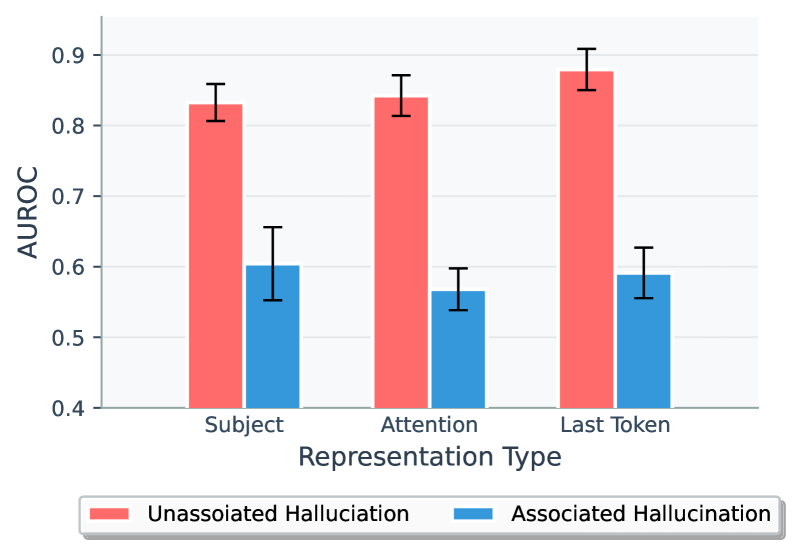
The chart compares the Area Under the Receiver Operating Characteristic curve (AUROC) for two types of hallucination ("Unassociated" and "Associated") across three representation types: "Subject," "Attention," and "Last Token." AUROC values are plotted on a y-axis (0.4–0.9), with error bars indicating uncertainty.
### Components/Axes
- **X-axis (Representation Type)**: Categorical axis with three labels: "Subject," "Attention," and "Last Token."
- **Y-axis (AUROC)**: Continuous scale from 0.4 to 0.9, labeled "AUROC."
- **Legend**: Located at the bottom, with red representing "Unassociated Hallucination" and blue representing "Associated Hallucination."
- **Error Bars**: Vertical lines atop each bar, representing measurement uncertainty.
### Detailed Analysis
1. **Subject Representation Type**:
- **Unassociated Hallucination**: AUROC ≈ 0.83 (±0.03).
- **Associated Hallucination**: AUROC ≈ 0.60 (±0.04).
2. **Attention Representation Type**:
- **Unassociated Hallucination**: AUROC ≈ 0.84 (±0.03).
- **Associated Hallucination**: AUROC ≈ 0.57 (±0.03).
3. **Last Token Representation Type**:
- **Unassociated Hallucination**: AUROC ≈ 0.87 (±0.03).
- **Associated Hallucination**: AUROC ≈ 0.59 (±0.03).
### Key Observations
- **Trend Verification**:
- Unassociated Hallucination consistently outperforms Associated Hallucination across all representation types (e.g., 0.83 vs. 0.60 for "Subject").
- AUROC values for Unassociated Hallucination increase slightly from "Subject" to "Last Token" (0.83 → 0.87), while Associated Hallucination remains relatively stable (0.60 → 0.59).
- **Error Bars**: Uncertainty ranges are narrow (0.03–0.04), suggesting precise measurements.
- **Color Consistency**: Red bars (Unassociated) and blue bars (Associated) align perfectly with the legend.
### Interpretation
The data demonstrates that **Unassociated Hallucination models achieve significantly higher AUROC values** than Associated Hallucination models across all representation types. This suggests that models trained without hallucination associations are more robust in distinguishing between classes. The marginal improvement in Unassociated Hallucination from "Subject" to "Last Token" may indicate that later-stage representations (e.g., final token outputs) retain higher discriminative power. The consistent underperformance of Associated Hallucination could reflect challenges in handling data leakage or overfitting when hallucination is explicitly modeled. The narrow error bars reinforce the reliability of these findings, though the small sample size (implied by limited categories) warrants caution in generalizing results.