## Diagram: Comparison of RLVR and ERL Approaches in Unknown Environment Tasks
### Overview
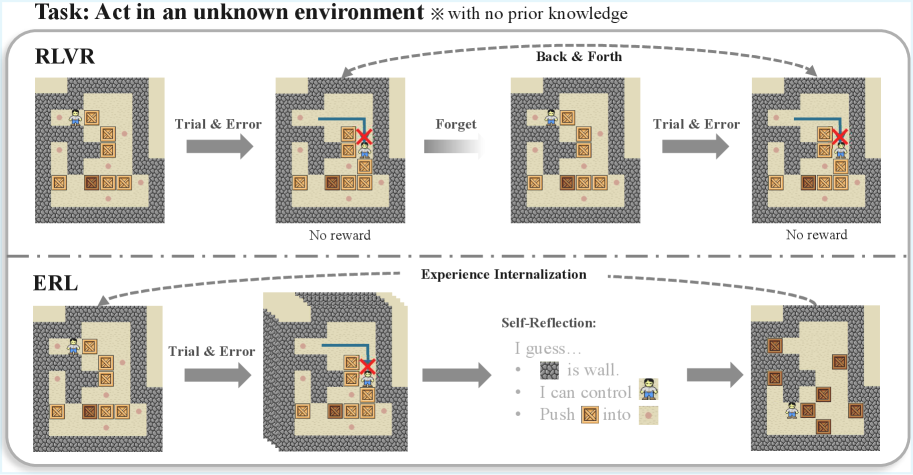
The diagram illustrates two approaches to acting in an unknown environment with no prior knowledge: **RLVR** (Reinforcement Learning with Value Representation) and **ERL** (Experience Replay Learning). It contrasts their processes, outcomes, and mechanisms for handling trial-and-error learning, forgetting, and experience internalization.
---
### Components/Axes
1. **Top Section (RLVR)**:
- **Steps**:
- **Trial & Error**: Initial attempts with errors (marked by red "X").
- **Forget**: Loss of prior knowledge (dashed arrow).
- **Back & Forth**: Iterative attempts without progress.
- **Trial & Error (Repeat)**: Continued failures with no reward.
- **Outcome**: No reward (explicitly labeled).
2. **Bottom Section (ERL)**:
- **Steps**:
- **Trial & Error**: Initial attempts with errors.
- **Experience Internalization**: Self-reflection process (text box with bullet points).
- **Trial & Error (Repeat)**: Improved attempts leading to success (checkmark).
- **Outcome**: Success (implied by checkmark and resolved environment).
3. **Arrows**:
- Solid arrows indicate progression.
- Dashed arrows denote forgetting or conceptual links (e.g., "Experience Internalization").
4. **Text Box (Self-Reflection)**:
- Contains explicit reasoning:
- "I guess..."
- "is wall"
- "I can control"
- "Push into"
---
### Detailed Analysis
- **RLVR Process**:
- Relies on repetitive trial-and-error without retaining past experiences (forgetting).
- Fails to adapt, resulting in no reward despite multiple attempts.
- **ERL Process**:
- Combines trial-and-error with **experience internalization** (self-reflection).
- Self-reflection includes:
- Hypothesis generation ("I guess...").
- Environmental understanding ("is wall").
- Action control ("I can control").
- Goal-directed behavior ("Push into").
- Leads to successful task completion.
---
### Key Observations
1. **RLVR Limitations**:
- No mechanism to retain or learn from past errors.
- Stagnant progress ("Back & Forth" loop).
2. **ERL Advantages**:
- Explicit self-reflection enables knowledge retention.
- Iterative learning improves performance over trials.
3. **Outcome Contrast**:
- RLVR: No reward (failure).
- ERL: Successful resolution (checkmark).
---
### Interpretation
The diagram emphasizes the importance of **experience internalization** and **self-reflection** in adaptive learning. ERL’s structured approach to encoding and applying past experiences allows it to overcome environmental challenges, whereas RLVR’s lack of memory leads to repeated failures. This aligns with principles of human-like learning, where reflection and abstraction of experiences drive problem-solving efficiency. The absence of a legend or numerical data suggests the focus is on conceptual workflows rather than quantitative metrics.