## Spatial Reasoning Test: Mental Rotation Task
### Overview
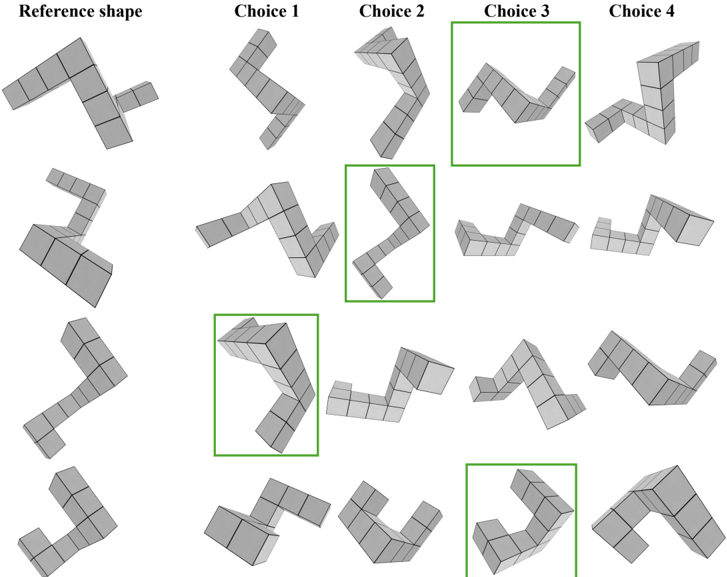
The image displays a visual puzzle or test, likely used to assess spatial reasoning or mental rotation abilities. It consists of a grid with one column of "Reference shapes" and four columns of "Choice" shapes. Each row presents a unique 3D block figure as the reference, followed by four potential matches. The correct matches are indicated by green rectangular outlines.
### Components/Axes
* **Structure:** A 4x5 grid (4 rows, 5 columns).
* **Column Headers (Top Row):**
* Column 1: "Reference shape"
* Column 2: "Choice 1"
* Column 3: "Choice 2"
* Column 4: "Choice 3"
* Column 5: "Choice 4"
* **Row Content:** Each cell contains a grayscale, isometric projection of a 3D figure composed of connected cubes. The figures are rendered with shading to indicate depth.
* **Annotations:** Green rectangular boxes are drawn around specific "Choice" figures, indicating they are the correct match for the corresponding "Reference shape" in that row.
### Detailed Analysis
The task requires identifying which of the four choice figures is the same 3D object as the reference shape, merely rotated in space.
**Row 1:**
* **Reference shape:** A "Z" or zig-zag shape made of 5 cubes, oriented diagonally from top-left to bottom-right.
* **Correct Match:** **Choice 3** (highlighted in green). This figure is the same "Z" shape, rotated approximately 90 degrees clockwise around a vertical axis.
* **Other Choices:** Choice 1 is a different, more compact shape. Choice 2 is a different "L" or hook shape. Choice 4 is a different, more complex bent shape.
**Row 2:**
* **Reference shape:** A complex shape with a central cube and three arms: one short arm pointing up, one longer arm pointing down-left, and one arm pointing down-right.
* **Correct Match:** **Choice 2** (highlighted in green). This is the same complex shape, rotated so the "up" arm now points towards the viewer.
* **Other Choices:** Choice 1 is a different, simpler bent shape. Choice 3 is a different, flatter "U" shape. Choice 4 is a different, more angular shape.
**Row 3:**
* **Reference shape:** A shape resembling a tilted "T" or a hammer, with a long handle and a perpendicular head.
* **Correct Match:** **Choice 1** (highlighted in green). This is the same "T" shape, rotated so the handle is more vertical.
* **Other Choices:** Choice 2 is a different, more compact bent shape. Choice 3 is a different, more complex zig-zag. Choice 4 is a different, more angular "Z" shape.
**Row 4:**
* **Reference shape:** A shape resembling a chair or a step, with a vertical back, a horizontal seat, and a short leg.
* **Correct Match:** **Choice 3** (highlighted in green). This is the same "chair" shape, rotated approximately 180 degrees.
* **Other Choices:** Choice 1 is a different, more compact "C" shape. Choice 2 is a different, more complex bent shape. Choice 4 is a different, more angular shape.
### Key Observations
1. **Consistent Task:** Each row is an independent instance of the same mental rotation task.
2. **Correct Answer Pattern:** The correct answer (green box) appears in a different column for each row (Choice 3, Choice 2, Choice 1, Choice 3), suggesting no positional bias in the test design.
3. **Shape Complexity:** The figures vary in complexity, from simple 5-cube "Z" shapes to more intricate 6-7 cube structures with multiple bends.
4. **Visual Style:** All figures use identical rendering: grayscale with consistent light-source shading (appearing to come from the top-left) to convey 3D form.
### Interpretation
This image is a classic example of a **mental rotation test**, a tool used in cognitive psychology and aptitude assessment. The test measures an individual's ability to mentally manipulate and visualize 2D representations of 3D objects.
* **What it demonstrates:** The core cognitive skill being tested is **spatial visualization**. To solve each row, a viewer must mentally rotate the reference shape in their mind's eye to see if it aligns with any of the choice shapes. The presence of the green boxes provides the solution key, indicating this image is likely from an answer key, a tutorial, or a demonstration of the test format.
* **Relationship between elements:** The "Reference shape" is the target. The "Choices" are distractors, with one being the correct rotated target and the others being different shapes entirely. The green boxes create a direct, unambiguous link between the problem (reference) and its solution (correct choice).
* **Notable patterns:** The test is well-designed. The distractor choices are plausible—they are similar in style and complexity but are fundamentally different objects. This forces the test-taker to rely on precise mental rotation rather than simple pattern matching. The variation in the correct answer's column position prevents strategy based on guesswork.
**In summary, this image is not a data chart but a visual cognitive test. Its informational content is the structure of the test itself: four problems demonstrating the mental rotation task, with their solutions explicitly marked.**