\n
## Diagram: Shape Matching Task
### Overview
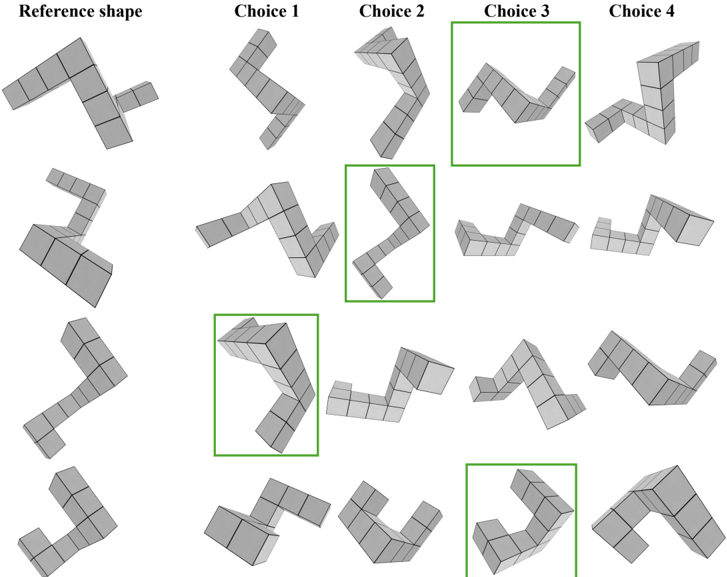
The image presents a shape matching task. A "Reference shape" is shown on the left, and four "Choices" (labeled 1 through 4) are presented to the right. The task appears to be identifying which of the choices is a rotated or mirrored version of the reference shape. Several instances of the choices are shown, with some choices highlighted by a green bounding box.
### Components/Axes
The diagram consists of the following labeled components:
* **Reference shape:** Located in the top-left corner.
* **Choice 1:** Located to the right of the "Reference shape", in the top row.
* **Choice 2:** Located to the right of "Choice 1", in the top row.
* **Choice 3:** Located to the right of "Choice 2", in the top row.
* **Choice 4:** Located to the right of "Choice 3", in the top row.
The diagram is arranged in a grid-like structure, with multiple repetitions of the four choices below the initial row. A green bounding box highlights specific instances of Choices 2, 3, and 4.
### Detailed Analysis or Content Details
The "Reference shape" is a complex 3D structure composed of multiple cubes connected together. It has a distinctive "S" like bend.
* **Choice 1:** Appears to be a rotated version of the reference shape, but with a different orientation.
* **Choice 2:** Appears to be a rotated and potentially mirrored version of the reference shape.
* **Choice 3:** Appears to be a rotated version of the reference shape, closely resembling the original.
* **Choice 4:** Appears to be a rotated version of the reference shape, with a different orientation.
The green bounding boxes highlight the following instances:
* Choice 2 in the second row.
* Choice 3 in the third row.
* Choice 4 in the fourth row.
* Choice 2 in the bottom row.
### Key Observations
The diagram presents a visual task that requires spatial reasoning and the ability to mentally rotate and/or mirror 3D objects. The green bounding boxes suggest that these specific instances of the choices are of particular interest, potentially representing correct matches or examples used in an experiment. The repetition of the choices suggests a multiple-choice format or a series of trials.
### Interpretation
This diagram likely represents a stimulus used in a cognitive psychology experiment, specifically one investigating spatial abilities. The task requires participants to identify the shape that is congruent to the reference shape, despite variations in orientation. The green boxes could indicate correct responses, or responses selected by a participant. The experiment could be designed to assess an individual's ability to perform mental rotations, or to identify patterns in their error rate. The complexity of the shape suggests that the task is not trivial and requires significant cognitive effort. The arrangement of the choices and the repetition of the task suggest a controlled experimental setup. The diagram does not provide any quantitative data, but it clearly illustrates the nature of the task being presented.