## Composite Image: World Models in Human Minds
### Overview
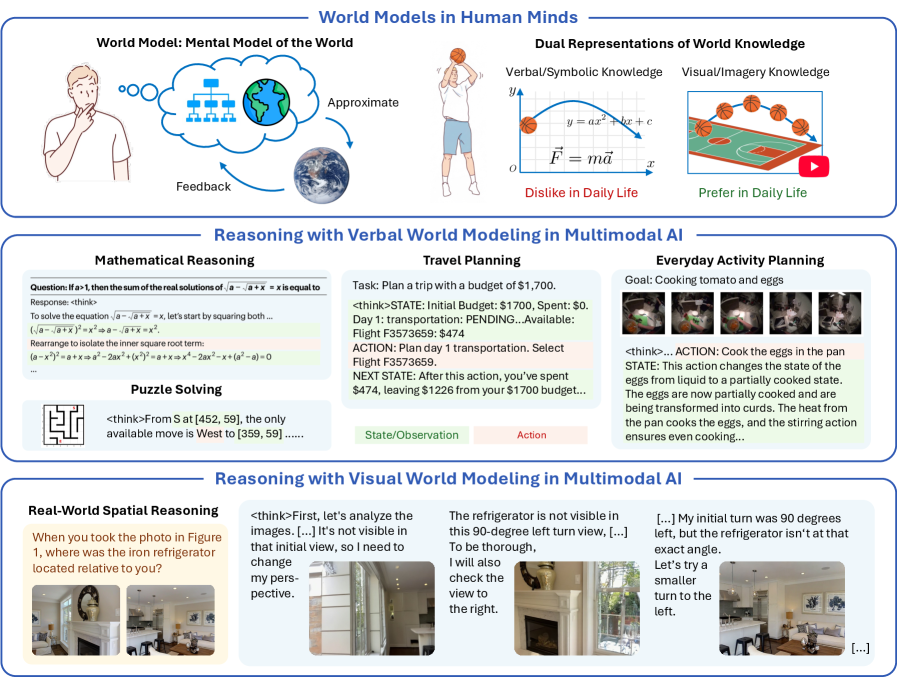
The image presents a conceptual overview of how world models are represented in human minds, contrasting verbal/symbolic and visual/imagery knowledge. It further illustrates reasoning processes using both verbal and visual world modeling in multimodal AI, providing examples of mathematical reasoning, travel planning, everyday activity planning, and real-world spatial reasoning.
### Components/Axes
**Top Section: World Models in Human Minds**
* **Title:** World Models in Human Minds
* **Left Sub-section:** World Model: Mental Model of the World
* Features a person thinking, a cloud containing a hierarchical diagram connected to a globe, and an arrow labeled "Feedback" pointing from the globe back to the person. The word "Approximate" is also present.
* **Right Sub-section:** Dual Representations of World Knowledge
* **Sub-titles:** Verbal/Symbolic Knowledge, Visual/Imagery Knowledge
* **Verbal/Symbolic Knowledge:** A graph with axes labeled 'y' and 'x'. A parabolic curve is plotted, represented by the equation y = ax² + bx + c. The equation F = ma is also present. Text "Dislike in Daily Life" is below the graph.
* **Visual/Imagery Knowledge:** A basketball court with a basketball moving through the air. A play button is superimposed on the image. Text "Prefer in Daily Life" is below the image.
**Middle Section: Reasoning with Verbal World Modeling in Multimodal AI**
* **Title:** Reasoning with Verbal World Modeling in Multimodal AI
* **Left Sub-section:** Mathematical Reasoning
* Presents a mathematical question and a step-by-step solution.
* **Question:** If a>1, then the sum of the real solutions of √(a - √(a+x)) = x is equal to
* **Response:** <think>
* To solve the equation √(a - √(a+x)) = x, let's start by squaring both...
* (√(a - √(a+x)))² = x² => a - √(a+x) = x²
* Rearrange to isolate the inner square root term:
* (a-x²)² = a+x => a² - 2ax² + (x²)² = a + x => x⁴ - 2ax² - x + (a² - a) = 0
* **Puzzle Solving:**
* <think>From S at [452, 59], the only available move is West to [359, 59] ......
* **Middle Sub-section:** Travel Planning
* Presents a travel planning task.
* **Task:** Plan a trip with a budget of $1,700.
* <think>STATE: Initial Budget: $1700, Spent: $0. Day 1: transportation: PENDING...Available: Flight F3573659: $474
* **ACTION:** Plan day 1 transportation. Select Flight F3573659.
* **NEXT STATE:** After this action, you've spent $474, leaving $1226 from your $1700 budget...
* Buttons labeled "State/Observation" and "Action" are present.
* **Right Sub-section:** Everyday Activity Planning
* **Goal:** Cooking tomato and eggs
* Presents a sequence of images showing eggs being cooked in a pan.
* <think>... ACTION: Cook the eggs in the pan STATE: This action changes the state of the eggs from liquid to a partially cooked state. The eggs are now partially cooked and are being transformed into curds. The heat from the pan cooks the eggs, and the stirring action ensures even cooking...
**Bottom Section: Reasoning with Visual World Modeling in Multimodal AI**
* **Title:** Reasoning with Visual World Modeling in Multimodal AI
* **Left Sub-section:** Real-World Spatial Reasoning
* **Question:** When you took the photo in Figure 1, where was the iron refrigerator located relative to you?
* Presents two images of a room.
* **Middle Sub-section:**
* <think>First, let's analyze the images. [...] It's not visible in that initial view, so I need to change my perspective.
* Presents an image of a room.
* **Right Sub-section:**
* The refrigerator is not visible in this 90-degree left turn view, [...] To be thorough, I will also check the view to the right.
* Presents an image of a room.
* **Rightmost Sub-section:**
* [...] My initial turn was 90 degrees left, but the refrigerator isn't at that exact angle. Let's try a smaller turn to the left.
* Presents an image of a room.
### Detailed Analysis or Content Details
* **Mathematical Reasoning:** The mathematical problem involves solving an equation with nested square roots. The solution attempts to isolate the square root terms and simplify the equation.
* **Travel Planning:** The travel planning task involves budgeting and selecting transportation options. The initial budget is $1700, and the first action involves planning day 1 transportation, costing $474.
* **Everyday Activity Planning:** The everyday activity planning task involves cooking tomato and eggs. The description focuses on the state changes of the eggs during the cooking process.
* **Real-World Spatial Reasoning:** The real-world spatial reasoning task involves determining the location of a refrigerator based on a series of images. The AI agent analyzes the images and adjusts its perspective to locate the refrigerator.
### Key Observations
* The image contrasts verbal/symbolic and visual/imagery knowledge representations.
* The examples demonstrate how AI can reason using both verbal and visual information.
* The real-world spatial reasoning example highlights the importance of perspective and visual analysis in problem-solving.
### Interpretation
The image illustrates the concept of world models in human minds and how AI can leverage both verbal and visual information to reason and solve problems. The examples demonstrate the potential of multimodal AI in various domains, including mathematical reasoning, travel planning, everyday activity planning, and real-world spatial reasoning. The contrast between verbal/symbolic and visual/imagery knowledge highlights the importance of integrating different modalities for effective AI systems. The real-world spatial reasoning example showcases the ability of AI to analyze visual information and adjust its perspective to solve spatial problems, mimicking human cognitive processes.