\n
## Diagram: World Models in Human Minds & Multimodal AI
### Overview
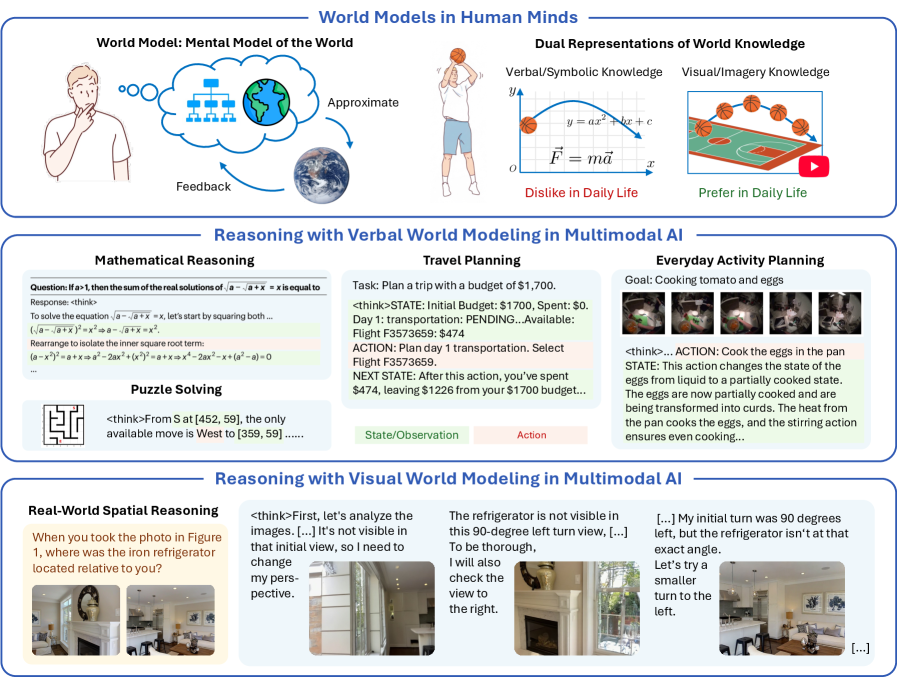
This diagram illustrates the concept of world models, comparing how humans and AI reason about the world. It's divided into sections: World Models, Reasoning with Verbal World Modeling in Multimodal AI, and Reasoning with Visual World Modeling in Multimodal AI. The diagram uses a combination of illustrations, text blocks, and flowcharts to explain these concepts.
### Components/Axes
The diagram is structured into three main horizontal sections. Each section contains multiple sub-sections with descriptive titles. There are no explicit axes in the traditional sense, but the diagram flows from left to right, representing a progression of thought or action. Key components include:
* **World Model:** Mental Model of the World, Dual Representations of World Knowledge
* **Reasoning with Verbal World Modeling:** Mathematical Reasoning, Travel Planning, Everyday Activity Planning, Puzzle Solving
* **Reasoning with Visual World Modeling:** Real-World Spatial Reasoning
### Detailed Analysis or Content Details
**1. World Models: Mental Model of the World**
* Illustration: A human head with interconnected nodes representing thoughts and concepts.
* Label: "Approximate" connecting the head to an arrow pointing towards feedback.
* Label: "Feedback"
**2. World Models: Dual Representations of World Knowledge**
* Left side: "Verbal/Symbolic Knowledge" with the equation "y = ax² + bx + c" and "F = ma"
* Right side: "Visual/Imagery Knowledge" with a person disliking something on the left and preferring something on the right.
* Labels: "Dislike in Daily Life", "Prefer in Daily Life"
**3. Reasoning with Verbal World Modeling in Multimodal AI**
* **Mathematical Reasoning:**
* Question: "If x-1 then the sum of the real solutions of a = x is equal to"
* Response: "To solve the equation (a - a² + x) = x, let's start by squaring both..." (truncated equation)
* **Travel Planning:**
* Task: "Plan a trip with a budget of $1,700."
* `<think>`: "INITIAL Budget: $1,700. Spent: $0."
* Day 1: "transportation: PENDING... Available: Flight F3573659. $474"
* ACTION: "Plan day 1 transportation. Select Flight F3573659."
* NEXT STATE: "After this action, you've spent $474, leaving $1226 from your $1700 budget..."
* **Everyday Activity Planning:**
* Goal: "Cooking tomato and eggs"
* `<think>`: "ACTION: Cook the eggs in the pan. STATE: This action changes the state of the eggs from liquid to a partially cooked state. The eggs are now partially cooked and are being transformed into curds. The heat from the pan cooks the eggs, and the stirring action ensures even cooking..."
* **Puzzle Solving:**
* `<think>`: "From [452, 59], the only available move is West to [359, 59]..."
* Illustration: A grid-like puzzle.
* Labels: "State/Observation", "Action"
**4. Reasoning with Visual World Modeling in Multimodal AI**
* **Real-World Spatial Reasoning:**
* Question: "Where did I took the photo in Figure 1, relative to the iron refrigerator located where was it?"
* `<think>`: "First, let's analyze the images. [...] It's not visible in that initial view, so I need to change my perspective..."
* Illustration: A series of images showing a room and a refrigerator.
* Label: "The refrigerator is not visible in this 90-degree left turn view. [...] To be thorough, I will also check the view to the right."
* `<think>`: "My initial turn was 90 degrees left, but the refrigerator isn't at that exact angle. Let's try a smaller turn to the left."
### Key Observations
* The diagram emphasizes the interplay between verbal and visual reasoning.
* The "think" blocks represent the internal reasoning process of an AI agent.
* The travel planning example demonstrates a step-by-step action and budget tracking.
* The spatial reasoning example highlights the importance of perspective and visual analysis.
* The diagram uses a consistent visual style with rounded rectangles for thought bubbles and arrows to indicate flow.
### Interpretation
The diagram presents a framework for understanding how AI can model the world, drawing parallels to human cognitive processes. It suggests that effective AI requires both verbal (symbolic) and visual reasoning capabilities. The examples provided – mathematical reasoning, travel planning, cooking, puzzle solving, and spatial reasoning – illustrate the diversity of tasks that benefit from this multimodal approach. The "think" blocks are crucial, as they represent the AI's internal state and decision-making process. The diagram implies that AI agents need to be able to observe, plan, act, and reflect on their actions to effectively navigate and interact with the world. The spatial reasoning example is particularly insightful, demonstrating how AI can overcome limitations in initial perception by actively seeking different viewpoints. The diagram is a high-level conceptual overview rather than a detailed technical specification, aiming to convey the core principles of multimodal AI and world modeling.