## Diagram: Knowledge Graph Search Process
### Overview
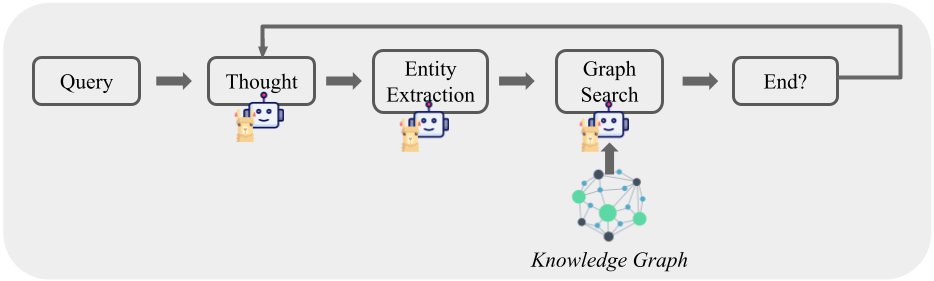
The image is a diagram illustrating a process flow for knowledge graph search. It depicts a sequence of steps, starting with a query and ending with a decision point, with a loop back to an earlier stage. Each step is represented by a rounded rectangle containing a label, and arrows indicate the direction of the process flow.
### Components/Axes
* **Nodes:**
* Query
* Thought (with a robot and llama icon)
* Entity Extraction (with a robot and llama icon)
* Graph Search (with a robot and llama icon)
* End?
* **Knowledge Graph:** A network of interconnected nodes, some colored light green and others dark blue.
* **Arrows:** Indicate the flow of the process.
* **Icons:** Each of the "Thought", "Entity Extraction", and "Graph Search" nodes has a small icon of a robot head and a llama.
### Detailed Analysis or ### Content Details
The process flow is as follows:
1. **Query:** The process begins with a query.
2. **Thought:** The query is processed, represented by the "Thought" node. A robot and llama icon are present.
3. **Entity Extraction:** Entities are extracted from the thought. A robot and llama icon are present.
4. **Graph Search:** A graph search is performed using the extracted entities. A robot and llama icon are present. The search interacts with a "Knowledge Graph," which is depicted as a network of interconnected nodes. Some nodes are light green, and others are dark blue.
5. **End?:** A decision point is reached. If the process is not complete, it loops back to the "Thought" node.
### Key Observations
* The diagram illustrates an iterative process, as indicated by the loop from "End?" back to "Thought."
* The robot and llama icons appear consistently in the "Thought," "Entity Extraction," and "Graph Search" nodes, suggesting a common agent or system performing these tasks.
* The Knowledge Graph is a key component of the process, providing the data for the graph search.
### Interpretation
The diagram describes a system that takes a query, extracts relevant entities, searches a knowledge graph, and then iteratively refines the process until a desired outcome is achieved. The presence of the robot and llama icons suggests that this system may involve a combination of automated and human-assisted processes, or perhaps a specific AI model or framework. The loop indicates that the system can refine its search based on the results of previous iterations.