\n
## Diagram: LLM Reasoning Process for Question Answering
### Overview
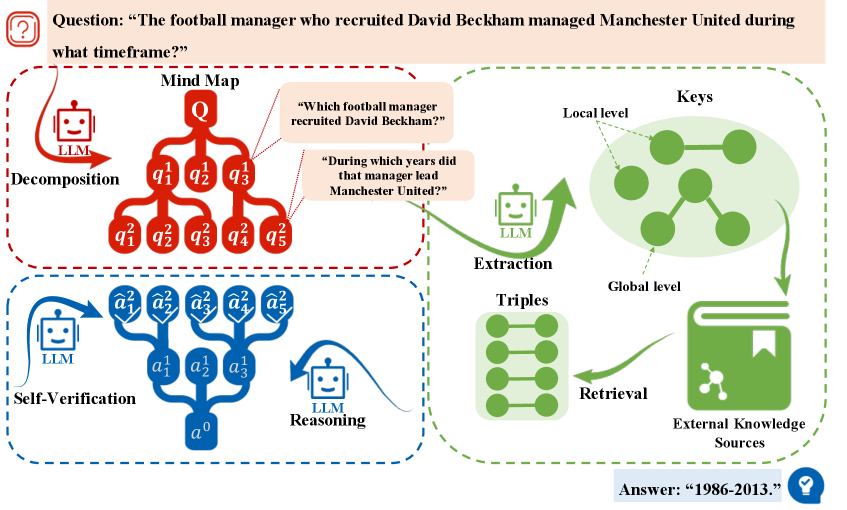
The image is a diagram illustrating a process for answering complex questions using a Large Language Model (LLM). The process involves decomposition of the question into sub-questions, extraction of relevant information, reasoning, and self-verification, leveraging both local and global knowledge sources. The question being addressed is: "The football manager who recruited David Beckham managed Manchester United during what timeframe?". The final answer provided is "1986-2013."
### Components/Axes
The diagram is divided into four main sections, visually demarcated by dashed-line boxes:
1. **Decomposition:** Focuses on breaking down the initial question (Q) into smaller sub-questions (q1-q5).
2. **Extraction:** Illustrates the process of extracting keys and triples from knowledge sources.
3. **Self-Verification:** Shows the LLM reasoning and verification process using sub-answers (a0-a5).
4. **Overall Flow:** Connects these sections with arrows indicating the flow of information.
Key elements include:
* **LLM Icons:** Representing the Large Language Model's role in each stage.
* **Question (Q):** The initial complex question.
* **Sub-Questions (q1-q5):** Decomposed parts of the original question.
* **Keys:** Representing extracted information at a local level.
* **Triples:** Representing structured knowledge retrieval.
* **External Knowledge Sources:** A database or repository of information.
* **Sub-Answers (a0-a5):** Results of the reasoning and verification process.
* **Answer:** The final answer to the original question.
### Detailed Analysis or Content Details
**1. Decomposition:**
* The initial question "Q" is positioned at the top-left.
* The question is decomposed into five sub-questions labeled q1 through q5.
* q1, q2, and q3 branch directly from Q.
* q4 and q5 branch from q2.
* The text associated with the sub-questions are:
* "Which football manager recruited David Beckham?"
* "During which years did that manager lead Manchester United?"
**2. Extraction:**
* The "Extraction" section shows the LLM extracting "Keys" at a "Local level" and "Triples" at a "Global level."
* The "Keys" are represented as a network of green circles connected by lines.
* The "Triples" are depicted as a vertical stack of linked rectangles.
* An icon representing "External Knowledge Sources" is shown as a green file cabinet with a magnifying glass.
**3. Self-Verification:**
* The "Self-Verification" section shows the LLM reasoning and verifying the answers.
* Sub-answers a1 through a5 are connected to a central node a0.
* a2 and a3 branch from a1.
* a4 and a5 branch from a3.
**4. Overall Flow:**
* Arrows indicate the flow of information:
* From Decomposition to Extraction.
* From Extraction to Self-Verification.
* From Self-Verification to the final "Answer."
**Final Answer:**
* The final answer displayed at the bottom-right is "1986-2013."
### Key Observations
* The diagram emphasizes a multi-stage process for complex question answering.
* The decomposition step is crucial for breaking down the problem into manageable parts.
* The use of both local and global knowledge sources suggests a hybrid approach to knowledge retrieval.
* The self-verification step indicates a mechanism for ensuring the accuracy and reliability of the answer.
* The diagram does not provide numerical data or specific values beyond the final answer.
### Interpretation
The diagram illustrates a sophisticated approach to question answering using LLMs. It highlights the importance of not just retrieving information, but also of reasoning about it and verifying its accuracy. The decomposition step allows the LLM to tackle complex questions by addressing smaller, more focused sub-problems. The integration of local and global knowledge sources suggests a strategy for leveraging both specific facts and broader contextual understanding. The self-verification step is critical for mitigating the risk of generating incorrect or misleading answers.
The diagram suggests that the LLM doesn't simply "know" the answer, but rather constructs it through a series of logical steps. The final answer of "1986-2013" likely represents the tenure of Sir Alex Ferguson as manager of Manchester United, who recruited David Beckham. The diagram provides a high-level overview of the process, but doesn't delve into the specific algorithms or techniques used at each stage. It's a conceptual representation of a complex system, designed to illustrate the key components and their interactions. The use of visual metaphors (e.g., keys, triples, file cabinet) helps to convey the abstract concepts in a more intuitive way.