## Image: Rendering and Gaussian Primitives Comparison
### Overview
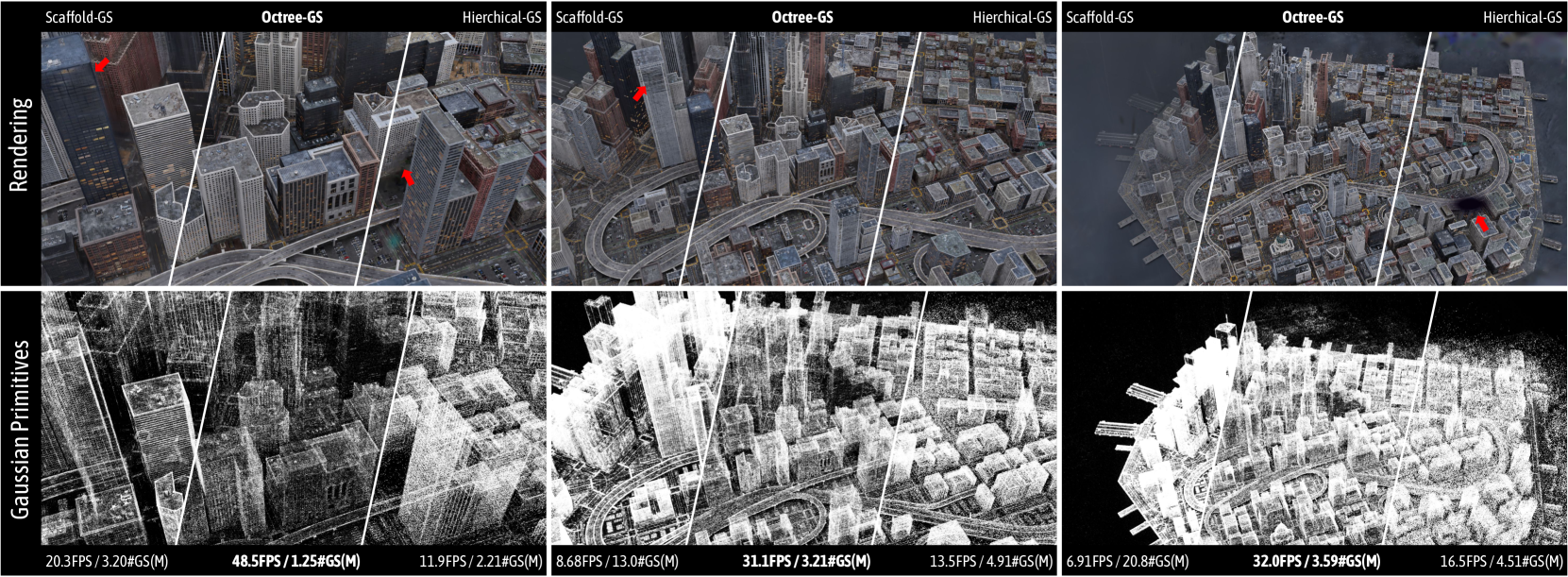
The image presents a comparative visualization of city rendering using different techniques: Scaffold-GS, Octree-GS, and Hierarchical-GS. It shows both the rendered output (top row) and the underlying Gaussian Primitives representation (bottom row) for each technique. Each technique is presented in two columns. Performance metrics (FPS and memory usage in MB) are displayed at the bottom of each Gaussian Primitives image.
### Components/Axes
The image is structured as a 2x3 grid.
* **Rows:** Rendering (top) and Gaussian Primitives (bottom).
* **Columns:** Represent different techniques: Scaffold-GS, Octree-GS, and Hierarchical-GS. Each technique is shown twice.
* **Labels:** Each column is labeled with the technique name (e.g., "Scaffold-GS", "Octree-GS", "Hierarchical-GS").
* **Performance Metrics:** Displayed at the bottom of each Gaussian Primitives image in the format "FPS / Memory Usage (MB)".
### Detailed Analysis or Content Details
**Rendering (Top Row):**
* **Scaffold-GS (Columns 1 & 2):** Shows a city scene rendered with a wireframe overlay. Buildings are clearly defined, but the scene appears somewhat sparse.
* **Octree-GS (Columns 3 & 4):** The rendering appears more detailed than Scaffold-GS, with more visible structures and a denser wireframe.
* **Hierarchical-GS (Columns 5 & 6):** The rendering is the most visually complete, with a high level of detail and a dense wireframe. The scene appears to have more complex geometry.
**Gaussian Primitives (Bottom Row):**
* **Scaffold-GS (Columns 1 & 2):** Displays a dense cloud of Gaussian primitives representing the city scene. The primitives are tightly packed in areas corresponding to buildings. Performance: 20.3 FPS / 3.204GS(M) and 48.5 FPS / 1.254GS(M)
* **Octree-GS (Columns 3 & 4):** Shows a similar cloud of primitives, but with a different distribution. The primitives appear more spread out than in Scaffold-GS. Performance: 11.9 FPS / 2.214GS(M) and 31.1 FPS / 3.214GS(M)
* **Hierarchical-GS (Columns 5 & 6):** Displays a very dense and complex cloud of primitives. The distribution appears more uniform than in the other techniques. Performance: 13.5 FPS / 4.914GS(M) and 32.0 FPS / 3.594GS(M) and 6.91 FPS / 20.84GS(M) and 16.5 FPS / 4.514GS(M)
### Key Observations
* **Rendering Detail:** Hierarchical-GS consistently produces the most detailed rendering, followed by Octree-GS, and then Scaffold-GS.
* **Primitive Density:** The density of Gaussian primitives generally correlates with the rendering detail. Hierarchical-GS has the densest primitive cloud.
* **Performance Trade-offs:** Higher rendering detail (and primitive density) often comes at the cost of performance (lower FPS and higher memory usage). Octree-GS shows the best FPS/Memory tradeoff.
* **Memory Usage:** Hierarchical-GS consistently uses the most memory.
* **FPS Variation:** There is significant variation in FPS within each technique (e.g., Scaffold-GS has 20.3 FPS and 48.5 FPS). This suggests that performance may be sensitive to scene complexity or other factors.
### Interpretation
The image demonstrates a comparison of different Gaussian Splatting techniques for rendering complex 3D scenes. The techniques differ in how they organize and represent the scene using Gaussian primitives.
* **Scaffold-GS** appears to be the simplest and fastest, but produces the least detailed rendering. It's likely a more basic implementation.
* **Octree-GS** offers a balance between rendering quality and performance. The Octree structure likely provides efficient spatial partitioning of the primitives.
* **Hierarchical-GS** achieves the highest rendering quality but at the cost of performance and memory usage. The hierarchical structure likely allows for more complex scene representation and finer detail.
The performance metrics (FPS and memory usage) provide quantitative data to support the visual observations. The variation in FPS within each technique suggests that the optimal technique may depend on the specific scene and performance requirements. The image highlights the trade-offs between rendering quality, performance, and memory usage in Gaussian Splatting. The differences in primitive distribution suggest that each technique employs a different strategy for approximating the scene geometry.