## Grid Comparison: Rendering Techniques and Gaussian Primitives
### Overview
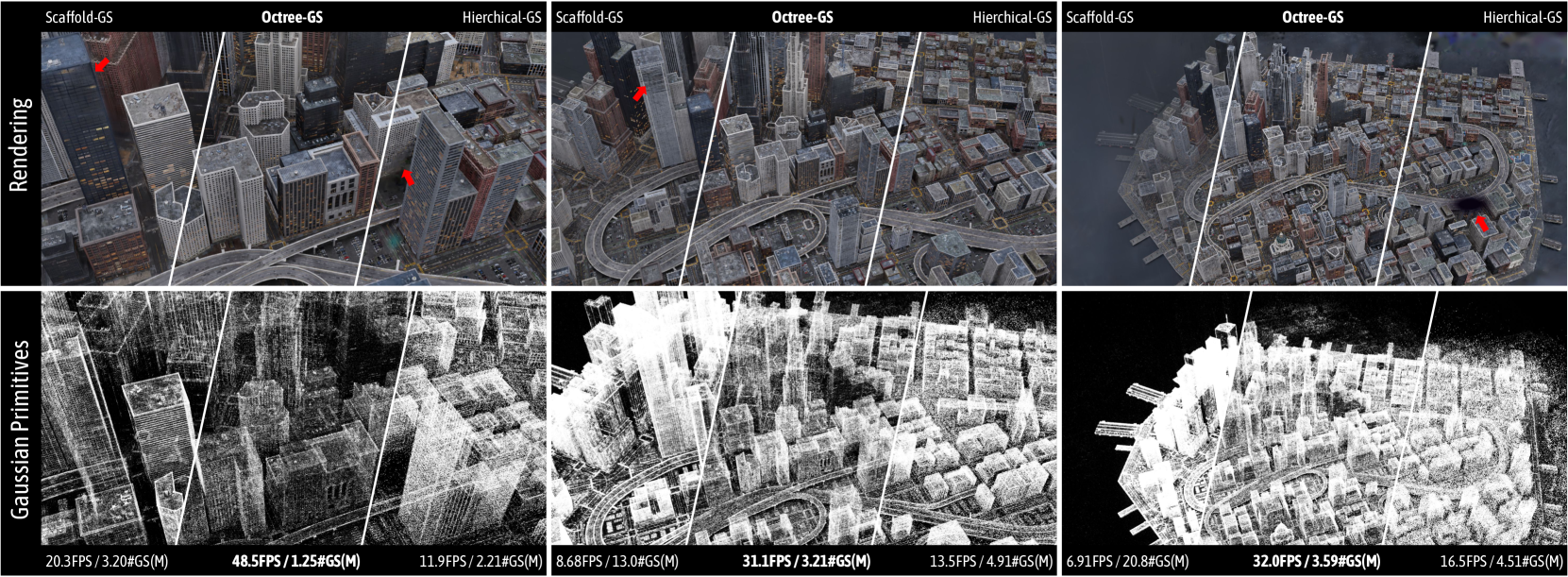
The image presents a comparative analysis of three 3D rendering techniques (Scaffold-GS, Octree-GS, Hierichical-GS) across two visualization modes:
1. **Top Row**: Color-rendered cityscapes with annotations
2. **Bottom Row**: Monochrome Gaussian primitives with performance metrics
Each column represents a different method, with spatial alignment between rendered scenes and their corresponding primitive visualizations.
---
### Components/Axes
**Top Row (Rendering):**
- **Columns**:
1. Scaffold-GS
2. Octree-GS
3. Hierichical-GS
- **Annotations**:
- Red arrows highlight specific buildings in Scaffold-GS (top-left) and Hierichical-GS (top-right)
- White diagonal lines divide scenes into quadrants
**Bottom Row (Gaussian Primitives):**
- **Columns**:
1. Scaffold-GS
2. Octree-GS
3. Hierichical-GS
- **Metrics**:
- **FPS**: Frame rate (e.g., 20.3FPS, 48.5FPS)
- **GS(M)**: Gaussian primitives count (e.g., 3.20#GS(M), 1.25#GS(M))
- **Text Overlays**:
- Positioned at bottom-left of each primitive visualization
---
### Detailed Analysis
**Rendering Techniques (Top Row):**
1. **Scaffold-GS**:
- Highest architectural detail in annotated buildings (red arrows)
- Visible texture variations in road surfaces and building facades
2. **Octree-GS**:
- Smoother surfaces with reduced geometric complexity
- Less distinct building edges compared to Scaffold-GS
3. **Hierichical-GS**:
- Lowest visual fidelity with noticeable aliasing artifacts
- Missing details in annotated building (red arrow)
**Gaussian Primitives (Bottom Row):**
1. **Scaffold-GS**:
- 20.3FPS / 3.20#GS(M)
- Dense primitive clusters in high-detail regions (e.g., annotated building)
2. **Octree-GS**:
- 48.5FPS / 1.25#GS(M)
- Uniform primitive distribution with sparse density
3. **Hierichical-GS**:
- 6.91FPS / 20.8#GS(M)
- Overlapping primitives creating visual noise in low-detail areas
---
### Key Observations
1. **Performance-Quality Tradeoff**:
- Octree-GS achieves **2.4x higher FPS** than Scaffold-GS but uses **62% fewer primitives**
- Hierichical-GS has **3.4x lower FPS** than Octree-GS but **16.6x more primitives**
2. **Artifact Correlation**:
- Hierichical-GS's low FPS correlates with visible aliasing in rendered scenes
- Scaffold-GS's high primitive count matches detailed rendering artifacts
3. **Spatial Consistency**:
- Red arrow annotations in top row align with dense primitive regions in bottom row
- Octree-GS's sparse primitives correspond to smoother rendered surfaces
---
### Interpretation
The data demonstrates a clear inverse relationship between rendering performance (FPS) and geometric complexity (GS(M)):
- **Octree-GS** optimizes for speed by reducing primitive density, sacrificing fine details visible in Scaffold-GS's annotated structures
- **Hierichical-GS** prioritizes quality through excessive primitive usage, resulting in both visual artifacts and performance bottlenecks
- **Scaffold-GS** represents a middle ground, maintaining moderate performance while preserving critical architectural details highlighted by red arrows
The consistent spatial alignment between rendering artifacts and primitive density suggests that Octree-GS's efficiency comes at the cost of geometric precision, while Hierichical-GS's thoroughness introduces computational overhead without proportional quality gains.