## Text-Based Logic Puzzle: Determining Truth Value of Conclusion
### Overview
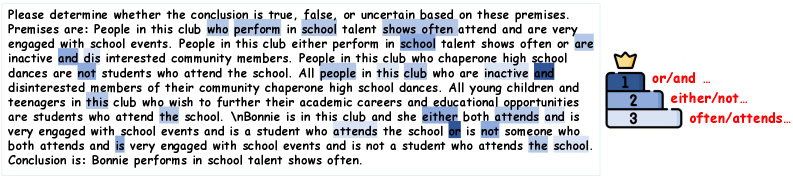
The image presents a logical reasoning task where the reader must evaluate whether a conclusion ("Bonnie performs in school talent shows often") is **true**, **false**, or **uncertain** based on five premises. The text includes highlighted keywords and a legend with symbolic annotations.
### Components/Axes
1. **Premises (1–5)**: Structured as conditional statements about club members' activities and school engagement.
2. **Conclusion**: A standalone statement to be validated against the premises.
3. **Legend**: A tiered ranking system with crown icons and color-coded labels:
- **Tier 1 (Dark Blue)**: "or/and ..."
- **Tier 2 (Medium Blue)**: "either/not..."
- **Tier 3 (Light Blue)**: "often/attends..."
### Detailed Analysis
#### Premises
1. **Premise 1**: "People in this club who perform in school talent shows often attend and are very engaged with school."
- Highlighted keywords: **perform**, **attend**, **engaged**.
2. **Premise 2**: "People in this club either perform in school talent shows often or are inactive and disinterested community members."
- Highlighted keywords: **perform**, **inactive**, **disinterested**.
3. **Premise 3**: "People in this club who chaperone high school dances are not students who attend the school."
- Highlighted keywords: **chaperone**, **attend**.
4. **Premise 4**: "All young children and teenagers in this club who wish to further their academic careers and educational opportunities are students who attend the school."
- Highlighted keywords: **attend**, **academic careers**, **educational opportunities**.
5. **Premise 5**: "Bonnie is in this club and she either both attends and is very engaged with school events and is a student who attends the school or is not someone who both attends and is very engaged with school events and is not a student who attends the school."
- Highlighted keywords: **attends**, **engaged**, **student**, **school**.
#### Conclusion
- "Bonnie performs in school talent shows often."
#### Legend
- **Tier 1 (Dark Blue)**: "or/and ..." (associated with Premise 5).
- **Tier 2 (Medium Blue)**: "either/not..." (associated with Premise 2).
- **Tier 3 (Light Blue)**: "often/attends..." (associated with Premises 1, 3, 4).
### Key Observations
1. **Logical Structure**: The premises use conditional logic (e.g., "if X, then Y") and disjunctions (e.g., "either A or B").
2. **Highlighted Keywords**: Critical terms like **attend**, **engaged**, and **perform** are emphasized, suggesting their relevance to the conclusion.
3. **Legend Symbolism**: The crown icon on Tier 1 may imply a hierarchical priority for evaluating logical operators (e.g., "or/and" as foundational).
4. **Ambiguity in Premise 5**: The use of "either...or..." in Premise 5 creates a paradoxical structure, complicating direct inference.
### Interpretation
- **Logical Validity**: The conclusion ("Bonnie performs often") hinges on Premise 1, which links performing in talent shows to school attendance and engagement. However, Premise 5 introduces ambiguity by stating Bonnie "either both attends/engaged **and** is a student **or** is not someone who both attends/engaged **and** is not a student." This creates a contradiction: Bonnie cannot simultaneously be a student who attends/engaged and not a student who attends/engaged.
- **Resolution**: If Premise 5 is interpreted as a biconditional (Bonnie is a student who attends/engaged **if and only if** she performs often), the conclusion becomes valid. However, the phrasing of Premise 5 introduces uncertainty, making the conclusion **uncertain** under strict logical analysis.
- **Legend Relevance**: The Tier 3 label ("often/attends") aligns with Premises 1, 3, and 4, reinforcing the connection between attendance/engagement and talent show participation.
### Final Assessment
The conclusion is **uncertain** due to conflicting interpretations of Premise 5. While Premise 1 suggests a direct link between performing and engagement, the paradoxical structure of Premise 5 undermines definitive validation.