## Text Analysis with Diagram
### Overview
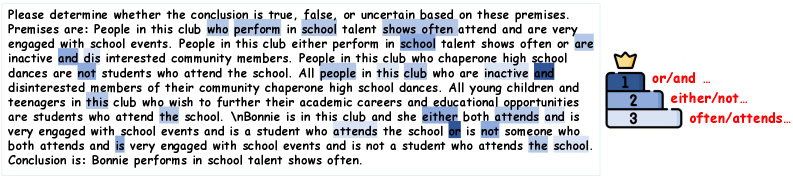
The image presents a logical reasoning problem alongside a diagram that visually represents different levels of logical connection. The problem consists of premises and a conclusion, and the diagram seems to offer a key to interpreting the strength or type of logical links within the premises. The text on the left presents a series of premises and a conclusion, while the diagram on the right provides a visual key to understanding the relationships between the premises and the conclusion.
### Components/Axes
**Left Side (Textual Problem):**
* **Instruction:** "Please determine whether the conclusion is true, false, or uncertain based on these premises."
* **Premises:** A series of statements about people in a club, their activities, and their relationships to school events and community involvement.
* **Conclusion:** "Bonnie performs in school talent shows often."
**Right Side (Diagram):**
* A three-tiered structure, resembling stacked platforms or steps. Each level is numbered 1, 2, and 3 from top to bottom.
* Each level is colored in a gradient of blue, with the top level being the lightest and the bottom level being the darkest.
* A golden crown sits atop the first level.
* Labels are associated with each level, written in red text:
* Level 1: "or/and..."
* Level 2: "either/not..."
* Level 3: "often/attends..."
### Detailed Analysis or ### Content Details
**Textual Problem Transcription:**
"Please determine whether the conclusion is true, false, or uncertain based on these premises.
Premises are: People in this club who perform in school talent shows often attend and are very engaged with school events. People in this club either perform in school talent shows often or are inactive and dis interested community members. People in this club who chaperone high school dances are not students who attend the school. All people in this club who are inactive and disinterested members of their community chaperone high school dances. All young children and teenagers in this club who wish to further their academic careers and educational opportunities are students who attend the school.
Bonnie is in this club and she either both attends and is very engaged with school events and is a student who attends the school or is not someone who both attends and is very engaged with school events and is not a student who attends the school.
Conclusion is: Bonnie performs in school talent shows often."
**Diagram Details:**
* **Level 1:** Lightest blue, labeled "1" and "or/and..."
* **Level 2:** Medium blue, labeled "2" and "either/not..."
* **Level 3:** Darkest blue, labeled "3" and "often/attends..."
### Key Observations
* The diagram appears to provide a key for interpreting the logical strength or type of connections within the premises.
* The color gradient in the diagram may indicate a hierarchy or strength of logical connection, with darker colors potentially representing stronger or more direct relationships.
* The keywords associated with each level ("or/and," "either/not," "often/attends") suggest different types of logical relationships.
* The text on the left has blue highlights over certain words.
### Interpretation
The image presents a logical reasoning problem where the task is to determine the validity of a conclusion based on a set of premises. The diagram on the right provides a visual aid for interpreting the logical relationships within the premises. The three levels of the diagram, each associated with different logical keywords, likely represent different types or strengths of connections between the premises and the conclusion. The user is expected to analyze the premises, identify the relevant logical connections using the diagram as a guide, and then determine whether the conclusion is true, false, or uncertain based on this analysis. The blue highlights on the left side are likely to indicate the words that are most important to the logical argument.