## Screenshot: Educational Document on Vein Function
### Overview
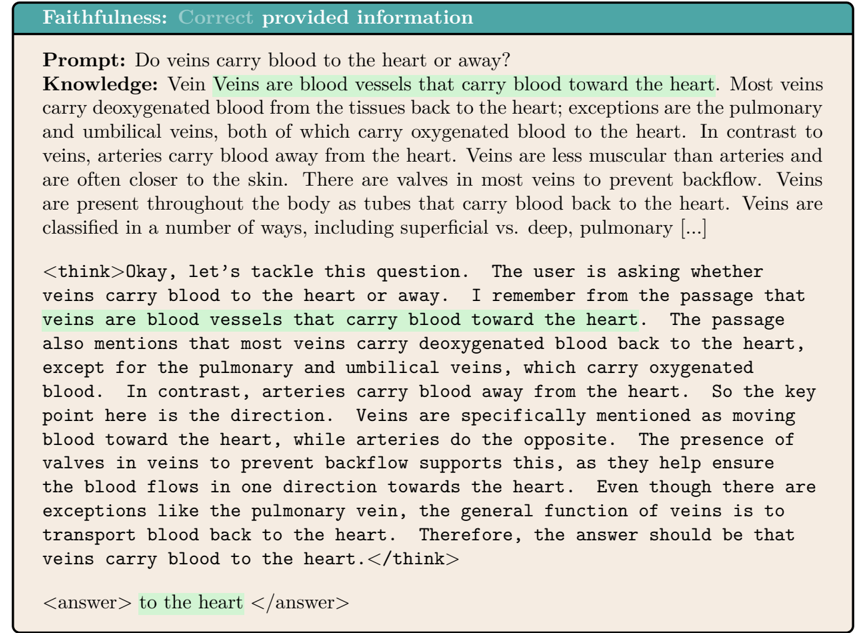
The image displays a structured educational document addressing the question "Do veins carry blood to the heart or away?" It includes a **prompt**, **knowledge section**, **thinking process**, and **answer**. Key text is highlighted in green, and the document emphasizes anatomical facts about veins and arteries.
---
### Components/Axes
- **Prompt**: "Do veins carry blood to the heart or away?"
- **Knowledge Section**:
- Defines veins as blood vessels carrying blood **toward the heart**.
- Notes exceptions: pulmonary and umbilical veins carry oxygenated blood to the heart.
- Contrasts veins (deoxygenated blood, less muscular, closer to skin) with arteries (oxygenated blood, away from heart).
- Mentions valves in veins to prevent backflow.
- **Thinking Process**:
- Step-by-step reasoning confirming veins carry blood to the heart.
- Highlights the key distinction between veins and arteries.
- Acknowledges exceptions (pulmonary vein) but reaffirms the general rule.
- **Answer**: "to the heart" (highlighted in green).
---
### Detailed Analysis
1. **Prompt**: Direct question about vein directionality.
2. **Knowledge Section**:
- **Veins**: Carry deoxygenated blood to the heart (exceptions: pulmonary/umbilical veins carry oxygenated blood).
- **Arteries**: Carry oxygenated blood away from the heart.
- **Structural Differences**: Veins are less muscular, closer to the skin, and contain valves.
3. **Thinking Process**:
- Logical breakdown of the question, referencing the knowledge section.
- Emphasizes the directional flow (veins → heart) and exceptions.
- Concludes with the answer despite exceptions.
4. **Answer**: Final response: "to the heart."
---
### Key Observations
- **Highlighted Text**: Critical information (e.g., "veins are blood vessels that carry blood toward the heart") is emphasized in green.
- **Structure**: Clear separation of prompt, knowledge, reasoning, and answer.
- **Exceptions**: Pulmonary and umbilical veins are explicitly noted as exceptions to the general rule.
---
### Interpretation
The document serves as a pedagogical tool to clarify the directional flow of blood in veins. It systematically addresses the question by:
1. Providing foundational knowledge about veins and arteries.
2. Using reasoning to reconcile exceptions (e.g., pulmonary vein) with the general rule.
3. Reinforcing the answer through structured logic.
The highlighted text ensures focus on the core concept: **veins primarily transport blood toward the heart**, with rare exceptions. This aligns with anatomical principles, where veins are defined by their directional flow relative to the heart, regardless of oxygenation status.