## Python Function: `equation` for Tensor Coefficient Prediction
### Overview
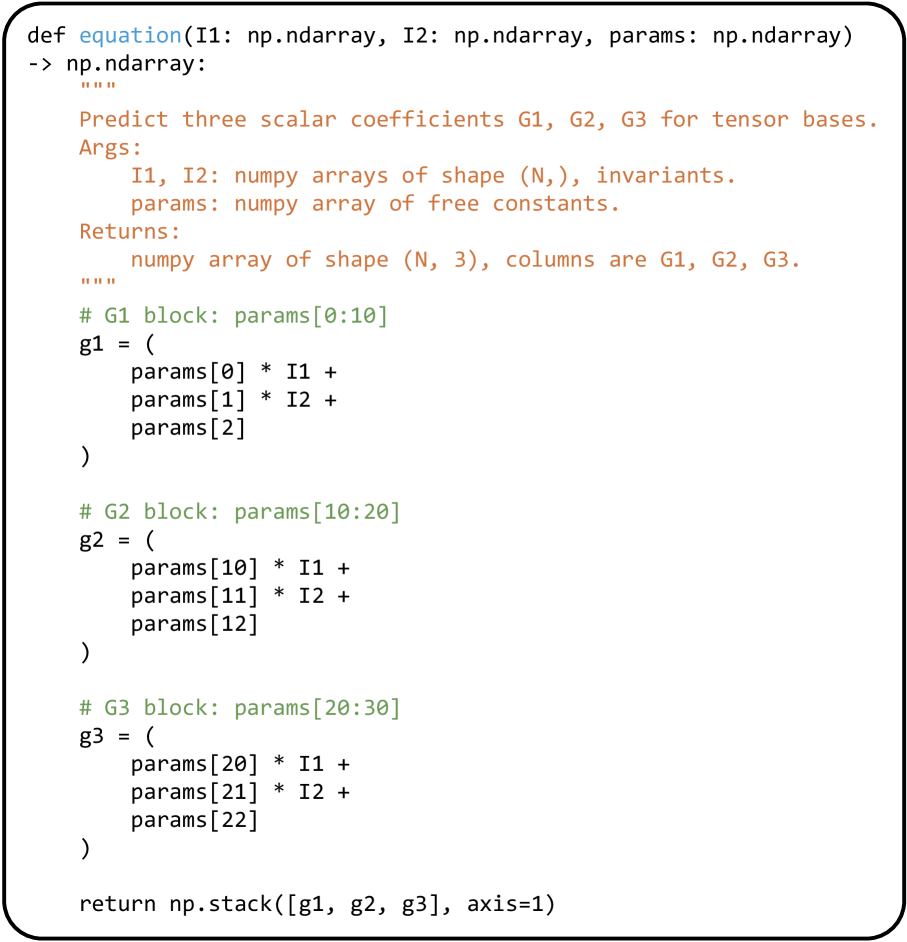
The image shows a Python function definition for `equation`, which computes three scalar coefficients (G1, G2, G3) for tensor bases using input arrays and free parameters. The function uses NumPy operations to combine input arrays (`I1`, `I2`) with parameter slices (`params`) and returns a stacked array of coefficients.
---
### Components/Axes
- **Function Signature**:
`def equation(I1: np.ndarray, I2: np.ndarray, params: np.ndarray) -> np.ndarray:`
- **Parameters**:
- `I1`, `I2`: Numpy arrays of shape `(N,)` (invariants).
- `params`: Numpy array of free constants (shape `(30,)`).
- **Return**: Numpy array of shape `(N, 3)` with columns `[G1, G2, G3]`.
- **Code Structure**:
- **G1 Block**: Uses `params[0:10]` (indices 0–9).
- **G2 Block**: Uses `params[10:20]` (indices 10–19).
- **G3 Block**: Uses `params[20:30]` (indices 20–29).
---
### Detailed Analysis
1. **G1 Calculation**:
```python
g1 = (params[0] * I1 + params[1] * I2 + params[2])
```
- Combines the first three parameters with `I1` and `I2`, then adds a constant (`params[2]`).
2. **G2 Calculation**:
```python
g2 = (params[10] * I1 + params[11] * I2 + params[12])
```
- Uses parameters 10–12 similarly to G1.
3. **G3 Calculation**:
```python
g3 = (params[20] * I1 + params[21] * I2 + params[22])
```
- Uses parameters 20–22.
4. **Stacking**:
```python
return np.stack([g1, g2, g3], axis=1)
```
- Combines `g1`, `g2`, and `g3` into a 2D array where each row corresponds to an input index `N`, and columns represent G1, G2, G3.
---
### Key Observations
- **Parameter Slicing**: Each coefficient block (`G1`, `G2`, `G3`) uses a distinct 3-parameter subset of `params`.
- **Linear Combination**: Each coefficient is a linear combination of `I1`, `I2`, and a constant term.
- **Output Shape**: The final output has shape `(N, 3)`, ensuring one coefficient per input element.
---
### Interpretation
This function models tensor coefficients as linear combinations of input invariants (`I1`, `I2`) and free parameters. The parameter array `params` is partitioned into three blocks, each governing one coefficient. The design suggests a modular approach, allowing independent tuning of G1, G2, and G3 via separate parameter subsets. The use of `np.stack` ensures the output aligns with the input dimensionality, making it suitable for tensor-based applications like material science or physics simulations.
No numerical values or trends are present in the code itself, as it defines a computational framework rather than presenting empirical data.