## Text-Based Instruction Set: Audio Feature Extraction Protocol
### Overview
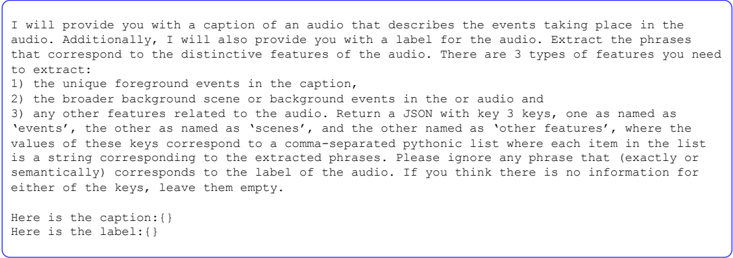
The image contains a technical instruction set for extracting and categorizing audio features from captions and labels. It outlines a structured JSON output format with three keys: `events`, `scenes`, and `other features`, each requiring specific types of audio-related information.
### Components/Axes
- **Keys**:
1. `events`: Unique foreground events in the caption.
2. `scenes`: Broader background scene or background events in the audio.
3. `other features`: Additional audio-related features not covered by the first two keys.
- **Output Format**:
- JSON structure with comma-separated Pythonic lists for each key.
- Empty values if no information is available for a key.
### Detailed Analysis
- **Text Content**:
The text provides explicit instructions for parsing audio descriptions into three categories:
- **Foreground Events**: Specific, unique occurrences in the audio (e.g., "a dog barking").
- **Background Scenes**: General environmental context (e.g., "city street noise").
- **Other Features**: Miscellaneous audio attributes (e.g., "echo effect").
- Placeholders for `caption` and `label` are included but left empty in the example.
- **Spatial Grounding**:
- The text is left-aligned with no visual hierarchy beyond paragraph breaks.
- No legends, axes, or numerical data present.
### Key Observations
- The instructions emphasize ignoring phrases that do not semantically align with the audio label.
- No numerical values, trends, or data points are provided in the image.
### Interpretation
This protocol is designed for natural language processing (NLP) tasks involving audio-visual data alignment. It prioritizes semantic relevance over exhaustive extraction, ensuring only contextually meaningful phrases are included. The absence of example data suggests this is a template for future use, requiring manual or automated input of actual audio descriptions.
## No numerical data, charts, or diagrams present. The image is purely textual.