## Diagram: Graphical Representation of Topological Structures
### Overview
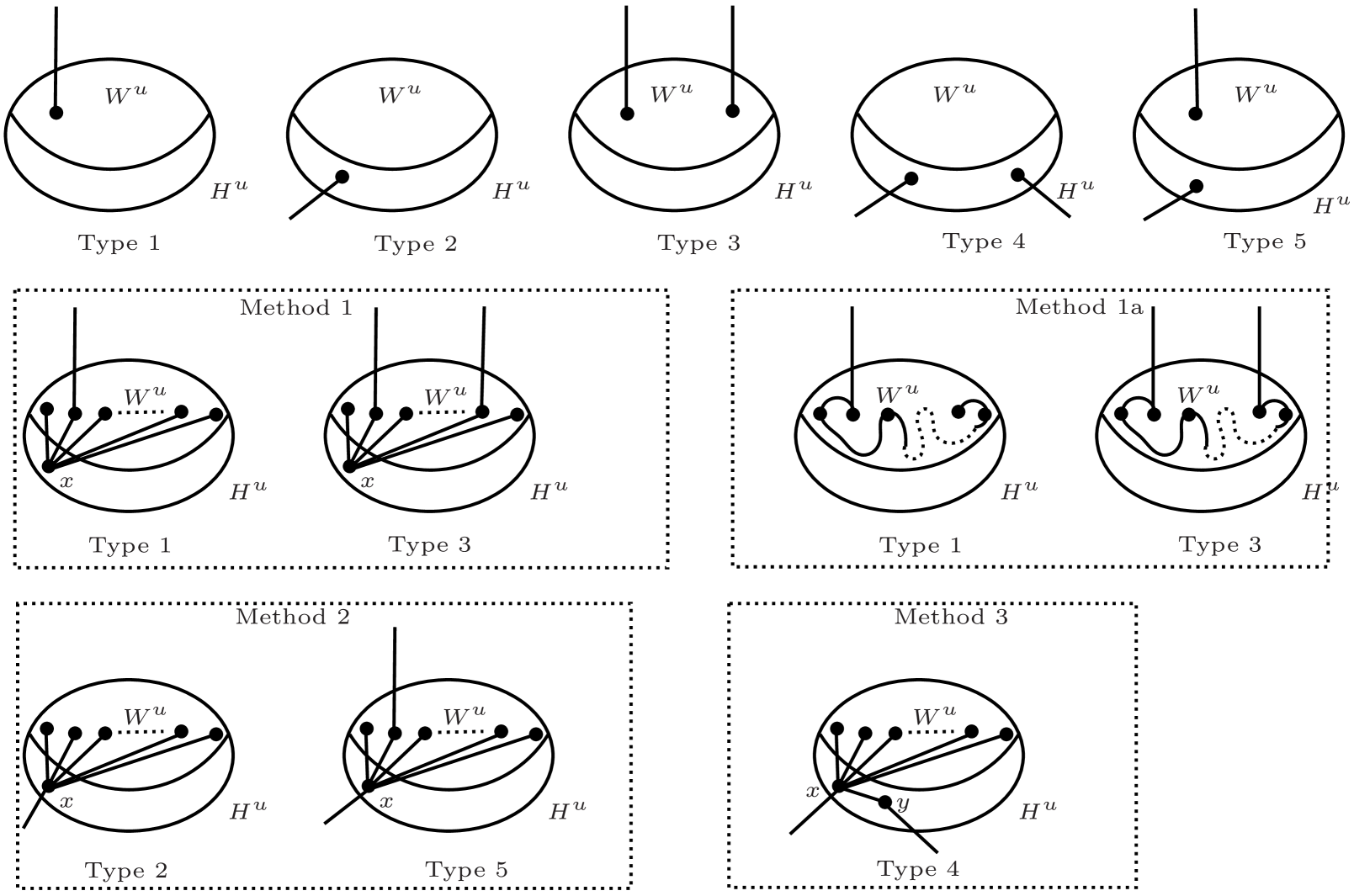
The image presents a series of diagrams illustrating different topological structures, categorized by "Type" and "Method." Each diagram consists of an oval shape, labeled components, and connecting lines, representing relationships between these components. The diagrams are grouped into distinct methods, each enclosed within a dotted-line rectangle.
### Components/Axes
* **Oval Shape:** Represents a base structure, with a curved line at the bottom.
* **Wu:** Label positioned inside the top half of the oval.
* **Hu:** Label positioned outside the bottom half of the oval.
* **Type Labels:** "Type 1," "Type 2," "Type 3," "Type 4," "Type 5" are located below each diagram in the top row and within the dotted rectangles in the subsequent rows.
* **Method Labels:** "Method 1," "Method 1a," "Method 2," "Method 3" are located above the diagrams within their respective dotted rectangles.
* **Points:** Small black circles representing nodes or points within the structure.
* **Lines:** Solid and dotted lines connecting the points and components.
* **x, y:** Labels indicating specific points in some diagrams.
### Detailed Analysis
**Top Row: Basic Types**
* **Type 1:** An oval with a horizontal line inside, connecting to a point on the top of the oval.
* **Type 2:** An oval with a curved line inside.
* **Type 3:** An oval with a curved line inside, connecting to two points on the top of the oval.
* **Type 4:** An oval with a curved line inside, and a line intersecting the oval.
* **Type 5:** An oval with a curved line inside, connecting to a point on the top of the oval.
**Method 1**
* Enclosed in a dotted rectangle.
* **Type 1:** An oval with a curved line inside. Several lines connect a point labeled "x" outside the oval to points inside the oval. A dotted line connects two points inside the oval.
* **Type 3:** Similar to Type 1, but with a different arrangement of connecting lines.
**Method 1a**
* Enclosed in a dotted rectangle.
* **Type 1:** An oval with a curved line inside. Several curved lines connect points inside the oval. A dotted line connects two points inside the oval.
* **Type 3:** Similar to Type 1, but with a different arrangement of curved lines.
**Method 2**
* Enclosed in a dotted rectangle.
* **Type 2:** An oval with a curved line inside. Several lines connect a point labeled "x" outside the oval to points inside the oval. A dotted line connects two points inside the oval.
* **Type 5:** Similar to Type 2, but with a different arrangement of connecting lines.
**Method 3**
* Enclosed in a dotted rectangle.
* **Type 4:** An oval with a curved line inside. Several lines connect a point labeled "x" outside the oval to points inside the oval. A dotted line connects two points inside the oval. Another line intersects the oval at point "y".
### Key Observations
* The diagrams represent different configurations of topological structures.
* The "Type" labels seem to indicate variations in the basic structure.
* The "Method" labels suggest different ways of modifying or connecting these structures.
* Dotted lines appear to represent a specific type of connection or relationship.
* The points labeled "x" and "y" likely represent specific nodes or points of interaction.
### Interpretation
The image likely illustrates different types of topological structures and methods for manipulating or connecting them. The diagrams could represent various mathematical or physical systems, where the ovals represent a base structure, and the lines represent relationships or interactions between components. The different "Types" and "Methods" likely represent different configurations or manipulations of these structures. The dotted lines might represent a specific type of interaction or connection, while the points labeled "x" and "y" could represent specific nodes or points of interest within the system. The image provides a visual representation of abstract concepts, potentially related to graph theory, network analysis, or other fields dealing with topological structures.