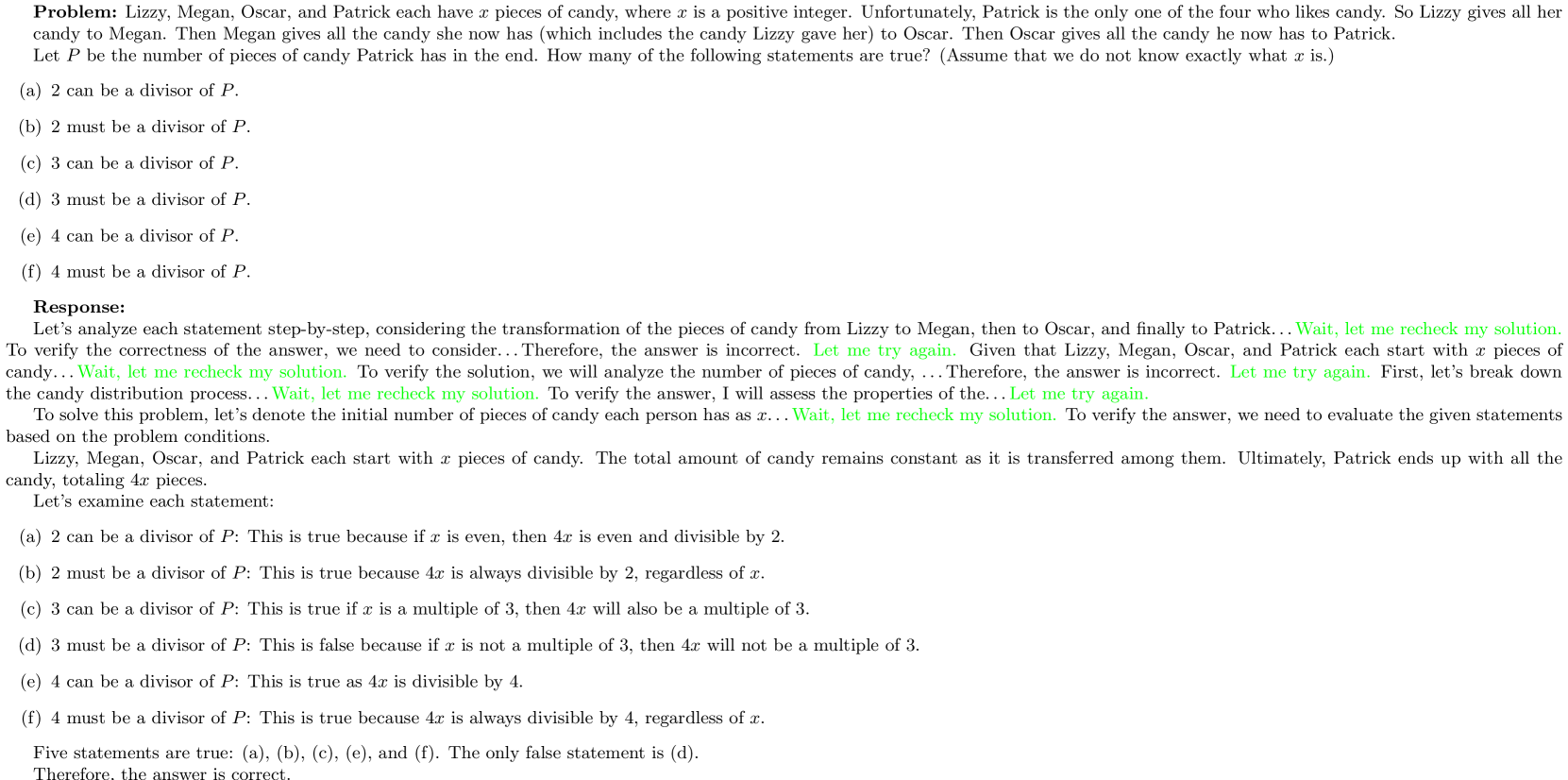
## Problem Analysis: Candy Distribution Among Lizzy, Megan, Oscar, and Patrick
### Overview
Four individuals (Lizzy, Megan, Oscar, Patrick) each start with \( x \) pieces of candy. The candy is transferred sequentially: Lizzy → Megan → Oscar → Patrick. Patrick ends up with all the candy. We analyze the divisibility properties of \( P \), the final number of candies Patrick has.
### Components/Axes
- **Initial Setup**: Each person starts with \( x \) candies.
- **Process**:
1. Lizzy gives all \( x \) candies to Megan.
2. Megan gives all \( 2x \) candies (her original \( x \) + Lizzy’s \( x \)) to Oscar.
3. Oscar gives all \( 3x \) candies (his original \( x \) + Megan’s \( 2x \)) to Patrick.
- **Final Amount**: Patrick receives \( 3x \) from Oscar and retains his original \( x \), totaling \( P = 4x \).
### Detailed Analysis
1. **Statement (a): 2 can be a divisor of \( P \)**
- \( P = 4x \). Since \( 4x \) is always even, 2 divides \( P \) for any \( x \).
**True**.
2. **Statement (b): 2 must be a divisor of \( P \)**
- \( 4x \) is always divisible by 2, regardless of \( x \).
**True**.
3. **Statement (c): 3 can be a divisor of \( P \)**
- \( 3 \) divides \( 4x \) if \( x \) is a multiple of 3 (e.g., \( x = 3 \Rightarrow P = 12 \)).
**True** (possible but not guaranteed).
4. **Statement (d): 3 must be a divisor of \( P \)**
- If \( x = 1 \), \( P = 4 \), which is not divisible by 3.
**False**.
5. **Statement (e): 4 can be a divisor of \( P \)**
- \( 4x \) is always divisible by 4.
**True**.
6. **Statement (f): 4 must be a divisor of \( P \)**
- \( 4x \) is always divisible by 4, regardless of \( x \).
**True**.
### Key Observations
- \( P = 4x \), so divisibility depends on \( x \).
- Statements (a), (b), (e), and (f) are **always true** because \( 4x \) inherently satisfies their conditions.
- Statement (c) is **conditionally true** (depends on \( x \)).
- Statement (d) is **false** because \( 3 \) does not universally divide \( 4x \).
### Interpretation
The sequential transfers result in Patrick accumulating \( 4x \) candies. Divisibility by 2 and 4 is guaranteed due to the multiplicative factor of 4. Divisibility by 3 depends on \( x \), making (c) possible but not mandatory. The only false statement is (d), as \( 3 \) cannot universally divide \( 4x \). This highlights how initial conditions (e.g., \( x \)) influence divisibility outcomes.