\n
## Diagram: Sub-Model Relationship
### Overview
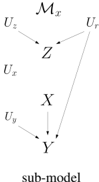
The image presents a directed acyclic graph (DAG) representing relationships within a "sub-model". The diagram illustrates dependencies between variables labeled U<sub>x</sub>, U<sub>y</sub>, U<sub>z</sub>, X, Y, and Z, with M<sub>x</sub> appearing at the top. Arrows indicate the direction of influence or dependency.
### Components/Axes
The diagram consists of nodes (labeled with letters and subscripts) and directed edges (arrows). The nodes represent variables or components within the sub-model. The edges represent relationships between these components. The label "sub-model" is positioned at the bottom center of the diagram.
### Detailed Analysis or Content Details
The diagram shows the following relationships:
* **M<sub>x</sub>** is connected to **Z** and **U<sub>f</sub>** via directed arrows.
* **U<sub>z</sub>** is connected to **Z** via a directed arrow.
* **U<sub>x</sub>** is connected to **Z** via a directed arrow.
* **Z** is connected to **X** via a directed arrow.
* **U<sub>y</sub>** is connected to **X** via a directed arrow.
* **X** is connected to **Y** via a directed arrow.
* **U<sub>f</sub>** is connected to **Y** via a directed arrow.
There are no numerical values or scales present in the diagram. It is a purely structural representation of relationships.
### Key Observations
The diagram suggests a hierarchical structure. M<sub>x</sub> appears to be a root node influencing Z and U<sub>f</sub>. Z then influences X, and X influences Y. U<sub>y</sub> and U<sub>f</sub> also directly influence Y. The diagram does not indicate the nature of the relationships (e.g., causal, correlational).
### Interpretation
This diagram likely represents a simplified model of a system, where the variables represent different components or factors. The arrows indicate how changes in one variable might affect others. The structure suggests that M<sub>x</sub> and U<sub>z</sub>, U<sub>x</sub> are upstream influences on Z, which in turn influences X and ultimately Y. U<sub>y</sub> and U<sub>f</sub> provide additional direct influence on Y. The diagram is abstract and requires further context to understand the specific meaning of the variables and relationships. It could represent a Bayesian network, a causal diagram, or a similar type of model used in various fields like statistics, machine learning, or engineering. The absence of quantitative data suggests this is a conceptual model rather than a quantitative analysis.