## Conceptual Diagram: Evolution of Cognitive Processing Paradigms
### Overview
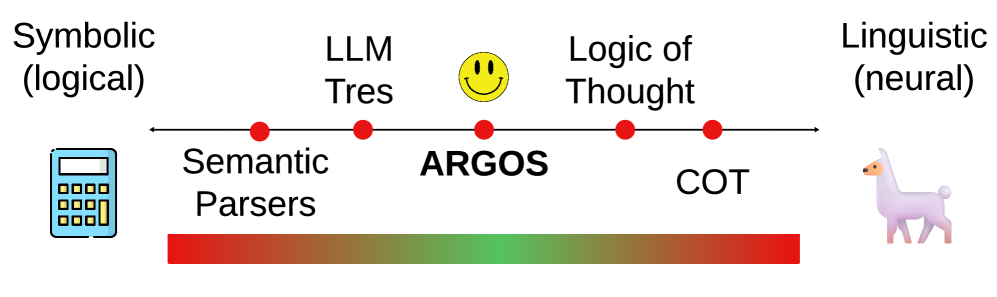
The image depicts a horizontal conceptual spectrum illustrating the progression from symbolic/logical processing to linguistic/neural processing. It includes labeled milestones, color gradients, and symbolic icons to represent different cognitive frameworks and their relationships.
### Components/Axes
1. **Horizontal Line**: Represents a continuum of cognitive processing paradigms.
- **Left End**: "Symbolic (logical)" with a calculator icon.
- **Right End**: "Linguistic (neural)" with a llama icon.
2. **Color Gradient**: Transitions from red (left) to green (center) to brown (right), likely indicating a spectrum of abstraction or methodology.
3. **Labels and Milestones**:
- **LLM Trees**: Positioned left of center, marked with a red dot.
- **Semantic Parsers**: Directly under "LLM Trees," marked with a red dot.
- **ARGOS**: Centered, marked with a red dot and a yellow smiley face icon.
- **Logic of Thought**: Right of center, marked with a red dot.
- **COT**: Further right, marked with a red dot.
4. **Icons**:
- **Calculator**: Under "Symbolic (logical)," symbolizing rule-based computation.
- **Smiley Face**: Over "ARGOS," suggesting human-like reasoning or adaptability.
- **Llama**: Under "Linguistic (neural)," representing neural network-based models.
### Detailed Analysis
- **Symbolic (logical)**: Anchored at the left with a calculator icon, representing traditional rule-based systems (e.g., formal logic, symbolic AI).
- **LLM Trees**: Positioned slightly right of "Symbolic," indicating early large language model architectures focused on hierarchical structures.
- **Semantic Parsers**: Directly below "LLM Trees," emphasizing systems that map inputs to meaning representations.
- **ARGOS**: Central position with a smiley face, suggesting a hybrid or human-centric approach bridging symbolic and neural methods.
- **Logic of Thought** and **COT**: Progressively rightward, representing advanced reasoning frameworks (e.g., chain-of-thought prompting).
- **Linguistic (neural)**: Final position with a llama icon, symbolizing modern neural architectures (e.g., transformers, LLMs).
### Key Observations
1. **ARGOS as a Bridge**: The central placement and smiley face icon imply ARGOS integrates symbolic and neural paradigms with human-like adaptability.
2. **Color Gradient**: Red (left) to green (center) to brown (right) may reflect a transition from rigid symbolic systems (red) to flexible hybrid models (green) to neural dominance (brown).
3. **Icon Symbolism**:
- Calculator: Rigid, rule-based logic.
- Smiley Face: Human-like intuition or contextual understanding.
- Llama: Neural networks' ability to generalize and adapt.
### Interpretation
The diagram illustrates the evolution of cognitive systems from purely symbolic (logical) methods to hybrid approaches (e.g., ARGOS) and finally to neural/linguistic paradigms. The color gradient and icons emphasize a continuum of abstraction, with ARGOS positioned as a pivotal model that incorporates human-like reasoning. The progression suggests a shift from rigid, rule-based systems to adaptive, context-aware frameworks, culminating in neural networks' capacity for open-ended linguistic processing. The absence of numerical data implies this is a conceptual map rather than an empirical analysis, highlighting theoretical relationships between paradigms.