\n
## Diagram: Reasoning Spectrum
### Overview
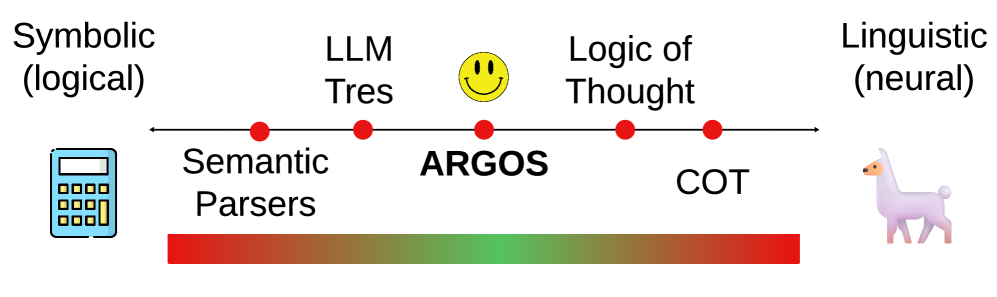
The image presents a diagram illustrating a spectrum of reasoning approaches, ranging from "Symbolic (logical)" to "Linguistic (neural)". The diagram uses a horizontal line with labeled points representing different stages or techniques, and a color gradient below to visually represent the transition between these approaches.
### Components/Axes
* **Horizontal Axis:** Represents the spectrum of reasoning, labeled from left to right as: "Symbolic (logical)", "LLM Tres", "Logic of Thought", and "Linguistic (neural)".
* **Points on the Line:** Four red dots are positioned along the line, corresponding to the following labels (from left to right): "Semantic Parsers", "ARGOS", "COT", and a llama emoji.
* **Color Gradient:** A horizontal color gradient is positioned below the line. It transitions from red on the left to green in the center, and back to red on the right.
* **Icons:** A calculator icon is positioned to the left of "Semantic Parsers", and a llama emoji is positioned to the right of "Linguistic (neural)".
* **Smiley Face:** A smiley face is positioned between "LLM Tres" and "Logic of Thought".
### Detailed Analysis
The diagram depicts a progression of reasoning techniques.
* **Symbolic (logical):** Associated with a calculator icon, suggesting rule-based, deterministic reasoning.
* **LLM Tres:** Represents a stage involving Large Language Models (LLMs), specifically "Tres".
* **Logic of Thought:** A central point, potentially representing a more advanced reasoning capability.
* **Linguistic (neural):** Associated with a llama emoji, suggesting neural network-based, language-focused reasoning.
The color gradient visually reinforces the idea of a transition. Red likely represents lower levels of reasoning complexity or more traditional approaches, while green represents a peak or optimal state, and the return to red suggests a different type of complexity.
### Key Observations
* The diagram is conceptual and does not contain numerical data.
* The placement of "ARGOS" and "COT" suggests they are intermediate steps between LLMs and more advanced reasoning.
* The use of icons and emojis adds a visual element to the abstract concepts.
* The smiley face between "LLM Tres" and "Logic of Thought" could indicate a positive or successful transition.
### Interpretation
The diagram illustrates a shift in reasoning paradigms. It suggests a move from traditional, symbolic logic (represented by the calculator) towards more nuanced, language-based reasoning (represented by the llama). The intermediate stages – "LLM Tres", "ARGOS", and "COT" – likely represent techniques or models that bridge this gap. The color gradient emphasizes the idea of a continuous spectrum, rather than discrete categories.
The diagram implies that "Logic of Thought" represents a potentially optimal or central point in this reasoning spectrum. The use of "Tres" suggests a specific LLM implementation or approach. The inclusion of "ARGOS" and "COT" (Chain of Thought) indicates specific reasoning techniques being explored within the LLM space.
The diagram is a high-level conceptual representation and doesn't provide specific details about the techniques or their relative effectiveness. It serves as a visual framework for understanding the evolution of reasoning approaches in the context of AI and LLMs. It is a qualitative rather than quantitative representation.