## Screenshot: Text-Only/Multimodal MQQA User Prompt Template
### Overview
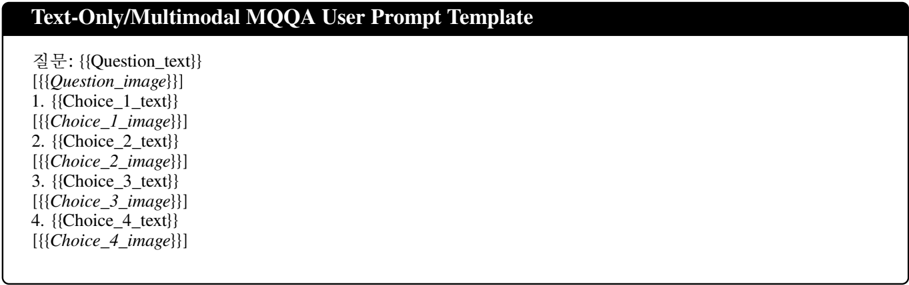
The image displays a structured template for constructing multimodal multiple-choice questions (MCQA). It includes placeholders for question text/images and four answer choices with corresponding text/image fields. The template is written in Korean, with English technical terms for placeholders.
### Components/Axes
1. **Header**:
- Title: "Text-Only/Multimodal MQQA User Prompt Template" (black bar at top)
2. **Question Section**:
- Label: "질문" (Korean for "Question")
- Placeholders:
- `{{Question_text}}` (text content)
- `{{Question_image}}` (image content)
3. **Answer Choices**:
- Four numbered options (1–4)
- Each choice contains:
- Text placeholder: `{{Choice_X_text}}` (X = 1–4)
- Image placeholder: `{{Choice_X_image}}` (X = 1–4)
### Content Details
- **Text Structure**:
- All placeholders use double curly braces (`{{ }}`) for variable substitution.
- Choices are sequentially numbered (1–4) with no additional formatting.
- **Language**:
- Primary text: Korean (e.g., "질문", "선택지")
- Placeholders: English technical notation (e.g., `{{Question_text}}`)
### Key Observations
- The template enforces a strict format for multimodal inputs (text + image).
- Placeholders suggest dynamic content insertion for both text and images.
- No default values or examples are provided—only structural placeholders.
### Interpretation
This template is designed for generating or standardizing multimodal MCQA prompts. The use of separate text/image placeholders indicates support for hybrid question/answer formats. The absence of predefined content implies flexibility for customization. The numbering system (1–4) suggests a fixed number of answer choices, typical for MCQA systems. The Korean text confirms the template's origin or target audience, while the English placeholders ensure technical clarity for developers or AI systems processing the prompts.