## Line Graph: Success Rate vs. Problem Size
### Overview
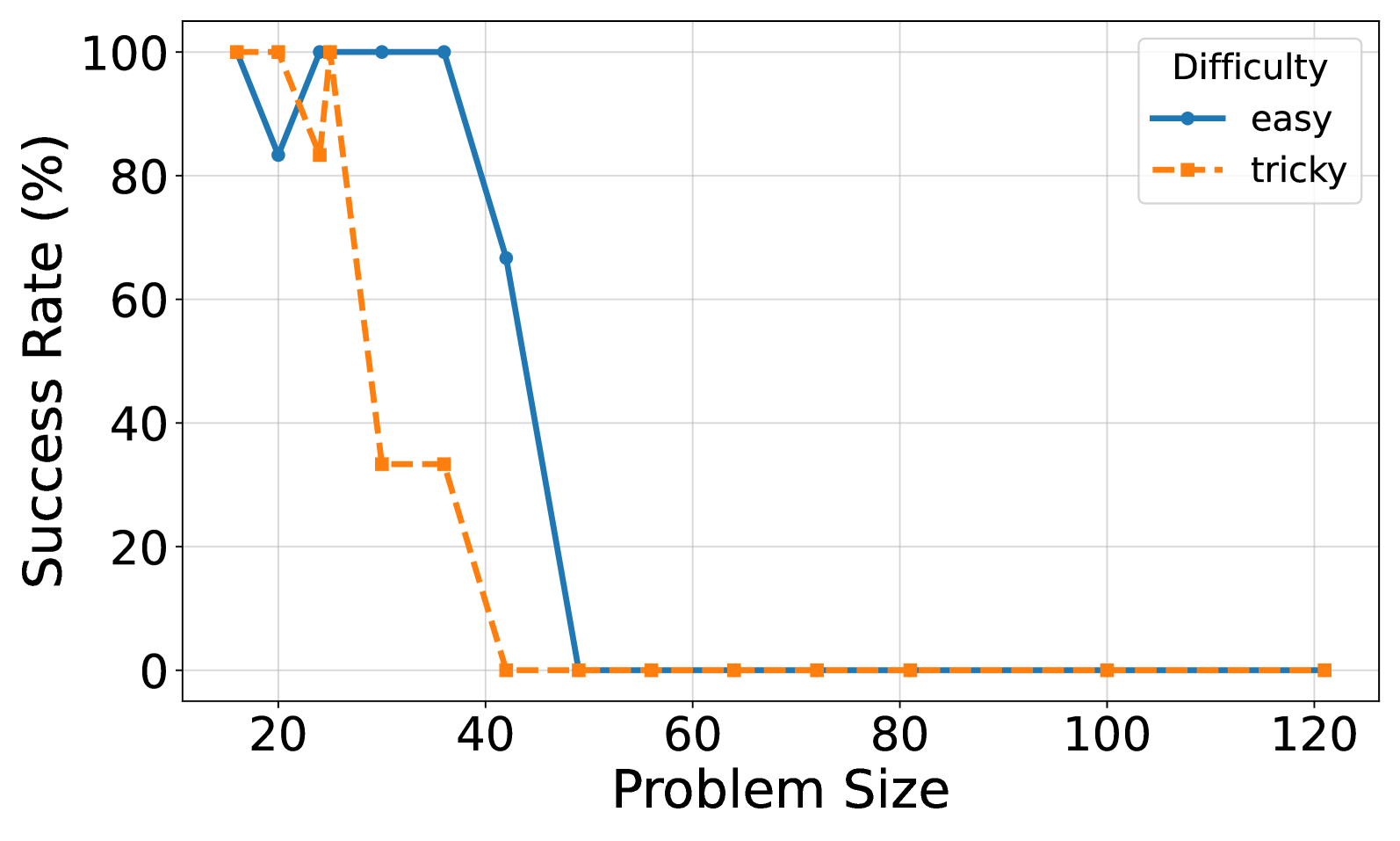
The graph illustrates the relationship between problem size (x-axis) and success rate (y-axis) for two difficulty levels: "easy" (blue solid line) and "tricky" (orange dashed line). Both lines show a sharp decline in success rate as problem size increases, with distinct thresholds where success rates drop to near 0%.
### Components/Axes
- **Title**: "Success Rate (%)"
- **X-axis**: "Problem Size" (ranges from 20 to 120 in increments of 20)
- **Y-axis**: "Success Rate (%)" (ranges from 0% to 100% in increments of 20)
- **Legend**: Located in the top-right corner, with:
- Blue solid line labeled "easy"
- Orange dashed line labeled "tricky"
### Detailed Analysis
1. **Easy (Blue Line)**:
- Starts at **100%** success rate for problem sizes 20, 25, and 30.
- Drops sharply to **~65%** at problem size 40.
- Plummets to **~0%** by problem size 50, remaining flat thereafter.
2. **Tricky (Orange Line)**:
- Starts at **100%** success rate for problem sizes 20 and 25.
- Declines to **~35%** at problem size 30.
- Further drops to **~25%** at problem size 35.
- Reaches **~0%** by problem size 40, remaining flat thereafter.
### Key Observations
- Both difficulty levels exhibit a **threshold effect**: success rates collapse abruptly after specific problem sizes (50 for "easy," 40 for "tricky").
- The "tricky" line shows a **steeper initial decline** compared to "easy," suggesting higher sensitivity to problem size increases.
- Success rates for both lines are **identical (0%)** for problem sizes ≥50.
### Interpretation
The data demonstrates that problem size critically impacts success rates, with "tricky" problems being more vulnerable to increases in size. The abrupt drops suggest a **non-linear relationship** where small increases in problem size beyond certain thresholds render success nearly impossible. This could imply that "tricky" problems require significantly more resources or cognitive effort, making them less scalable than "easy" problems. The identical 0% success rate for large problem sizes may indicate a **hard failure ceiling** for both difficulty levels under the tested conditions.