## Footprint Analysis: Determining Foot Type from Footprint Diagrams
### Overview
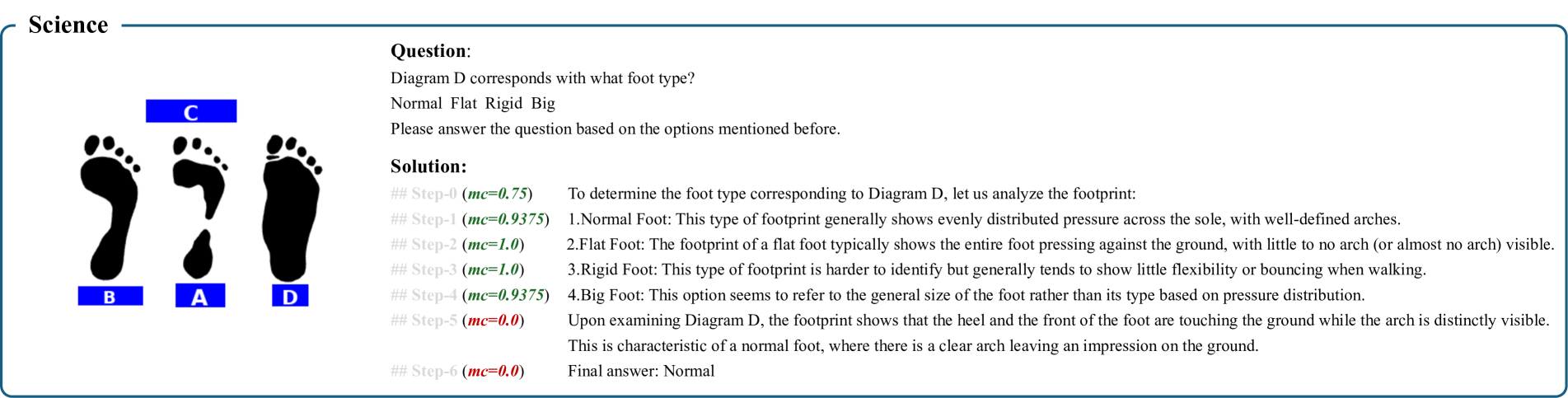
The image presents a science question related to identifying foot types based on footprint diagrams. It includes four footprint diagrams labeled A, B, C, and D, along with a question asking which foot type Diagram D corresponds to (Normal, Flat, Rigid, or Big). A solution is provided, analyzing the characteristics of each foot type and concluding that Diagram D represents a normal foot.
### Components/Axes
* **Title:** Science (top-left)
* **Footprint Diagrams:** Four black footprint diagrams labeled A, B, C, and D with blue rectangles.
* Diagram A: Footprint showing a gap in the midfoot area.
* Diagram B: Footprint showing a relatively complete impression of the foot.
* Diagram C: Footprint showing a relatively complete impression of the foot, but smaller than B.
* Diagram D: Footprint showing a gap in the midfoot area, similar to A.
* **Question:**
* "Diagram D corresponds with what foot type?"
* Options: Normal, Flat, Rigid, Big
* "Please answer the question based on the options mentioned before."
* **Solution:**
* Steps 0-6 with associated 'mc' values (mc = 0.75, 0.9375, 1.0, 1.0, 0.9375, 0.0, 0.0)
* Descriptions of Normal Foot, Flat Foot, Rigid Foot, and Big Foot.
* Analysis of Diagram D's footprint.
* Final answer: Normal
### Detailed Analysis or Content Details
* **Diagram A:** Shows a footprint with a distinct gap in the arch area.
* **Diagram B:** Shows a footprint with a full impression, indicating a flat foot.
* **Diagram C:** Shows a footprint with a full impression, similar to B, but smaller.
* **Diagram D:** Shows a footprint with a distinct gap in the arch area, similar to A.
* **Step-0:** mc=0.75
* **Step-1:** mc=0.9375
* **Step-2:** mc=1.0
* **Step-3:** mc=1.0
* **Step-4:** mc=0.9375
* **Step-5:** mc=0.0
* **Step-6:** mc=0.0
* **Normal Foot Description:** Evenly distributed pressure, well-defined arches.
* **Flat Foot Description:** Entire foot pressing against the ground, little to no arch visible.
* **Rigid Foot Description:** Harder to identify, shows little flexibility or bouncing when walking.
* **Big Foot Description:** Refers to the general size of the foot rather than its type based on pressure distribution.
* **Analysis of Diagram D:** Heel and front of the foot touching the ground, arch is distinctly visible.
### Key Observations
* Diagrams A and D both show footprints with a visible arch, suggesting a normal foot type.
* Diagrams B and C show footprints with a full impression, suggesting a flat foot type.
* The solution correctly identifies Diagram D as representing a normal foot based on the visible arch.
* The 'mc' values associated with the steps are not clearly explained in the context of the image.
### Interpretation
The image effectively demonstrates how to identify foot types based on footprint analysis. The solution provides clear descriptions of each foot type and accurately matches Diagram D to a normal foot. The 'mc' values are not explained, and their purpose is unclear without additional context. The image highlights the importance of observing the arch area in a footprint to determine foot type.