\n
## Diagram: Foot Type Identification
### Overview
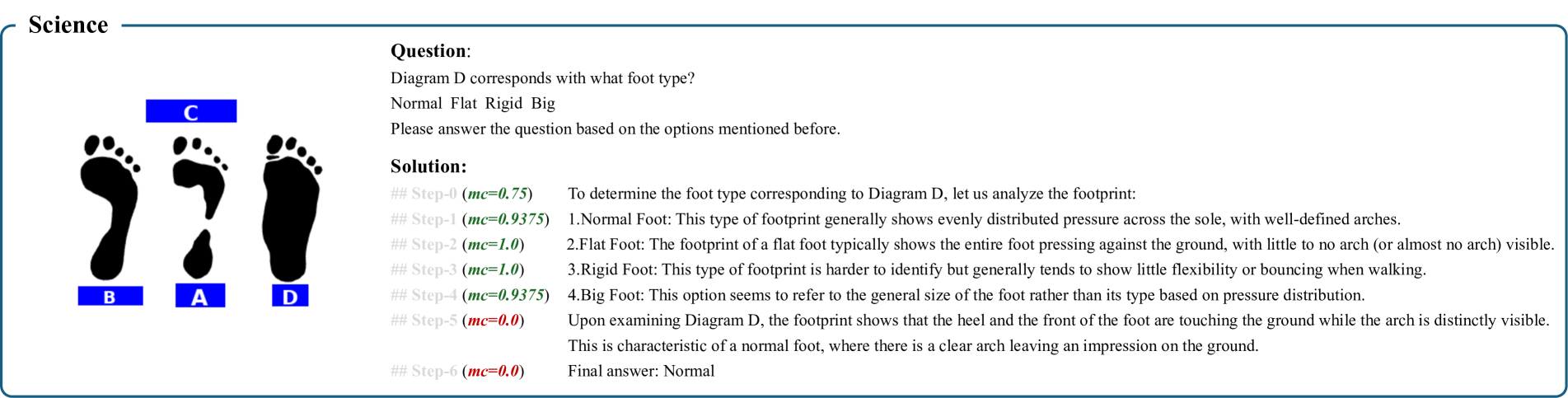
The image presents a science-related diagram illustrating different foot types (Normal, Flat, Rigid, Big) and a question asking to identify the foot type corresponding to Diagram D. The diagram shows four footprint images labeled A, B, C, and D, alongside a step-by-step solution process.
### Components/Axes
The image contains the following components:
* **Footprint Diagrams:** Four footprint images labeled A, B, C, and D.
* **Question:** "Diagram D corresponds with what foot type? Normal Flat Rigid Big. Please answer the question based on the options mentioned before."
* **Solution:** A step-by-step solution process with associated confidence scores (mc=).
* Step 0 (mc=0.75): Introduction to the problem.
* Step 1 (mc=0.9375): Description of Normal Foot.
* Step 2 (mc=1.0): Description of Flat Foot.
* Step 3 (mc=1.0): Description of Rigid Foot.
* Step 4 (mc=0.9375): Description of Big Foot.
* Step 5 (mc=0.0): Analysis of Diagram D and conclusion.
* Step 6 (mc=0.0): Final answer.
### Detailed Analysis or Content Details
The footprints are arranged horizontally across the image.
* **Footprint A:** Shows a footprint with a pronounced arch.
* **Footprint B:** Shows a footprint with a very slight arch.
* **Footprint C:** Shows a footprint with a moderate arch.
* **Footprint D:** Shows a footprint where the heel and the front of the foot are touching the ground, with a distinctly visible arch.
The solution process provides the following descriptions:
* **Normal Foot:** Generally shows evenly distributed pressure across the sole, with well-defined arches.
* **Flat Foot:** Typically shows the entire foot pressing against the ground, with little to no arch (or almost no arch) visible.
* **Rigid Foot:** Harder to identify but generally tends to show little flexibility or bouncing when walking.
* **Big Foot:** Seems to refer to the general size of the foot rather than its type based on pressure distribution.
The analysis in Step 5 concludes that Diagram D represents a normal foot, where there is a clear arch leaving an impression on the ground. The final answer is "Normal".
### Key Observations
The solution process assigns confidence scores (mc) to each step, indicating the certainty of the analysis. The highest confidence scores are given to the descriptions of Flat and Rigid feet (mc=1.0). The final answer is determined by visual examination of Diagram D.
### Interpretation
The diagram demonstrates a method for identifying foot types based on footprint analysis. The step-by-step solution provides a logical reasoning process, starting with defining each foot type and then applying those definitions to the given footprint (Diagram D). The confidence scores suggest that the descriptions of Flat and Rigid feet are more definitive than those of Normal and Big feet. The diagram highlights the importance of observing the arch of the foot to determine its type. The inclusion of "Big Foot" as an option seems somewhat irrelevant to the actual analysis of foot *type* based on pressure distribution. The diagram is a pedagogical tool for understanding podiatric concepts.