## Diagram: Footprint Analysis for Foot Type Identification
### Overview
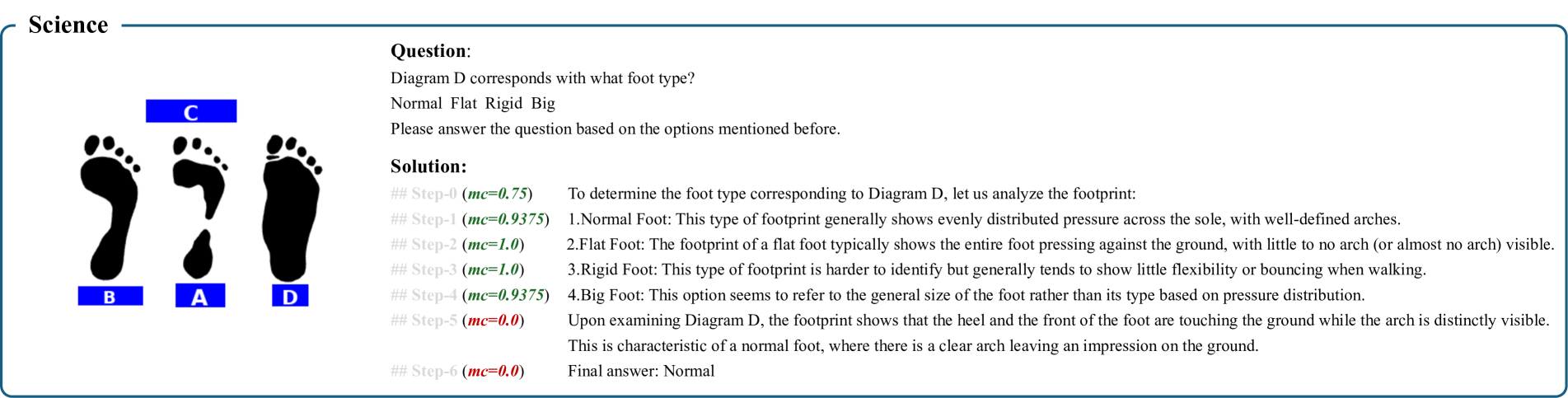
The image presents a science-related diagram comparing three footprints labeled **B**, **A**, and **D**, alongside a question asking which foot type corresponds to Diagram **D**. The solution provides a step-by-step analysis of pressure distribution and arch visibility to determine the foot type.
### Components/Axes
- **Footprints**: Three black silhouettes labeled **B**, **A**, and **D** (left to right).
- **Question Text**: "Diagram D corresponds with what foot type? Normal Flat Rigid Big."
- **Solution Text**: A detailed explanation analyzing pressure distribution and arch visibility.
### Detailed Analysis
1. **Footprint Labels**:
- **B**: Full footprint with no visible arch (indicative of a flat foot).
- **A**: Partial footprint with a pronounced arch (indicative of a rigid foot).
- **D**: Full footprint with a visible arch (indicative of a normal foot).
2. **Solution Steps**:
- **Step 0**: Initial analysis of Diagram D’s footprint.
- **Step 1**: Definition of a normal foot (even pressure distribution, well-defined arches).
- **Step 2**: Definition of a flat foot (entire footprint presses against the ground, no arch).
- **Step 3**: Definition of a rigid foot (hard to identify, little flexibility).
- **Step 4**: Definition of a "big foot" (size-based, not pressure-based).
- **Step 5**: Observation that Diagram D shows a visible arch with heel and forefoot touching the ground.
- **Step 6**: Conclusion: Diagram D matches a **normal foot**.
### Key Observations
- Diagram **D** is the only footprint with a visible arch, distinguishing it from **B** (flat) and **A** (rigid).
- The solution explicitly rules out "big foot" as a pressure-distribution-based category.
### Interpretation
The diagram demonstrates that foot type classification relies on arch visibility and pressure distribution. Diagram **D**’s clear arch and balanced contact points align with the anatomical characteristics of a **normal foot**, where the arch acts as a shock absorber. This contrasts with flat feet (no arch) and rigid feet (exaggerated arch with reduced flexibility). The analysis emphasizes that foot size ("big") is irrelevant to this classification, focusing instead on structural and functional traits.