## Diagram: Existing Methods for CoT vs. DiffCoT
### Overview
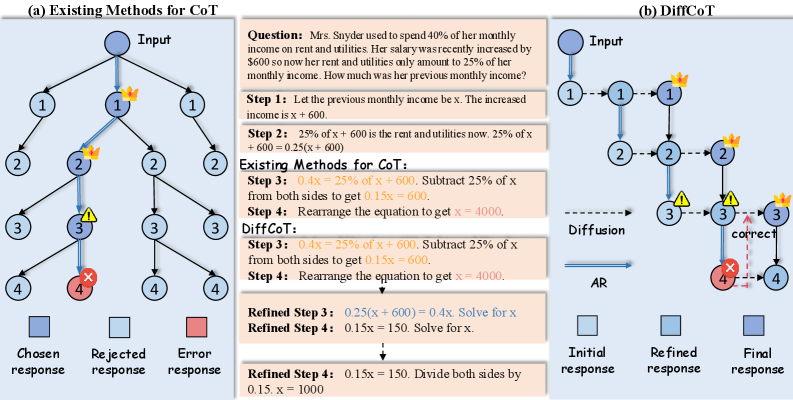
The image presents two diagrams comparing "Existing Methods for CoT" (Chain of Thought) and "DiffCoT" (Diffusion Chain of Thought). Both diagrams illustrate a tree-like structure representing a problem-solving process, with nodes indicating steps and branches representing different solution paths. The diagrams highlight the flow of reasoning and potential errors in each method.
### Components/Axes
**Diagram (a) - Existing Methods for CoT:**
* **Title:** (a) Existing Methods for CoT
* **Nodes:** Represented by blue circles containing numbers (1, 2, 3, 4). These numbers likely indicate the step number in the chain of thought.
* **Root Node:** Labeled "Input" at the top.
* **Branches:** Represented by lines connecting the nodes, indicating the flow of reasoning.
* **Chosen Response Path:** Highlighted with a thicker blue line and arrows, showing the selected path through the chain of thought.
* **Error Indicators:** Represented by a yellow triangle with an exclamation point and a crown-like symbol, indicating potential errors at specific nodes.
* **Legend (Bottom-Left):**
* Blue Square: "Chosen response"
* Light Blue Square: "Rejected response"
* Red Square: "Error response"
**Diagram (b) - DiffCoT:**
* **Title:** (b) DiffCoT
* **Nodes:** Represented by light blue circles containing numbers (1, 2, 3, 4).
* **Root Node:** Labeled "Input" at the top.
* **Branches:** Represented by dashed lines connecting the nodes, indicating the flow of reasoning.
* **Diffusion Arrow:** A blue arrow labeled "Diffusion" pointing from left to right, indicating the diffusion process.
* **AR Arrow:** A blue arrow labeled "AR" pointing from left to right, indicating the Auto-Regressive process.
* **Error Indicators:** Represented by a yellow triangle with an exclamation point and a crown-like symbol, indicating potential errors at specific nodes.
* **Correct Indicator:** A green checkmark and the word "correct" near node 3.
* **Error Response:** Node 4 is colored red and contains a red "X".
* **Legend (Bottom-Center):**
* Blue Square: "Initial response"
* Light Blue Square: "Refined response"
* Blue Square: "Final response"
**Textual Content (Center):**
* **Question:** Mrs. Snyder used to spend 40% of her monthly income on rent and utilities. Her salary was recently increased by $600 so now her rent and utilities only amount to 25% of her monthly income. How much was her previous monthly income?
* **Step 1:** Let the previous monthly income be x. The increased income is x + 600.
* **Step 2:** 25% of x + 600 is the rent and utilities now. 25% of x + 600 = 0.25(x + 600)
* **Existing Methods for CoT:**
* **Step 3:** 0.4x = 25% of x + 600. Subtract 25% of x from both sides to get 0.15x = 600.
* **Step 4:** Rearrange the equation to get x = 4000.
* **DiffCoT:**
* **Step 3:** 0.4x = 25% of x + 600. Subtract 25% of x from both sides to get 0.15x = 600.
* **Step 4:** Rearrange the equation to get x = 4000.
* **Refined Step 3:** 0.25(x + 600) = 0.4x. Solve for x
* **Refined Step 4:** 0.15x = 150. Solve for x.
* **Refined Step 4:** 0.15x = 150. Divide both sides by 0.15. x = 1000
### Detailed Analysis
**Diagram (a) - Existing Methods for CoT:**
* The "Chosen response" path starts at the "Input" node, goes to node "1", then to node "2", then to node "3", and finally to node "4" which is marked as an "Error response".
* Error indicators are present at nodes "1" and "2", suggesting potential issues in the reasoning at those steps.
* The tree branches out at each step, representing multiple possible reasoning paths.
**Diagram (b) - DiffCoT:**
* The diagram shows a diffusion process where the initial response is refined through multiple steps.
* The "AR" arrow indicates an auto-regressive process, suggesting that each step builds upon the previous one.
* Error indicators are present at nodes "1", "2", and "3", suggesting potential issues in the reasoning at those steps.
* The final response at node "4" is marked as an "Error response", but there is a "correct" indicator at node "3", suggesting a correction mechanism is in place.
### Key Observations
* Both diagrams represent a chain-of-thought process for solving a problem.
* Diagram (a) shows a traditional approach, while diagram (b) shows a diffusion-based approach.
* Error indicators highlight potential issues in the reasoning process.
* DiffCoT includes a correction mechanism, as indicated by the "correct" label and the refined steps in the textual content.
### Interpretation
The diagrams illustrate the difference between traditional chain-of-thought methods and a diffusion-based approach (DiffCoT). The traditional method (a) follows a single path, which can lead to an error. DiffCoT (b) uses a diffusion process to refine the reasoning, potentially correcting errors along the way. The "correct" indicator in DiffCoT suggests that this method is more robust to errors. The textual content provides the mathematical steps involved in solving the problem, highlighting the differences in how each method approaches the solution. The refined steps in DiffCoT demonstrate the iterative nature of the diffusion process.