\n
## Diagram: Chain of Thought (CoT) Comparison - Existing Methods vs. DiffCoT
### Overview
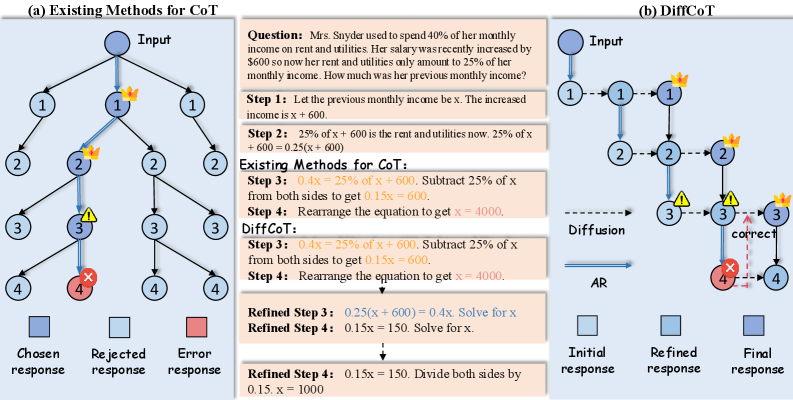
The image presents a comparative diagram illustrating two approaches to Chain of Thought (CoT) reasoning: "Existing Methods for CoT" (a) and "DiffCoT" (b). Both diagrams depict a tree-like structure representing the reasoning process, with nodes numbered 1 through 4. The diagrams are accompanied by a word problem and step-by-step solutions demonstrating how each method attempts to solve it. The diagram highlights the differences in how each method handles errors and refines its reasoning.
### Components/Axes
The diagram is divided into two main sections, labeled (a) and (b). Each section contains a tree-like diagram, a word problem, and a series of steps outlining the solution process.
* **Nodes:** Represent steps in the reasoning process, numbered 1-4.
* **Arrows:** Indicate the flow of reasoning.
* **Symbols:**
* Circle with an arrow pointing inward: Input
* Yellow Star: Indicates a step in the reasoning process.
* Blue Circle: Chosen response.
* Yellow Triangle with exclamation point: Rejected response.
* Red 'X' in a circle: Error response.
* Green Checkmark: Correct response.
* **Labels:** "Existing Methods for CoT", "DiffCoT", "Input", "Chosen response", "Rejected response", "Error response", "Diffusion", "AR", "Initial response", "Refined response", "Final response".
* **Text Blocks:** Word problem, step-by-step solutions for both methods.
### Detailed Analysis or Content Details
**Section (a): Existing Methods for CoT**
* **Word Problem:** "Question: Mrs. Snyder used to spend 40% of her monthly income on rent and utilities. Her salary was recently increased by $600 so her new and utilities only amount to 25% of her monthly income. How much was her previous monthly income?"
* **Step 1:** "Let the previous monthly income be x. The increased income is x + 600."
* **Step 2:** "25% of x + 600 is the rent and utilities now. 25% of x = 0.25(x + 600)"
* **Step 3:** "0.4x = 25% of x + 600. Subtract 25% of x from both sides to get 0.15x = 600."
* **Step 4:** "Rearrange the equation to get x = 4000."
* **Reasoning Path:** The diagram shows a path from Input (node 1) to node 4. Node 2 is marked with a yellow triangle (rejected response), and node 3 is marked with a red 'X' (error response). The chosen response is node 4 (blue circle).
**Section (b): DiffCoT**
* **Word Problem:** Same as in section (a).
* **Step 3:** "0.4x = 25% of x + 600. Subtract 25% of x from both sides to get 0.15x = 600."
* **Step 4:** "Rearrange the equation to get x = 4000."
* **Refined Step 3:** "0.25(x + 600) = 0.4x. Solve for x"
* **Refined Step 4:** "0.15x = 150. Solve for x."
* **Refined Step 4:** "0.15 x = 150. Divide both sides by 0.15 x = 1000"
* **Reasoning Path:** The diagram shows an initial path from Input (node 1) to node 4, marked with a red 'X' (error response). A "Diffusion" arrow points to a refined path, starting from node 2, going through node 3 (marked with a green checkmark - correct response), and finally to node 4 (blue circle - final response). The initial response is node 1, the refined response is node 3, and the final response is node 4.
### Key Observations
* **Error Handling:** Existing Methods directly lead to an error (node 3 in section a) and then correct it in the final step. DiffCoT uses a "Diffusion" process to refine the reasoning and correct the error earlier in the process (node 3 in section b).
* **Refinement:** DiffCoT explicitly shows the refinement steps (Refined Step 3 & 4), demonstrating how the reasoning is adjusted based on the initial error.
* **Visual Representation:** The use of colors and symbols effectively highlights the differences in how each method handles errors and refines its reasoning.
### Interpretation
The diagram illustrates a key difference between traditional Chain of Thought methods and the proposed DiffCoT approach. Existing methods proceed linearly, potentially leading to errors that are only corrected at the final step. DiffCoT, on the other hand, incorporates a "Diffusion" mechanism that allows for earlier error detection and refinement of the reasoning process. This is visually represented by the branching paths and the correction of the error at node 3 in section (b). The refined steps demonstrate a more iterative and robust approach to problem-solving. The diagram suggests that DiffCoT is more likely to arrive at the correct answer by proactively addressing potential errors during the reasoning process. The word problem itself is a standard algebraic problem, and the diagram focuses on *how* the solution is reached, rather than the solution itself. The diagram is a conceptual illustration of a methodology, not a presentation of empirical data.