TECHNICAL ASSET FINGERPRINT
ade8e4664cbbf7cb85f9135d
Click to view fullscreen
Press ESC or click to close
FOUND IN PAPERS
EXPERT: healer-alpha-free VERSION 1
RUNTIME: free/openrouter/healer-alpha
INTEL_VERIFIED
## Diagram: Comparison of Chain-of-Thought (CoT) Reasoning Methods
### Overview
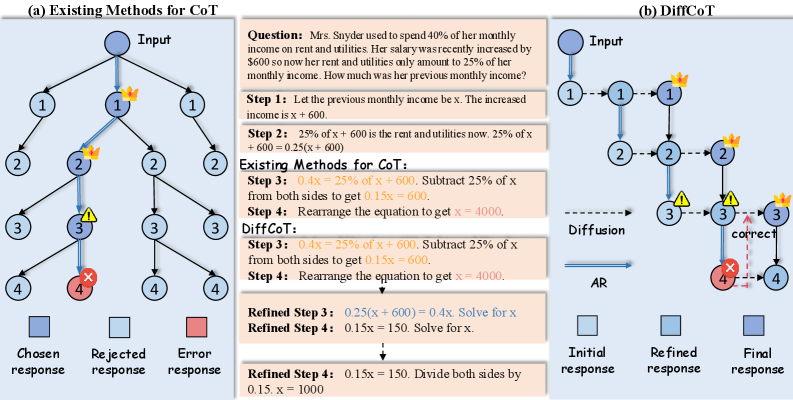
The image is a technical diagram comparing two approaches to solving multi-step reasoning problems, specifically a math word problem. The left side, labeled **(a) Existing Methods for CoT**, illustrates a branching, tree-like process where multiple reasoning paths are explored, some leading to errors. The right side, labeled **(b) DiffCoT**, illustrates a linear, iterative refinement process that uses "Diffusion" and "AR" (Autoregressive) steps to correct errors and arrive at the final answer. A central text block contains the problem statement and the step-by-step solutions generated by both methods.
### Components/Axes
* **Main Sections:** The diagram is split into three primary regions:
1. **Left Panel (a):** A flowchart titled "Existing Methods for CoT".
2. **Center Panel:** A text block containing the problem and solution steps.
3. **Right Panel (b):** A flowchart titled "DiffCoT".
* **Flowchart Elements:**
* **Nodes:** Numbered circles (1, 2, 3, 4) representing reasoning steps.
* **Arrows:** Indicate the flow of reasoning. Solid arrows show the primary path. Dashed arrows in (b) indicate the diffusion process.
* **Symbols:** A yellow warning triangle (⚠) and a red cross (❌) indicate errors or problematic steps.
* **Legends:**
* **Bottom-Left Legend (for panel a):**
* Blue square: "Chosen response"
* Light blue square: "Rejected response"
* Red square: "Error response"
* **Bottom-Right Legend (for panel b):**
* Light blue square: "Initial response"
* Medium blue square: "Refined response"
* Dark blue square: "Final response"
* **Text Block Content:**
* **Question:** "Mrs. Snyder used to spend 40% of her monthly income on rent and utilities. Her salary was recently increased by $600 so now her rent and utilities only amount to 25% of her monthly income. How much was her previous monthly income?"
* **Step 1:** "Let the previous monthly income be x. The increased income is x + 600."
* **Step 2:** "25% of x + 600 is the rent and utilities now. 25% of x + 600 = 0.25(x + 600)"
* **Existing Methods for CoT Steps:**
* Step 3: "0.4x = 25% of x + 600. Subtract 25% of x from both sides to get 0.15x = 600."
* Step 4: "Rearrange the equation to get x = 4000."
* **DiffCoT Steps:**
* Step 3: "0.4x = 25% of x + 600. Subtract 25% of x from both sides to get 0.15x = 600."
* Step 4: "Rearrange the equation to get x = 4000."
* **Refined Steps (below DiffCoT):**
* Refined Step 3: "0.25(x + 600) = 0.4x. Solve for x"
* Refined Step 4: "0.15x = 150. Solve for x"
* Refined Step 4 (final): "0.15x = 150. Divide both sides by 0.15. x = 1000"
### Detailed Analysis
**Panel (a) - Existing Methods for CoT:**
* **Structure:** A tree diagram starting from a single "Input" node. It branches into three parallel paths at Step 1, each leading to a Step 2 node.
* **Path Analysis:**
* **Leftmost Path:** Steps 1 -> 2 -> 3 -> 4. The Step 4 node is colored red with a red cross (❌), indicating an "Error response" per the legend.
* **Center Path:** Steps 1 -> 2 -> 3. The Step 3 node has a yellow warning triangle (⚠). This path does not proceed to Step 4.
* **Rightmost Path:** Steps 1 -> 2 -> 3 -> 4. The Step 4 node is light blue, indicating a "Rejected response".
* **Interpretation:** This panel depicts a method that generates multiple reasoning chains. One chain contains an error (red), one is flagged as problematic but incomplete (warning), and one is completed but ultimately rejected (light blue). The "chosen response" (dark blue) is not explicitly shown in the final step, implying the method may fail to select a correct answer from the generated paths.
**Panel (b) - DiffCoT:**
* **Structure:** A primarily linear flow from "Input" through Steps 1, 2, and 3.
* **Process Flow:**
1. **Initial Path:** Input -> 1 -> 2 -> 3. The Step 3 node has a yellow warning triangle (⚠).
2. **Diffusion & Correction:** A dashed arrow labeled "Diffusion" points from the problematic Step 3 node to a new Step 3 node. This new node is connected via a dashed red arrow labeled "correct" to a Step 4 node marked with a red cross (❌). This suggests the diffusion process identifies and targets an error.
3. **AR Refinement:** A solid blue arrow labeled "AR" (Autoregressive) points from the initial Step 3 node to a refined Step 3 node (medium blue). This node then leads to a final Step 4 node (dark blue).
* **Legend Correlation:** The nodes in the final, successful path (Input -> 1 -> 2 -> Refined 3 -> Final 4) correspond to the "Initial," "Refined," and "Final" response colors in the bottom-right legend.
### Key Observations
1. **Structural Contrast:** Existing methods use a parallel, branching search (a tree), while DiffCoT uses a sequential, iterative refinement process (a line with correction loops).
2. **Error Handling:** In (a), errors (red nodes) are terminal outcomes of a branch. In (b), errors (warning triangle, red cross) are intermediate states that trigger a corrective "diffusion" process.
3. **Solution Path:** Both methods initially generate the same incorrect equation in Step 3 (`0.15x = 600`), leading to the wrong answer `x = 4000`. However, DiffCoT's refinement process corrects this to the proper equation (`0.15x = 150`) and the correct answer (`x = 1000`).
4. **Spatial Layout:** The problem statement and solution steps are centrally located, acting as the shared context for both method diagrams. The legends are placed directly below their respective panels for clear association.
### Interpretation
This diagram argues for the superiority of the **DiffCoT** method over existing Chain-of-Thought approaches for complex reasoning tasks.
* **The Problem with Existing CoT:** Panel (a) suggests that simply generating multiple reasoning paths is inefficient and unreliable. It can produce erroneous, incomplete, or rejected chains without a clear mechanism to identify and converge on the correct solution. The chosen path may still be wrong.
* **The DiffCoT Solution:** Panel (b) presents a more robust, self-correcting pipeline. It doesn't just generate paths; it incorporates a **diffusion-based error detection and correction mechanism**. When a step is flagged (warning triangle), the model doesn't abandon the path. Instead, it uses diffusion to "imagine" or explore corrections, explicitly identifying the erroneous step (red cross) and then using autoregressive refinement to generate a corrected step and proceed to the final, accurate answer.
* **Underlying Message:** The core innovation is treating reasoning not as a single forward pass or a random search, but as a **denoising or refinement process**. By modeling the generation of reasoning steps as a diffusion process, the system can iteratively "clean up" errors in the thought process, leading to more accurate and reliable final answers. The central math problem serves as a concrete example where this refinement leads to the correct answer (`1000`) versus the incorrect one (`4000`).
DECODING INTELLIGENCE...