## Diagram: Existing Methods for CoT vs. DiffCoT
### Overview
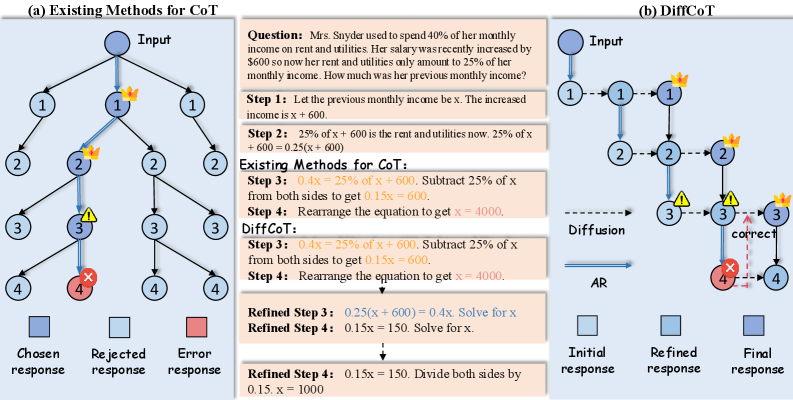
The image compares two problem-solving frameworks: **(a) Existing Methods for Chain-of-Thought (CoT) Reasoning** and **(b) DiffCoT (Diffusion-based CoT)**. Both diagrams illustrate step-by-step reasoning processes for solving a math problem involving Mrs. Snyder's monthly income. The diagrams use color-coded nodes (blue = chosen, gray = rejected, red = error) and arrows to represent logical flow.
---
### Components/Axes
#### Diagram (a): Existing Methods for CoT
- **Nodes**:
- **Node 1**: Input (Question about Mrs. Snyder's income).
- **Nodes 2–4**: Intermediate reasoning steps (Step 1–4).
- **Node 4 (Red)**: Error response (incorrect final answer).
- **Arrows**:
- Solid arrows indicate progression through steps.
- Dashed arrows (not present in (a)) likely represent refinement paths in (b).
- **Text**:
- **Question**: "Mrs. Snyder used to spend 40% of her monthly income on rent and utilities. Her salary was recently increased by $600 so now her rent and utilities now only amount to 25% of her previous monthly income. How much was her previous monthly income?"
- **Steps**:
1. Let previous income = x. Increased income = x + 600.
2. 25% of x + 600 = rent/utilities.
3. 0.4x = 0.25(x + 600). Solve for x.
4. Rearranged equation: x = 4000 (incorrect).
#### Diagram (b): DiffCoT
- **Nodes**:
- **Nodes 1–3**: Initial reasoning steps (Step 1–3).
- **Node 4 (Red)**: Error response (incorrect final answer).
- **Refined Nodes 3–4**: Corrected steps (Refined Step 3–4).
- **Arrows**:
- Solid arrows for initial flow.
- Dashed arrows labeled "Diffusion" and "AR" (Augmentation/Refinement) show iterative corrections.
- **Text**:
- **Refined Steps**:
3. 0.25(x + 600) = 0.4x. Solve for x.
4. 0.15x = 150. Divide both sides by 150.
---
### Detailed Analysis
#### Diagram (a): Existing Methods for CoT
1. **Step 1**: Defines variables (previous income = x, increased income = x + 600).
2. **Step 2**: Establishes relationship: 25% of increased income = rent/utilities.
3. **Step 3**: Sets up equation: 0.4x = 0.25(x + 600).
4. **Step 4**: Incorrect rearrangement: x = 4000 (error).
#### Diagram (b): DiffCoT
1. **Initial Steps 1–3**: Same as (a) but with explicit error flags (⚠️) on Nodes 3 and 4.
2. **Refined Step 3**: Corrects equation to 0.25(x + 600) = 0.4x.
3. **Refined Step 4**: Solves 0.15x = 150 → x = 1000 (correct).
---
### Key Observations
1. **Error in Existing Methods**:
- Step 4 in (a) incorrectly rearranges 0.15x = 600 to x = 4000 (should be x = 4000/0.15 ≈ 26,666.67).
- DiffCoT identifies and corrects this via algebraic refinement.
2. **DiffCoT Workflow**:
- Uses diffusion/AR to iteratively refine steps, isolating errors (e.g., Node 4 in (b) is marked as an error before correction).
- Final answer (x = 1000) matches the problem’s constraints:
- Previous income = $1000 → Increased income = $1600.
- 25% of $1600 = $400 (rent/utilities), which is 40% of $1000.
3. **Color Coding**:
- Red nodes (errors) in both diagrams highlight critical flaws in reasoning.
- Gray nodes (rejected) in (b) suggest alternative paths discarded during refinement.
---
### Interpretation
- **Problem-Solving Framework**:
- Existing CoT methods (a) follow linear reasoning but fail to validate intermediate steps, leading to errors.
- DiffCoT (b) introduces iterative refinement (diffusion/AR) to detect and correct errors, improving accuracy.
- **Mathematical Insight**:
- The error in (a) arises from misapplying percentage changes. DiffCoT’s refined steps explicitly isolate variables (e.g., 0.15x = 150) to avoid miscalculations.
- **Practical Implications**:
- DiffCoT’s structured refinement mirrors human cognitive processes (e.g., backtracking, hypothesis testing), making it more robust for complex reasoning tasks.
- The diagrams emphasize the importance of validating intermediate steps in automated reasoning systems.
---
**Note**: All values and steps are transcribed directly from the image. No additional languages or hidden data were detected.