## Screenshot: YouCook2 Dataset Visualization
### Overview
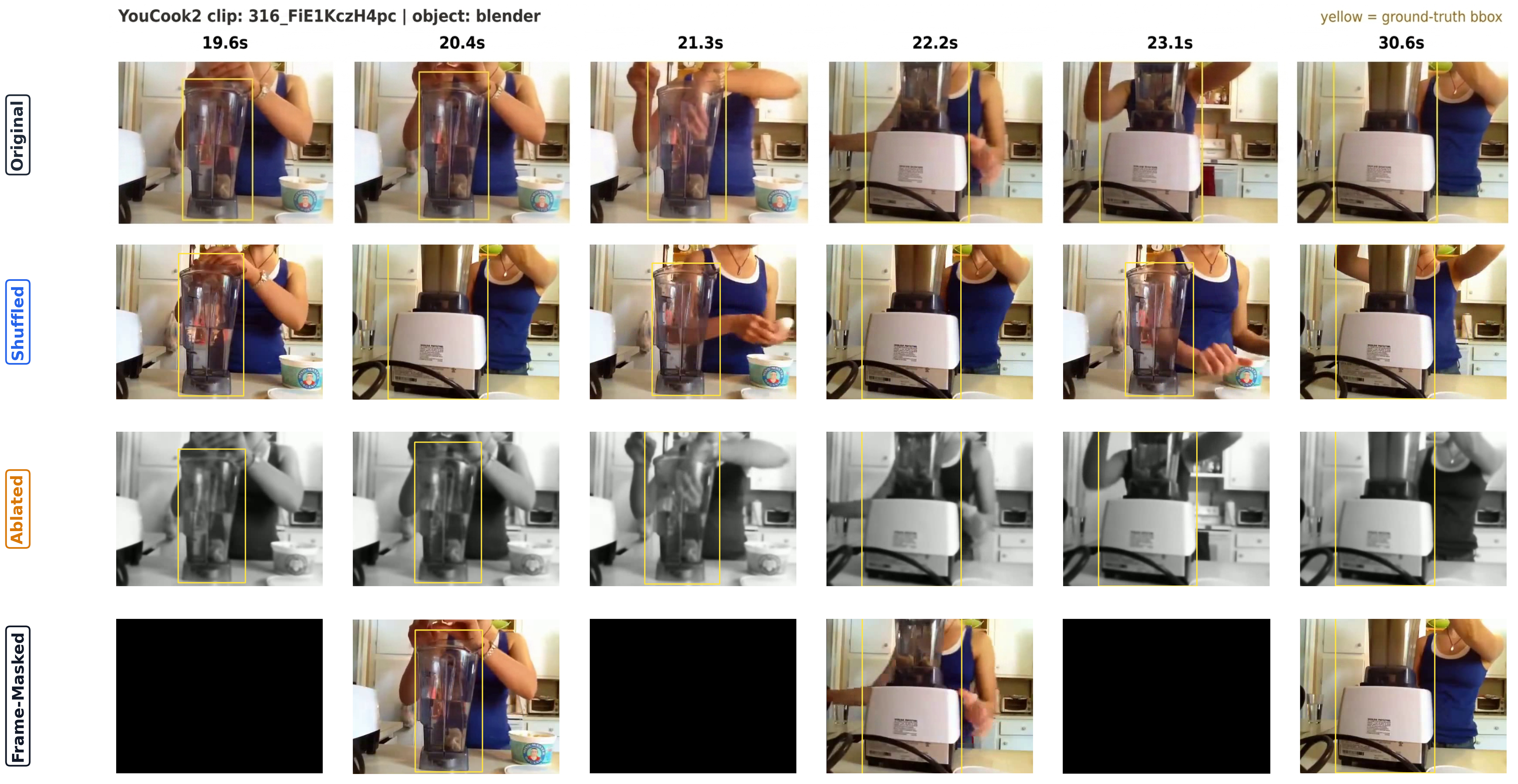
The image displays a sequence of six frames from a video clip (ID: `316_FiE1KczH4pc`) in the YouCook2 dataset, annotated with timestamps (19.6s to 30.6s) and labeled with processing methods. The central object is a blender, and the frames are organized into four rows representing different processing techniques: **Original**, **Shuffled**, **Ablated**, and **Frame-Masked**. Yellow vertical lines indicate the ground-truth bounding box (bbox) for the blender.
### Components/Axes
- **Top Caption**:
- Text: `"YouCook2 clip: 316_FiE1KczH4pc | object: blender"`
- Position: Center-top of the image.
- **Timestamps**:
- Values: `19.6s`, `20.4s`, `21.3s`, `22.2s`, `23.1s`, `30.6s`
- Position: Top of each column, aligned with corresponding frames.
- **Row Labels (Left Side)**:
- **Original**: Blue box with white text.
- **Shuffled**: Orange box with white text.
- **Ablated**: Black box with white text.
- **Frame-Masked**: Black box with white text.
- **Legend**:
- Yellow lines labeled `"yellow = ground-truth bbox"`
- Position: Right side of the image, spanning all rows.
### Detailed Analysis
- **Original Row**:
- Color: Full-color images.
- Content: A person in a blue tank top interacting with a white blender on a kitchen countertop. The blender’s transparent container holds ingredients.
- Ground-truth bbox: Yellow vertical lines align with the blender’s position in each frame.
- **Shuffled Row**:
- Color: Grayscale images.
- Content: Same scene as Original, but with pixelated/shuffled regions outside the blender’s bbox.
- **Ablated Row**:
- Color: Grayscale images.
- Content: Blender and person visible, but background elements (e.g., cabinets, countertop) are blurred or removed.
- **Frame-Masked Row**:
- Color: Black frames for all timestamps except `22.2s` and `23.1s`, where partial blender visibility remains.
- Content: Most frames are entirely black, suggesting object masking.
### Key Observations
1. **Temporal Consistency**: The blender’s position (yellow bbox) remains consistent across Original, Shuffled, and Ablated rows, indicating stable object detection.
2. **Processing Effects**:
- Shuffled: Artifacts outside the bbox suggest data augmentation or noise introduction.
- Ablated: Background simplification implies feature isolation for object-focused analysis.
- Frame-Masked: Selective masking (e.g., `22.2s`, `23.1s`) may test robustness to partial occlusions.
3. **Temporal Gaps**: The Frame-Masked row has missing frames (`19.6s`, `20.4s`, `30.6s`), possibly due to processing limitations.
### Interpretation
This visualization demonstrates how different preprocessing methods affect video analysis for object detection tasks. The **Original** row serves as the ground truth, while **Shuffled** and **Ablated** rows test model resilience to noise and background complexity. The **Frame-Masked** row evaluates handling of occlusions or missing data. The ground-truth bbox (yellow lines) provides a reference for evaluating detection accuracy. Notably, the Frame-Masked row’s incomplete frames suggest potential challenges in real-time processing or edge-case handling.
The dataset’s structure highlights the importance of robust object tracking across varying temporal and spatial conditions, critical for applications like automated cooking tutorials or robotic assistance.