\n
## Diagram: Robot Pathfinding
### Overview
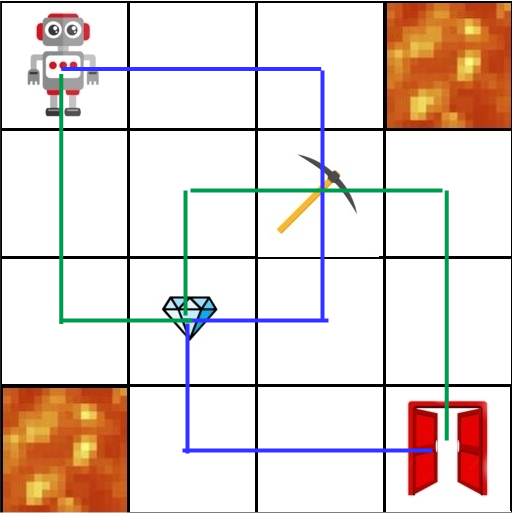
The image depicts a grid-based diagram illustrating a pathfinding scenario. A robot navigates a grid to reach a destination, encountering obstacles and a reward (diamond) along the way. The path is represented by colored lines. The grid is 4x4.
### Components/Axes
The diagram consists of the following elements:
* **Robot:** Located in the top-left corner.
* **Diamond:** Located near the center of the grid.
* **Pickaxe:** Located in the center-right of the grid.
* **Doors:** Located in the bottom-right corner.
* **Obstacles:** Represented by textured blocks (orange/brown) in the top-right and bottom-left corners.
* **Path:** Represented by three colored lines:
* Green Line
* Blue Line
* Red Line
* **Grid:** A 4x4 grid structure.
### Detailed Analysis or Content Details
The diagram shows a robot attempting to navigate a grid. The robot starts at the top-left corner and the goal appears to be the doors in the bottom-right corner. The path is composed of three segments:
1. **Green Line:** Starts at the robot and extends horizontally to the right, then turns downwards.
2. **Blue Line:** Starts at the robot, extends horizontally to the right, then downwards, and finally to the right again.
3. **Red Line:** Starts at the bottom-left obstacle and extends upwards, then to the right, and finally downwards to the doors.
The green line passes near the diamond. The blue line passes near the pickaxe. The red line leads to the doors.
### Key Observations
* The robot's path is not a single continuous line, but rather a combination of three different colored lines.
* The diamond and pickaxe are positioned along the robot's path, suggesting they may be points of interest or interaction.
* The obstacles appear to block direct paths, forcing the robot to navigate around them.
* The red line seems to be a separate path, originating from the bottom-left obstacle.
### Interpretation
This diagram likely represents a simplified model of a robot navigation problem. The robot is tasked with finding a path from its starting location to the doors, potentially collecting the diamond along the way. The different colored lines could represent different strategies or stages of the pathfinding process. The obstacles introduce complexity, requiring the robot to plan its route carefully. The red line originating from the obstacle suggests a possible alternative route or a separate task involving the obstacle. The diagram could be used to illustrate concepts in robotics, artificial intelligence, or pathfinding algorithms. The diagram does not provide any quantitative data, but rather a visual representation of a problem and potential solutions. It is a conceptual illustration rather than a data-driven chart.