## Diagram: Grid-Based Pathfinding with Objects
### Overview
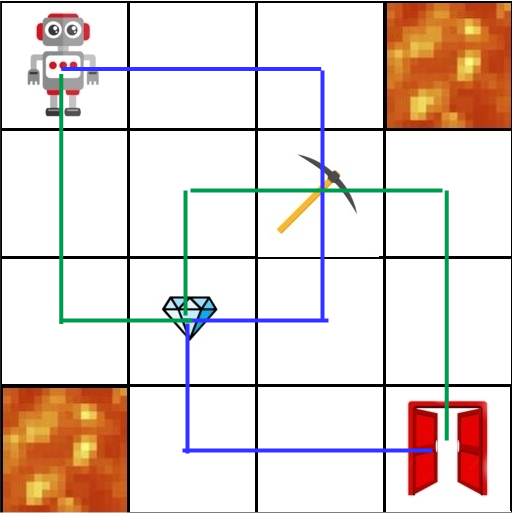
The image displays a 4x4 grid containing various graphical objects and two colored paths (blue and green) connecting them. The diagram appears to illustrate possible routes or connections between a starting point (a robot) and an endpoint (a portal), passing through or around intermediate items (a pickaxe and a diamond) and avoiding obstacles (lava blocks). There are no textual labels, axis titles, or legends present in the image.
### Components/Axes
* **Grid Structure:** A 4x4 grid of white squares with black borders.
* **Objects (by grid position, using (row, column) from top-left):**
* **(1,1):** A grey robot with red accents (headphones, chest light, feet).
* **(1,4):** A block of orange/yellow pixelated lava.
* **(2,3):** A pickaxe with a grey head and a yellow handle.
* **(3,2):** A blue diamond.
* **(4,1):** A second block of orange/yellow pixelated lava.
* **(4,4):** A red nether-style portal frame.
* **Paths:**
* **Blue Path:** A continuous blue line.
* **Green Path:** A continuous green line.
### Detailed Analysis
**Path Tracing and Spatial Grounding:**
1. **Blue Path:**
* **Start:** Originates from the robot at (1,1).
* **Route:** Travels horizontally right across row 1 to column 3. Turns down, traveling vertically down column 3 to row 3. Turns left, traveling horizontally left across row 3 to column 2. Turns down, traveling vertically down column 2 to row 4. Turns right, traveling horizontally right across row 4 to the portal at (4,4).
* **Trend Verification:** The path forms a rectangular detour. It moves right, then down, then left, then down, then right. It does not intersect the pickaxe or diamond directly but passes adjacent to them.
* **Objects Touched:** Starts at robot, ends at portal. Passes through cells (1,2), (1,3), (2,3), (3,3), (3,2), (4,2), (4,3).
2. **Green Path:**
* **Start:** Originates from the robot at (1,1).
* **Route:** Travels vertically down column 1 to row 3. Turns right, traveling horizontally right across row 3 to column 2, intersecting the diamond. Turns up, traveling vertically up column 2 to row 2. Turns right, traveling horizontally right across row 2 to column 3, intersecting the pickaxe. Turns down, traveling vertically down column 3 to row 4. Turns right, traveling horizontally right across row 4 to the portal at (4,4).
* **Trend Verification:** The path forms a more complex, zig-zagging route that actively visits the intermediate items. It moves down, right (to diamond), up, right (to pickaxe), down, then right.
* **Objects Touched:** Starts at robot, intersects the diamond at (3,2), intersects the pickaxe at (2,3), ends at portal. Passes through cells (2,1), (3,1), (3,2), (2,2), (2,3), (3,3), (4,3).
**Object Placement Summary:**
* **Lava Blocks:** Positioned at opposite corners (top-right and bottom-left). Neither path intersects them.
* **Intermediate Items:** The diamond (3,2) and pickaxe (2,3) are positioned such that the green path can connect them in sequence, while the blue path bypasses them.
### Key Observations
1. **Dual Pathways:** Two distinct, non-overlapping paths connect the same start (robot) and end (portal) points.
2. **Path Divergence:** The paths diverge immediately after the start. The blue path takes a wider, outer route, while the green path takes a more central, item-focused route.
3. **Item Interaction:** The green path is the only one that intersects the diamond and the pickaxe. The blue path avoids them.
4. **Obstacle Avoidance:** Both paths successfully navigate around the two lava blocks, which act as static obstacles.
5. **Convergence:** Both paths converge on the final segment, traveling along the bottom row (row 4) from column 3 to the portal at (4,4).
### Interpretation
This diagram is likely a visual representation of a **pathfinding problem or solution**, possibly from a game, puzzle, or algorithmic demonstration.
* **What it Suggests:** It contrasts two strategies for reaching a goal (the portal) from a starting point (the robot).
* The **Blue Path** represents a **direct or efficient route** that minimizes interaction with intermediate objects, possibly prioritizing speed or safety by avoiding the items.
* The **Green Path** represents a **collection or task-oriented route** that deliberately goes out of its way to acquire resources (the diamond) and tools (the pickaxe) before proceeding to the goal. This suggests a trade-off where time or path length is sacrificed to gain advantages.
* **Relationships:** The objects are not random; they form a logical set for a mining/adventure theme (robot, pickaxe, diamond, portal, lava hazard). The paths define the narrative or functional relationship between them.
* **Anomalies/Notable Points:** The precise, grid-aligned paths suggest this is a schematic or logical diagram rather than a free-form illustration. The lack of text implies the visual symbols are meant to be self-explanatory within a specific context (e.g., a game level design, a flowchart for a decision tree). The lava blocks serve as clear boundary constraints for the pathfinding logic.