## Diagram: Grid-Based Pathway with Interactive Elements
### Overview
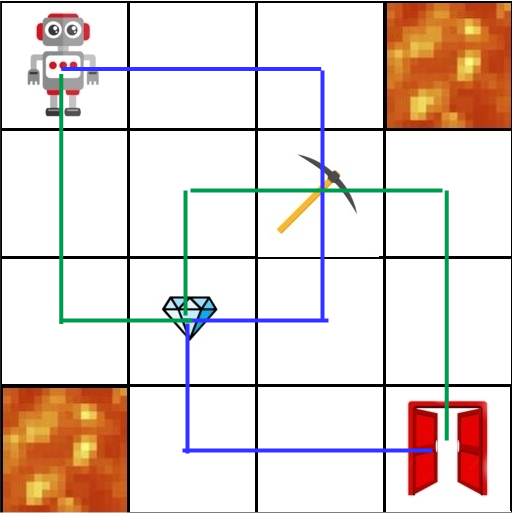
The image depicts a 4x4 grid with a robot, a diamond, a pickaxe, and a door. Blue and green lines connect these elements in a specific sequence, suggesting a pathway or interaction flow. The grid is divided into 16 cells, with some cells containing colored textures (red/yellow) in the top-right and bottom-left corners.
### Components/Axes
- **Grid Structure**: 4x4 grid with black lines separating cells.
- **Elements**:
- **Robot**: Top-left cell (0,0).
- **Diamond**: Center-left cell (1,2).
- **Pickaxe**: Center-right cell (2,2).
- **Door**: Bottom-right cell (3,3).
- **Lines**:
- **Blue Line**: Connects robot (0,0) → diamond (1,2).
- **Green Line**: Connects diamond (1,2) → pickaxe (2,2) → door (3,3).
- **Textures**: Red/yellow pixelated patterns in top-right (0,3) and bottom-left (3,0) cells.
### Detailed Analysis
- **Pathway**: The blue line forms a diagonal from the robot to the diamond, while the green line creates a horizontal-vertical path from the diamond to the door via the pickaxe.
- **Element Placement**:
- Robot (0,0) is isolated from other elements except via the blue line.
- Diamond (1,2) acts as a bridge between the robot and the green pathway.
- Pickaxe (2,2) is positioned midway between the diamond and door.
- Door (3,3) is the endpoint of the green line.
- **Textures**: No labels or annotations are present on the grid or elements.
### Key Observations
- **No Textual Information**: The image contains no labels, legends, or textual annotations.
- **Color Coding**: Blue and green lines differentiate pathways but lack a legend to explain their purpose.
- **Symmetry**: The red/yellow textures in opposite corners (top-right and bottom-left) create visual balance.
### Interpretation
The diagram likely represents a puzzle or game mechanic where the robot must navigate from its starting position to the door, collecting the diamond and pickaxe along the way. The absence of text suggests the elements are self-explanatory, relying on visual cues (e.g., the pickaxe’s position near the door might imply a "digging" action). The red/yellow textures could indicate obstacles, hazards, or special zones, but their purpose is unclear without additional context. The pathway’s structure emphasizes a logical sequence, possibly testing problem-solving or spatial reasoning.