## Chart Type: Box Plot of Agent Performance
### Overview
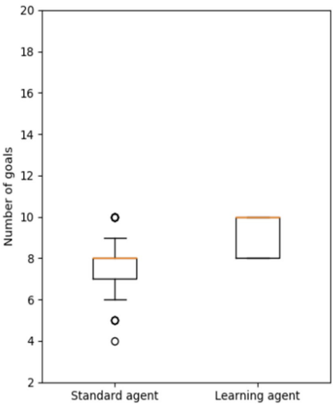
The image displays a box plot comparing the "Number of goals" achieved by two different types of agents: a "Standard agent" and a "Learning agent." The chart provides a visual summary of the distribution of goals for each agent, including their median, interquartile range, whiskers, and any outliers.
### Components/Axes
* **Y-axis Label**: "Number of goals"
* **Y-axis Scale**: Ranges from 2 to 20, with major tick marks at intervals of 2 (2, 4, 6, 8, 10, 12, 14, 16, 18, 20).
* **X-axis Labels**:
* "Standard agent" (positioned below the left box plot)
* "Learning agent" (positioned below the right box plot)
* **Legend**: No explicit legend is present; the categories are labeled directly on the X-axis. The box plots are rendered in white with an orange outline and median line. Outliers are depicted as black circles.
### Detailed Analysis
The chart presents two box plots, one for each agent type:
1. **Standard agent (left box plot)**:
* **Median (orange line inside the box)**: Approximately 7.5 goals.
* **Interquartile Range (IQR - the box)**:
* First Quartile (Q1, bottom of the box): Approximately 7 goals.
* Third Quartile (Q3, top of the box): Approximately 8 goals.
* The IQR is approximately 1 goal (8 - 7).
* **Whiskers**:
* Lower Whisker (bottom line): Approximately 6 goals.
* Upper Whisker (top line): Approximately 9 goals.
* **Outliers (individual black circles)**:
* Lower outliers are present at approximately 4 goals and 5 goals.
* An upper outlier is present at approximately 10 goals.
* **Visual Trend**: The "Standard agent" shows a relatively compact central distribution (IQR) but has several outliers, indicating a wider range of performance including some significantly lower and higher goal counts compared to its typical performance. The data is somewhat skewed, with outliers extending further below the lower whisker than above the upper whisker, relative to the box.
2. **Learning agent (right box plot)**:
* **Median (orange line inside the box)**: Approximately 9 goals.
* **Interquartile Range (IQR - the box)**:
* First Quartile (Q1, bottom of the box): Approximately 8 goals.
* Third Quartile (Q3, top of the box): Approximately 10 goals.
* The IQR is approximately 2 goals (10 - 8).
* **Whiskers**:
* Lower Whisker (bottom line): Approximately 8 goals.
* Upper Whisker (top line): Approximately 10 goals.
* **Outliers**: No outliers are visible for the "Learning agent."
* **Visual Trend**: The "Learning agent" exhibits a higher overall performance, with its entire distribution (from minimum to maximum, including the median and IQR) concentrated between 8 and 10 goals. The box is wider than the "Standard agent's" box, suggesting a slightly larger spread for the middle 50% of the data, but the absence of whiskers extending beyond the box implies that the minimum and maximum values are at the edges of the box (Q1 and Q3 respectively), or that the data is very tightly clustered within this range without extreme values.
### Key Observations
* The "Learning agent" consistently achieves a higher number of goals than the "Standard agent," as indicated by its higher median (9 goals vs. 7.5 goals).
* The "Learning agent" shows a much tighter and more consistent performance range, with all its data points (including min/max) falling between 8 and 10 goals, and no outliers.
* The "Standard agent" exhibits greater variability and less consistent performance, with a lower median and the presence of multiple outliers, ranging from 4 goals to 10 goals.
* The interquartile range (IQR) for the "Learning agent" (2 goals) is slightly wider than that of the "Standard agent" (1 goal), but the overall spread of the "Learning agent" is more constrained due to the lack of outliers.
### Interpretation
The data strongly suggests that the "Learning agent" is a more effective and reliable performer in terms of achieving goals compared to the "Standard agent." The "Learning agent" not only achieves a higher typical number of goals (median of 9 vs. 7.5) but also demonstrates significantly greater consistency, with all its observed performances falling within a narrow band of 8 to 10 goals and no extreme low or high outliers. This indicates a robust and predictable performance.
In contrast, the "Standard agent" shows a lower typical performance and a wider, less predictable range of outcomes. The presence of outliers at 4 and 5 goals suggests that the "Standard agent" can, at times, perform significantly worse than its typical average. While it also has an outlier at 10 goals, matching the "Learning agent's" maximum, its overall distribution is centered lower and is more prone to extreme variations.
From a practical standpoint, if the objective is to maximize the number of goals achieved consistently, the "Learning agent" is clearly superior. Its lack of low-performing outliers makes it a more dependable choice, while the "Standard agent" carries a higher risk of underperforming.