## Image Analysis: Speech Waveforms and Sentiment Analysis
### Overview
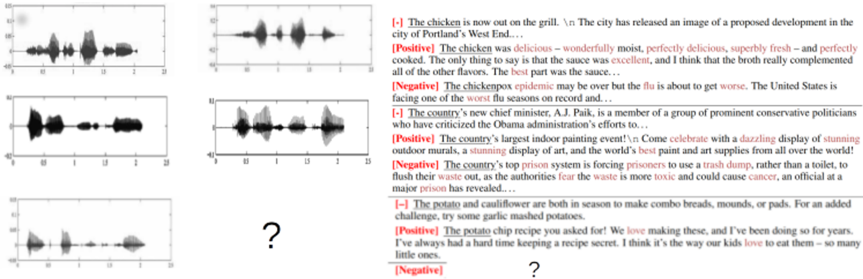
The image presents a combination of speech waveforms and text snippets with sentiment analysis labels. On the left, there are six speech waveform plots. On the right, there are text excerpts, each labeled with a sentiment: neutral (`[-]`), positive (`[Positive]`), or negative (`[Negative]`). The bottom-middle section contains a question mark, indicating missing data.
### Components/Axes
**Left Side: Speech Waveforms**
* **Axes:** Each waveform plot has an x-axis ranging from approximately 0 to 2.5 (likely representing time in seconds) and a y-axis ranging from approximately -0.2 to 0.2 (likely representing amplitude).
* **Waveforms:** Six distinct waveforms are displayed, each representing a different speech segment.
**Right Side: Text Snippets and Sentiment Analysis**
* **Sentiment Labels:** Each text snippet is preceded by a sentiment label: `[-]` (neutral), `[Positive]`, or `[Negative]`.
* **Text Content:** The text snippets are short phrases or sentences related to various topics.
* **Highlighting:** Certain words within the text snippets are highlighted in red, presumably to emphasize the sentiment or key aspects of the statement.
### Detailed Analysis or ### Content Details
**Speech Waveforms (Left Side)**
* **Top Row:**
* Waveform 1: Shows a series of peaks and valleys, with the highest amplitude occurring around 1 second.
* Waveform 2: Similar to waveform 1, but with a slightly different pattern of peaks and valleys.
* **Middle Row:**
* Waveform 3: Shows a more consistent pattern of peaks and valleys, with a relatively high amplitude throughout.
* Waveform 4: Similar to waveform 3, but with a slightly different pattern of peaks and valleys.
* **Bottom Row:**
* Waveform 5: Shows a series of distinct peaks and valleys, with the highest amplitude occurring around 0.5 seconds.
* Waveform 6: Missing.
**Text Snippets and Sentiment Analysis (Right Side)**
* **Snippet 1:**
* Sentiment: `[-]` (Neutral)
* Text: "The chicken is now out on the grill. \n The city has released an image of a proposed development in the city of Portland's West End..."
* **Snippet 2:**
* Sentiment: `[Positive]`
* Text: "The chicken was delicious - wonderfully moist, perfectly delicious, superbly fresh - and perfectly cooked. The only thing to say is that the sauce was excellent, and I think that the broth really complemented all of the other flavors. The best part was the sauce..."
* Highlighted words: "delicious", "excellent"
* **Snippet 3:**
* Sentiment: `[Negative]`
* Text: "The chickenpox epidemic may be over but the flu is about to get worse. The United States is facing one of the worst flu seasons on record and..."
* Highlighted words: "flu", "worse", "worst"
* **Snippet 4:**
* Sentiment: `[-]` (Neutral)
* Text: "The country's new chief minister, A.J. Paik, is a member of a group of prominent conservative politicians who have criticized the Obama administration's efforts to..."
* **Snippet 5:**
* Sentiment: `[Positive]`
* Text: "The country's largest indoor painting event!\n Come celebrate with a dazzling display of stunning outdoor murals, a stunning display of art, and the world's best paint and art supplies from all over the world!"
* Highlighted words: "celebrate", "dazzling", "stunning", "stunning", "best"
* **Snippet 6:**
* Sentiment: `[Negative]`
* Text: "The country's top prison system is forcing prisoners to use a trash dump, rather than a toilet, to flush their waste out, as the authorities fear the waste is more toxic and could cause cancer, an official at a major prison has revealed..."
* Highlighted words: "waste", "fear", "waste", "toxic", "cancer"
* **Snippet 7:**
* Sentiment: `[-]` (Neutral)
* Text: "The potato and cauliflower are both in season to make combo breads, mounds, or pads. For an added challenge, try some garlic mashed potatoes."
* **Snippet 8:**
* Sentiment: `[Positive]`
* Text: "The potato chip recipe you asked for! We love making these, and I've been doing so for years. I've always had a hard time keeping a recipe secret. I think it's the way our kids love to eat them - so many little ones."
* Highlighted words: "love", "love"
* **Snippet 9:**
* Sentiment: `[Negative]`
* Text: Missing.
### Key Observations
* The image combines speech waveforms with sentiment analysis of related text.
* The sentiment analysis labels (Neutral, Positive, Negative) appear to be based on the content of the text snippets.
* The highlighted words in the text snippets seem to be indicators of the sentiment.
* There are missing data points, indicated by the question mark and the missing text snippet.
### Interpretation
The image likely represents an experiment or analysis where speech patterns are being correlated with the sentiment expressed in the spoken words. The waveforms provide a visual representation of the speech, while the sentiment analysis labels provide a classification of the emotional tone of the speech. The highlighted words likely play a key role in the sentiment analysis process. The missing data points suggest that the analysis is incomplete or that some data is unavailable. The image suggests a multimodal approach to understanding human communication, combining acoustic and textual information.