\n
## Diagram: System Flow
### Overview
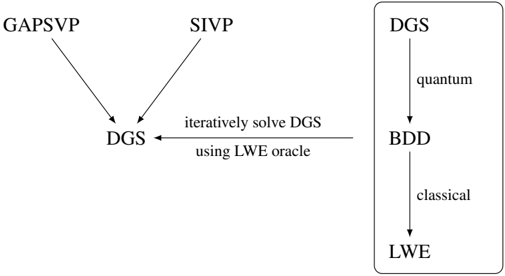
The image depicts a system flow diagram illustrating the relationship between several algorithms and problem-solving approaches. It shows how GAPsvp and SIVP contribute to solving DGS, and how DGS is related to BDD and LWE. The diagram uses arrows to indicate the direction of influence or dependency.
### Components/Axes
The diagram consists of the following components:
* **GAPsvp:** An algorithm or method.
* **SIVP:** An algorithm or method.
* **DGS:** A problem or algorithm.
* **BDD:** A problem or algorithm.
* **LWE:** A problem or algorithm.
* **"iteratively solve DGS using LWE oracle"**: A process description.
* **"quantum"**: A descriptor of DGS.
* **"classical"**: A descriptor of BDD.
### Detailed Analysis or Content Details
The diagram shows the following relationships:
1. **GAPsvp** and **SIVP** both contribute to **DGS**. Each has a single arrow pointing to DGS.
2. **DGS** is iteratively solved using an **LWE oracle**. This is indicated by an arrow pointing from the right side of the diagram to DGS, with the text "iteratively solve DGS using LWE oracle" along the arrow.
3. **DGS** is related to **BDD**, with an arrow pointing from DGS to BDD. The label "quantum" is associated with DGS in this context.
4. **BDD** is related to **LWE**, with an arrow pointing from BDD to LWE. The label "classical" is associated with BDD in this context.
### Key Observations
The diagram suggests a hierarchical relationship between the components. GAPsvp and SIVP are inputs to DGS, which in turn influences BDD and ultimately LWE. The labels "quantum" and "classical" suggest that DGS and BDD operate under different computational paradigms. The iterative solving of DGS using an LWE oracle indicates a dependency on LWE for solving DGS.
### Interpretation
This diagram likely represents a computational process or a theoretical framework in cryptography or computational complexity. GAPsvp and SIVP are likely algorithms used to approach the DGS problem. The iterative solving of DGS using an LWE oracle suggests that LWE (Learning With Errors) is a crucial component in solving DGS. The connection between DGS, BDD (Binary Decision Diagram), and LWE indicates a possible reduction or relationship between these problems. The "quantum" and "classical" labels suggest that DGS might have quantum algorithmic solutions, while BDD is more commonly associated with classical computation. The diagram illustrates a flow of information or computation, where GAPsvp and SIVP feed into DGS, which is then used to influence BDD and ultimately LWE. The diagram doesn't provide specific data or numerical values, but rather a conceptual overview of the relationships between these components.