## Diagram: Cryptographic Problem Reduction Flowchart
### Overview
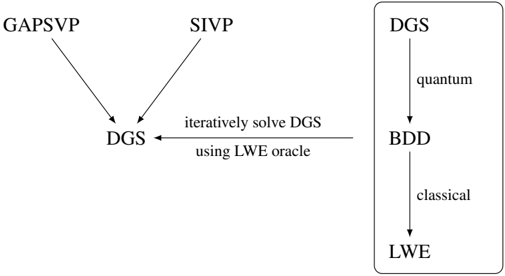
The image is a technical flowchart illustrating relationships and reduction pathways between several computational problems in lattice-based cryptography. It depicts how certain problems relate to or can be solved via others, highlighting both classical and quantum computational steps.
### Components/Axes
The diagram consists of two main sections:
1. **Left Section (Problem Reductions):**
* **Top Nodes:** Two acronyms are positioned at the top: `GAPSVP` (top-left) and `SIVP` (top-center).
* **Central Node:** The acronym `DGS` is positioned below and between the two top nodes.
* **Arrows:** Two arrows point downward from `GAPSVP` and `SIVP` to `DGS`, indicating a reduction or relationship where these problems lead to or are connected to `DGS`.
* **Process Arrow:** A horizontal arrow points from `DGS` to the right section. It is labeled with the text: `iteratively solve DGS using LWE oracle`.
2. **Right Section (Solution Pathway):**
* **Container:** This section is enclosed within a vertical rectangle.
* **Vertical Flow:** A sequence of three acronyms connected by downward arrows:
* `DGS` (top of the rectangle)
* An arrow labeled `quantum` points from `DGS` to `BDD`.
* `BDD` (middle of the rectangle)
* An arrow labeled `classical` points from `BDD` to `LWE`.
* `LWE` (bottom of the rectangle)
**Language:** All text in the diagram is in English.
### Detailed Analysis
The flowchart defines a specific algorithmic or theoretical pathway:
1. **Problem Origins:** The problems `GAPSVP` (likely Gap Shortest Vector Problem) and `SIVP` (Shortest Independent Vectors Problem) are shown as foundational problems that relate to or reduce to `DGS` (likely Discrete Gaussian Sampling).
2. **Core Process:** The central `DGS` problem is then addressed via an iterative process that utilizes an oracle for `LWE` (Learning With Errors). This is indicated by the horizontal arrow.
3. **Solution Pathway:** The right-hand box details a specific method for solving `DGS`:
* A **quantum** computational step transforms the `DGS` problem into a `BDD` (likely Bounded Distance Decoding) problem.
* A subsequent **classical** computational step solves the `BDD` problem, which in turn relates to or solves the `LWE` problem.
### Key Observations
* The diagram distinguishes between **quantum** and **classical** computational steps, placing the quantum step earlier in the solution chain for `DGS`.
* `LWE` appears in two contexts: as the oracle used to iteratively solve `DGS` (left side) and as the final output of the classical solution step (right side). This suggests `LWE` is both a tool and a target problem within this framework.
* The layout spatially separates the general problem relationships (left) from a specific, stepwise solution pathway (right).
### Interpretation
This diagram maps a reduction chain in lattice-based cryptography, a field crucial for post-quantum cryptography. It suggests a theoretical approach where solving the core problem of Discrete Gaussian Sampling (`DGS`)—which is connected to hard lattice problems like `GAPSVP` and `SIVP`—can be approached by leveraging an `LWE` oracle. Furthermore, it outlines a concrete method where a quantum algorithm reduces `DGS` to `BDD`, which is then solvable by a classical algorithm, ultimately connecting back to `LWE`.
The flow implies that `LWE` is a central, versatile problem: it can act as an oracle to help solve other problems (`DGS`), and it can also be the end result of solving a chain that starts with `DGS`. The inclusion of a quantum step highlights the diagram's relevance to analyzing security against both classical and quantum adversaries. The overall message is one of interconnectedness between fundamental lattice problems and the pathways (involving both quantum and classical resources) to solve them.