## Diagram: Computational Framework for DGS Solving
### Overview
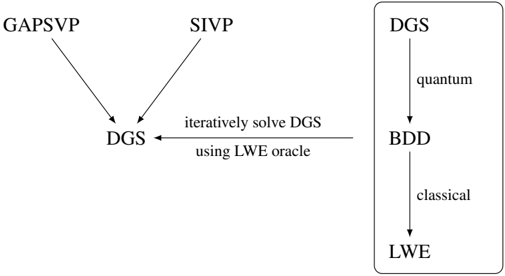
The diagram illustrates a computational framework involving two interconnected sections. The left section shows inputs (GapsVP and SIVP) feeding into a central component (DGS), which iteratively solves using an LWE oracle. The right section depicts a vertical flow from DGS through quantum, BDD, classical, and LWE components.
### Components/Axes
- **Left Section**:
- **GapsVP**: Input component.
- **SIVP**: Input component.
- **DGS**: Central component receiving inputs from GapsVP and SIVP.
- **LWE Oracle**: Tool used iteratively to solve DGS.
- **Right Section**:
- **DGS**: Central component (shared with left section).
- **Quantum**: Sub-component following DGS.
- **BDD**: Sub-component following quantum.
- **Classical**: Sub-component following BDD.
- **LWE**: Final sub-component in the vertical flow.
### Detailed Analysis
- **Left Section Flow**:
- Arrows indicate GapsVP and SIVP directly feed into DGS.
- DGS is labeled as "iteratively solve DGS using LWE oracle," suggesting a feedback loop or repeated computation.
- **Right Section Flow**:
- DGS leads to "quantum," then "BDD," "classical," and finally "LWE."
- Vertical arrows imply a sequential or hierarchical relationship between these components.
### Key Observations
1. **Central Role of DGS**: DGS acts as a bridge between the left and right sections, integrating inputs (GapsVP, SIVP) and driving the right-side flow.
2. **Iterative Process**: The explicit mention of "iteratively solve DGS" highlights a computational loop involving the LWE oracle.
3. **Quantum to Classical Transition**: The right section transitions from "quantum" to "classical," possibly indicating a shift in computational paradigms.
4. **LWE as Terminal Component**: LWE appears at the end of both the iterative solving (left) and the vertical flow (right), suggesting its foundational role.
### Interpretation
The diagram represents a hybrid computational model where:
- **Inputs (GapsVP, SIVP)** contribute to solving a core problem (DGS) through iterative quantum-classical interactions.
- The **LWE oracle** serves as a critical tool for solving DGS, implying a reliance on lattice-based cryptographic assumptions.
- The right-side flow (quantum → BDD → classical → LWE) may reflect stages in a hybrid algorithm, where quantum methods are combined with classical techniques (BDD) and lattice-based cryptography (LWE).
- The iterative nature of DGS solving suggests optimization or refinement processes, possibly for cryptographic or optimization problems.
This framework likely models a post-quantum cryptographic system or a hybrid algorithm leveraging quantum and classical resources, with LWE as a foundational security or computational primitive.