## Diagram: Attention Mechanism Architectures Comparison
### Overview
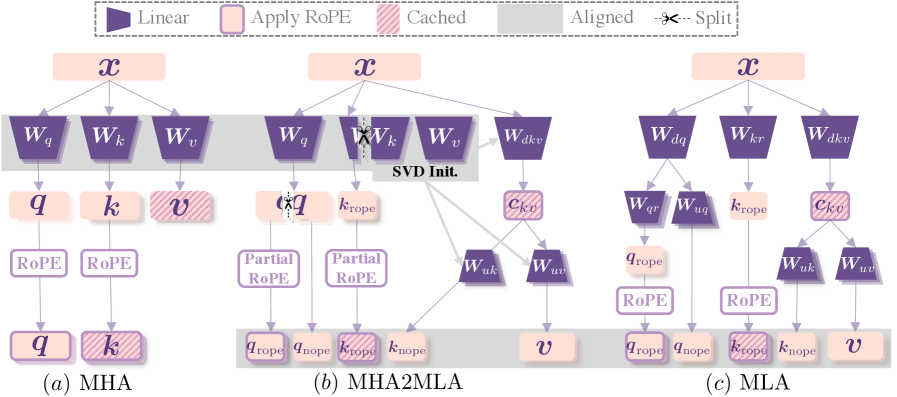
The diagram illustrates three attention mechanism architectures: (a) MHA (Multi-Head Attention), (b) MHA2MLA (Multi-Head Attention to Multi-Layer Attention), and (c) MLA (Multi-Layer Attention). Each architecture is represented as a flow of operations with labeled components, weights, and transformations. The legend at the top defines symbols for operations (e.g., Linear, Apply RoPE, Cached, Aligned, Split).
### Components/Axes
- **Legend**:
- **Linear**: Purple trapezoid (e.g., `W_q`, `W_k`, `W_v`).
- **Apply RoPE**: Pink square with stripes (e.g., `RoPE` blocks).
- **Cached**: Purple square with diagonal stripes (e.g., `C_kv`).
- **Aligned**: Gray rectangle (e.g., `Aligned` blocks).
- **Split**: Scissors icon (e.g., `Split` operations).
- **Key Elements**:
- **Input**: `x` (top-left of each architecture).
- **Weights**: `W_q`, `W_k`, `W_v`, `W_dq`, `W_dk`, `W_dv`, `W_qr`, `W_qk`, `W_uk`, `W_uv`.
- **Operations**:
- `RoPE` (Rotary Positional Encoding).
- `Partial RoPE` (applied selectively).
- `C_kv` (Cached key-value pairs).
- `Split` (divides data streams).
### Detailed Analysis
#### (a) MHA (Multi-Head Attention)
1. **Flow**:
- `x` → Linear projections (`W_q`, `W_k`, `W_v`) → `RoPE` applied to `q` and `k` → Output `q`, `k`.
2. **Components**:
- Standard attention weights (`W_q`, `W_k`, `W_v`).
- Full `RoPE` applied to both `q` and `k`.
#### (b) MHA2MLA (Multi-Head to Multi-Layer Attention)
1. **Flow**:
- `x` → Linear projections (`W_q`, `W_k`, `W_v`) → Partial `RoPE` applied to `q` and `k` → Split into `q_rope`, `q_nope`, `k_rope`, `k_nope`.
- `C_kv` (Cached `k` and `v`) → `W_uk`, `W_uv` → `k_rope`, `k_nope`, `v`.
2. **Components**:
- Partial `RoPE` applied only to `q_rope` and `k_rope`.
- Cached `C_kv` reused for efficiency.
- Additional weights (`W_uk`, `W_uv`) for residual connections.
#### (c) MLA (Multi-Layer Attention)
1. **Flow**:
- `x` → Linear projections (`W_dq`, `W_dk`, `W_dv`) → `RoPE` applied to `q_rope` and `k_rope` → Split into `q_rope`, `q_nope`, `k_rope`, `k_nope`, `v`.
- `C_kv` (Cached `k` and `v`) → `W_qr`, `W_qk`, `W_uk`, `W_uv` → Final `q`, `k`, `v`.
2. **Components**:
- Deeper linear projections (`W_dq`, `W_dk`, `W_dv`).
- Full `RoPE` applied to `q_rope` and `k_rope`.
- Multiple cached streams (`C_kv`) and residual weights.
### Key Observations
1. **Efficiency Improvements**:
- MHA2MLA and MLA introduce **partial RoPE** and **caching** to reduce computational overhead.
- MLA further optimizes by splitting and reusing cached `k`/`v` pairs.
2. **Architectural Complexity**:
- MLA has the most components (e.g., `W_dq`, `W_dk`, `W_dv`), suggesting deeper processing layers.
- MHA2MLA bridges MHA and MLA with hybrid operations.
3. **Symbol Consistency**:
- All `RoPE` operations are marked with pink stripes.
- Cached components (`C_kv`) use diagonal stripes.
### Interpretation
The diagram demonstrates a progression from basic MHA to more efficient MHA2MLA and MLA architectures. By introducing **partial RoPE** and **caching**, MHA2MLA reduces redundant computations while maintaining positional encoding benefits. MLA further optimizes by splitting and reusing cached data, likely improving memory efficiency and scalability. The use of **residual connections** (e.g., `W_uk`, `W_uv`) suggests an emphasis on gradient flow and model stability. These modifications align with trends in transformer optimization for large-scale models, balancing accuracy and computational cost.