## Comparison of Symbolic AI and Large Language Models (LLMs)
### Overview
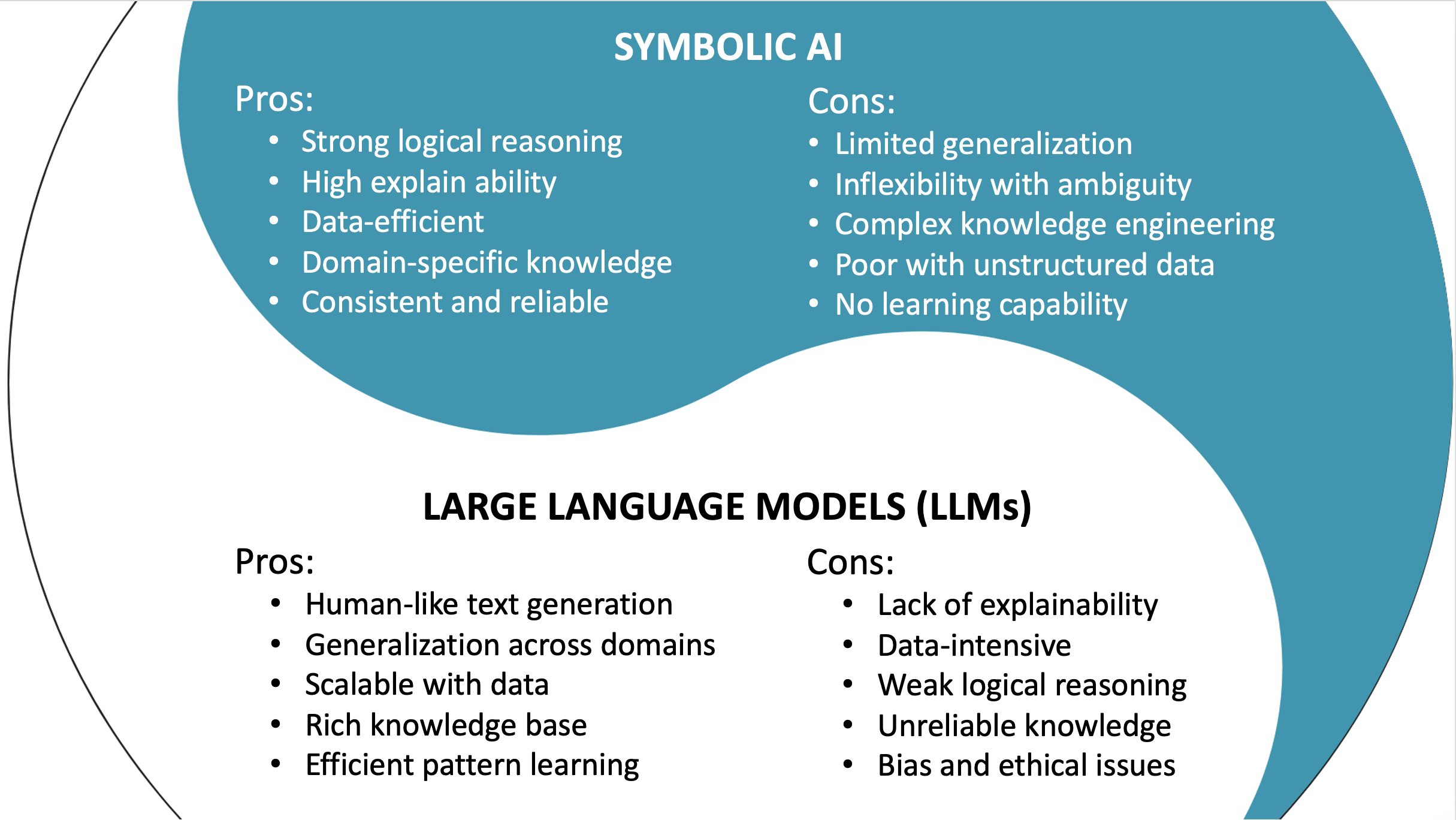
The image presents a comparison of Symbolic AI and Large Language Models (LLMs), outlining the pros and cons of each approach. The information is visually organized with each AI type having its own section, further divided into advantages (Pros) and disadvantages (Cons).
### Components/Axes
* **Title:** SYMBOLIC AI, LARGE LANGUAGE MODELS (LLMs)
* **Categories:** Pros, Cons
* **Layout:** The image is divided into two main sections, one for Symbolic AI and one for Large Language Models (LLMs). Each section is further divided into "Pros" and "Cons" lists. The background is a teal color.
### Detailed Analysis or ### Content Details
**SYMBOLIC AI**
* **Pros:**
* Strong logical reasoning
* High explain ability
* Data-efficient
* Domain-specific knowledge
* Consistent and reliable
* **Cons:**
* Limited generalization
* Inflexibility with ambiguity
* Complex knowledge engineering
* Poor with unstructured data
* No learning capability
**LARGE LANGUAGE MODELS (LLMs)**
* **Pros:**
* Human-like text generation
* Generalization across domains
* Scalable with data
* Rich knowledge base
* Efficient pattern learning
* **Cons:**
* Lack of explainability
* Data-intensive
* Weak logical reasoning
* Unreliable knowledge
* Bias and ethical issues
### Key Observations
* Symbolic AI excels in logical reasoning, explainability, and data efficiency, but struggles with generalization, ambiguity, and unstructured data.
* LLMs are strong in text generation, generalization, and scalability, but are weak in explainability, logical reasoning, and can suffer from bias and ethical issues.
### Interpretation
The image provides a concise comparison of two distinct approaches to AI. Symbolic AI, with its emphasis on explicit rules and knowledge representation, offers advantages in situations requiring strong logical reasoning and explainability. However, its limitations in handling unstructured data and generalizing to new situations make it less suitable for certain applications.
LLMs, on the other hand, leverage vast amounts of data to learn patterns and generate human-like text. Their ability to generalize across domains and scale with data makes them powerful tools for a wide range of tasks. However, their lack of explainability, potential for bias, and reliance on large datasets raise concerns about their reliability and ethical implications.
The comparison highlights the trade-offs between these two approaches, suggesting that the choice of AI technique depends on the specific requirements and constraints of the application.