\n
## Diagram: Symbolic AI vs. Large Language Models (LLMs)
### Overview
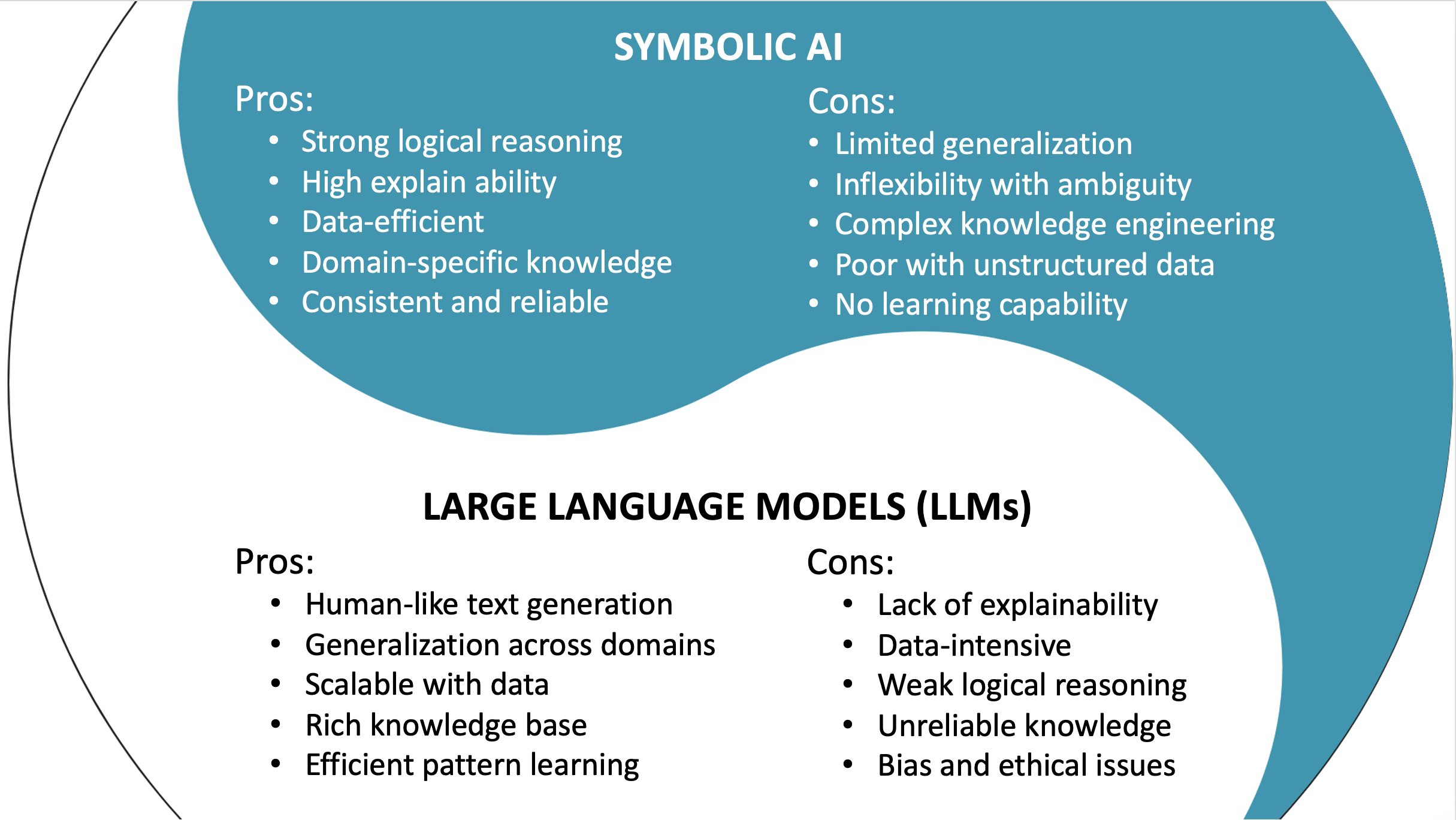
This diagram visually compares and contrasts Symbolic AI and Large Language Models (LLMs) by listing their respective pros and cons. The diagram uses two overlapping circles, one representing Symbolic AI (teal) and the other representing LLMs (coral), to highlight areas of strength and weakness for each approach.
### Components/Axes
The diagram consists of two main sections, each dedicated to one AI approach. Each section is further divided into "Pros" and "Cons" lists. There are no explicit axes in the traditional sense, but the diagram uses spatial arrangement to convey relationships.
### Content Details
**Symbolic AI (Teal Circle - Top)**
* **Pros:**
* Strong logical reasoning
* High explainability
* Data-efficient
* Domain-specific knowledge
* Consistent and reliable
* **Cons:**
* Limited generalization
* Inflexibility with ambiguity
* Complex knowledge engineering
* Poor with unstructured data
* No learning capability
**Large Language Models (LLMs) (Coral Circle - Bottom)**
* **Pros:**
* Human-like text generation
* Generalization across domains
* Scalable with data
* Rich knowledge base
* Efficient pattern learning
* **Cons:**
* Lack of explainability
* Data-intensive
* Weak logical reasoning
* Unreliable knowledge
* Bias and ethical issues
### Key Observations
The diagram highlights a trade-off between the two approaches. Symbolic AI excels in areas requiring precision and explainability but struggles with adaptability and unstructured data. LLMs, conversely, are strong in generalization and pattern recognition but lack the logical rigor and reliability of Symbolic AI. The overlapping area suggests potential for integration or hybrid approaches.
### Interpretation
The diagram presents a comparative analysis of two distinct paradigms in artificial intelligence. Symbolic AI, representing the earlier approach, relies on explicitly programmed rules and knowledge representation. Its strengths lie in its transparency and ability to provide verifiable reasoning. However, it is brittle and requires significant manual effort to adapt to new situations.
LLMs, a more recent development, leverage massive datasets and statistical learning to generate human-like text and perform various language-based tasks. Their power comes from their ability to learn complex patterns from data, but this comes at the cost of explainability and potential biases.
The diagram implicitly suggests that neither approach is inherently superior. The choice between them depends on the specific application and the relative importance of factors like explainability, adaptability, and data availability. The overlapping circles hint at the possibility of combining the strengths of both approaches to create more robust and versatile AI systems. The diagram is a high-level overview and does not delve into the technical details of each approach. It serves as a conceptual framework for understanding their key characteristics and trade-offs.