\n
## Diagram: Comparison of Symbolic AI and Large Language Models (LLMs)
### Overview
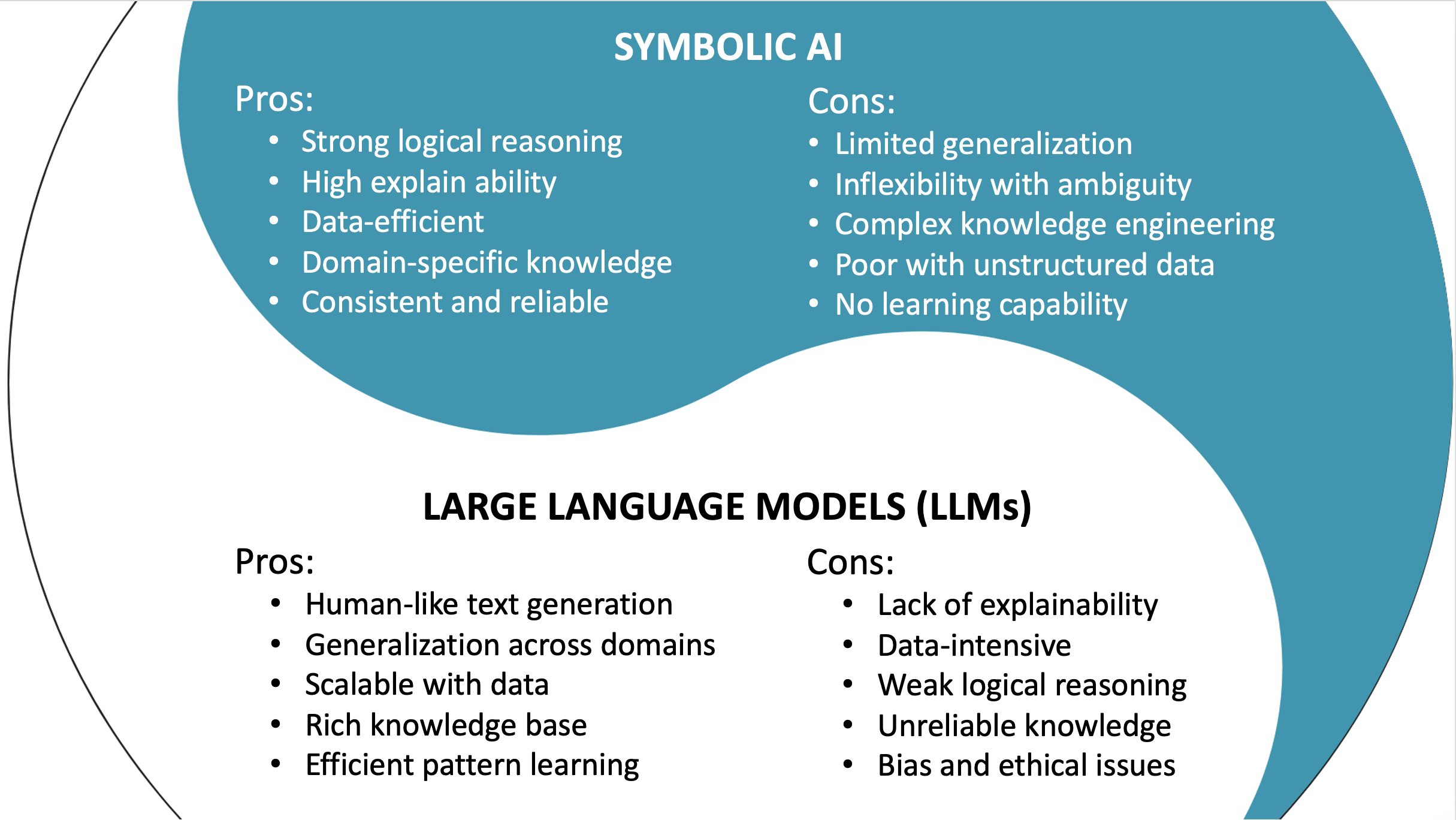
The image is a conceptual diagram comparing two paradigms in artificial intelligence: Symbolic AI and Large Language Models (LLMs). It presents the advantages (Pros) and disadvantages (Cons) of each approach in a side-by-side list format, visually separated by curved shapes.
### Components/Axes
The diagram is divided into two primary sections:
1. **Top Section (Teal Background):** Labeled "SYMBOLIC AI" in white, centered text at the top.
2. **Bottom Section (White Background):** Labeled "LARGE LANGUAGE MODELS (LLMs)" in black, centered text.
Each section contains two columns of bullet points:
* **Left Column:** Titled "Pros:" listing advantages.
* **Right Column:** Titled "Cons:" listing disadvantages.
### Detailed Analysis / Content Details
**1. SYMBOLIC AI (Top, Teal Section)**
* **Pros:**
* Strong logical reasoning
* High explainability
* Data-efficient
* Domain-specific knowledge
* Consistent and reliable
* **Cons:**
* Limited generalization
* Inflexibility with ambiguity
* Complex knowledge engineering
* Poor with unstructured data
* No learning capability
**2. LARGE LANGUAGE MODELS (LLMs) (Bottom, White Section)**
* **Pros:**
* Human-like text generation
* Generalization across domains
* Scalable with data
* Rich knowledge base
* Efficient pattern learning
* **Cons:**
* Lack of explainability
* Data-intensive
* Weak logical reasoning
* Unreliable knowledge
* Bias and ethical issues
### Key Observations
* **Direct Opposition:** The pros and cons of each paradigm are largely direct opposites of the other's strengths. For example, Symbolic AI's "Strong logical reasoning" contrasts with LLMs' "Weak logical reasoning," and LLMs' "Generalization across domains" contrasts with Symbolic AI's "Limited generalization."
* **Visual Segregation:** The use of a solid teal background for Symbolic AI and a plain white background for LLMs creates a strong visual separation, emphasizing they are distinct, non-overlapping approaches in this representation.
* **Textual Consistency:** All text is presented in clear, sans-serif fonts. The "Pros:" and "Cons:" headers are in a slightly larger or bolder font than the bullet points.
### Interpretation
This diagram serves as a high-level, pedagogical comparison to illustrate the fundamental trade-offs between classical, rule-based AI (Symbolic) and modern, statistical, data-driven AI (LLMs).
* **Complementary Strengths:** The data suggests that neither approach is universally superior. Symbolic AI excels in controlled, logical domains where explainability and precision are critical (e.g., formal verification, expert systems). LLMs excel in open-ended, unstructured domains requiring flexibility and broad knowledge (e.g., conversation, content creation).
* **Core Tension:** The diagram highlights the central tension in AI development between **interpretability/control** (Symbolic AI) and **flexibility/scale** (LLMs). The "Cons" list for each points to the primary challenges researchers face when trying to improve or hybridize these systems.
* **Implied Need for Hybridization:** By laying out these complementary weaknesses and strengths so clearly, the diagram implicitly argues for the potential of neuro-symbolic AI—a field aiming to combine the learning and generalization of neural networks (like LLMs) with the reasoning and explainability of symbolic systems.
* **Pedagogical Tool:** The clean, list-based format is designed for quick comprehension, making it effective for educational materials or introductory presentations to contrast these two major AI paradigms.