\n
## Diagram: Chemical Retrosynthesis & Propositional Logic
### Overview
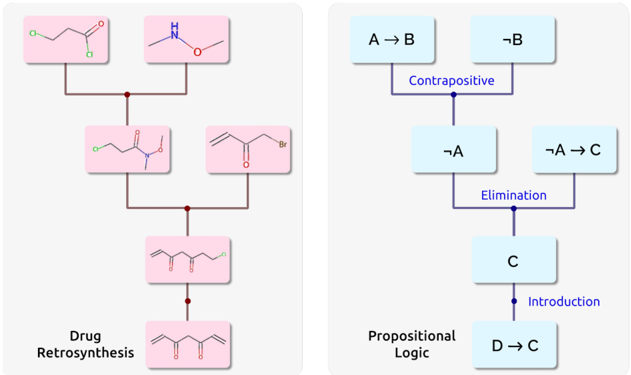
The image presents two diagrams side-by-side. The left diagram illustrates a chemical retrosynthesis process, showing a series of reactions leading to simpler precursor molecules. The right diagram depicts a logical deduction process using propositional logic rules. Both diagrams use a flowchart-like structure with boxes representing compounds or logical statements and arrows indicating transformations or inferences.
### Components/Axes
**Left Diagram (Drug Retrosynthesis):**
* **Compounds:** The diagram features several organic molecules represented by their structural formulas. These include:
* Butanoic acid with a chlorine substituent (C₄H₇ClO₂)
* Ammonia (NH₃)
* An intermediate compound with a longer carbon chain and a ketone group.
* A brominated alkene.
* A diene.
* A final product, a conjugated diene.
* **Arrows:** Arrows connect the compounds, indicating a retrosynthetic step (breaking down a complex molecule into simpler precursors).
* **Label:** "Drug Retrosynthesis" is located at the bottom-left corner.
**Right Diagram (Propositional Logic):**
* **Logical Statements:** The diagram contains propositional statements:
* A → B (A implies B)
* ¬B (Not B)
* ¬A (Not A)
* ¬A → C (Not A implies C)
* C
* D → C (D implies C)
* **Inference Rules:** Labels on the arrows indicate the logical rules applied:
* "Contrapositive"
* "Elimination"
* "Introduction"
* **Label:** "Propositional Logic" is located at the bottom-right corner.
### Detailed Analysis or Content Details
**Left Diagram (Drug Retrosynthesis):**
The retrosynthesis starts with a complex molecule (the final product) and proceeds upwards, breaking it down into simpler precursors.
1. The final product (a conjugated diene) is derived from a precursor diene.
2. The diene is derived from a brominated alkene.
3. The brominated alkene is derived from an intermediate ketone compound.
4. The ketone compound is derived from butanoic acid with a chlorine substituent and ammonia.
**Right Diagram (Propositional Logic):**
The logical deduction proceeds as follows:
1. Starting with A → B and ¬B, the "Contrapositive" rule is applied to derive ¬A.
2. Starting with ¬A and ¬A → C, the "Elimination" rule is applied to derive C.
3. Finally, starting with C, the "Introduction" rule is applied to derive D → C.
### Key Observations
* The retrosynthesis diagram demonstrates a stepwise simplification of a molecule, a common strategy in organic chemistry for designing synthetic routes.
* The propositional logic diagram illustrates a valid logical argument, demonstrating how conclusions can be derived from premises using established inference rules.
* The diagrams are visually similar in their structure, both employing a top-down flow with boxes and arrows.
### Interpretation
The image juxtaposes two distinct but related problem-solving approaches: chemical synthesis and logical deduction. The retrosynthesis diagram represents a "backward" reasoning process, starting with a target molecule and working backward to identify suitable starting materials. This is analogous to the logical deduction process, where one starts with known premises and uses inference rules to arrive at a conclusion. The use of arrows in both diagrams signifies a transformation or inference, highlighting the dynamic nature of both processes. The diagrams demonstrate how structured reasoning can be applied to both scientific and abstract domains. The "Drug Retrosynthesis" label suggests a practical application of the chemical retrosynthesis process, while the "Propositional Logic" label indicates a more theoretical framework. The diagrams are not providing quantitative data, but rather illustrating a process or methodology.