## Diagram: Game Mechanics Annotation - Flappy Bird Style
### Overview
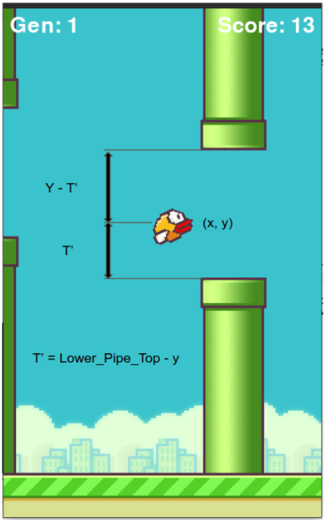
This image is a screenshot from a video game, likely a clone or variant of "Flappy Bird," with technical annotations overlaid to explain the game's coordinate system and a key variable used in its mechanics. The scene depicts the player-controlled bird character navigating between two green pipes. Textual annotations define variables related to the bird's vertical position relative to the pipes.
### Components/Axes
The image is segmented into three primary regions:
1. **Header (Top Bar):**
* **Top-Left:** Text "Gen: 1". This likely stands for "Generation 1," suggesting this screenshot is from an AI training or evolutionary algorithm context.
* **Top-Right:** Text "Score: 13". This indicates the player's current score.
2. **Main Game Scene (Center):**
* **Background:** A light blue sky with white, stylized clouds at the bottom and a faint city skyline silhouette.
* **Foreground Elements:**
* **Pipes:** Two large, vertical green pipes with darker green rims. One descends from the top edge, and one ascends from the bottom edge, creating a gap.
* **Ground:** A green, grassy strip at the very bottom.
* **Player Character:** A small, cartoon bird (red body, yellow wing, white eye) positioned in the gap between the pipes.
* **Annotations (Overlaid Text & Lines):**
* **(x, y):** Placed to the right of the bird, indicating its coordinates in the game's 2D space.
* **Vertical Measurement Lines:** Two black vertical lines with arrows are drawn to the left of the bird.
* The upper line spans from the bird's vertical center to the bottom edge of the top pipe. It is labeled **"Y - T'"**.
* The lower line spans from the bird's vertical center to the top edge of the bottom pipe. It is labeled **"T'"**.
* **Formula:** Located in the lower-left quadrant of the scene, the text reads: **"T' = Lower_Pipe_Top - y"**.
3. **Footer (Bottom):** The grassy ground strip, with no additional text.
### Detailed Analysis
* **Text Transcription (All text is in English):**
* "Gen: 1"
* "Score: 13"
* "Y - T'"
* "(x, y)"
* "T'"
* "T' = Lower_Pipe_Top - y"
* **Variable Definitions (Inferred from annotations):**
* `(x, y)`: The bird's current position coordinates.
* `Lower_Pipe_Top`: The y-coordinate of the top edge of the lower pipe.
* `T'`: A derived variable representing the vertical distance from the bird's center (`y`) to the top of the lower pipe (`Lower_Pipe_Top`). The formula confirms this: `T' = Lower_Pipe_Top - y`.
* `Y`: Likely represents the y-coordinate of the bottom edge of the upper pipe (though not explicitly defined in text, it is implied by the measurement line labeled "Y - T'").
* `Y - T'`: Therefore, represents the vertical distance from the bird's center to the bottom of the upper pipe.
### Key Observations
1. **Purpose of Annotations:** The diagram is not merely a gameplay screenshot but a technical illustration. It visually defines `T'` as a critical input variable, likely for an AI agent or a game physics calculation. `T'` measures how "low" the bird is within the pipe gap.
2. **Spatial Grounding:** The annotations are precisely placed. The measurement lines are anchored to the bird's center and the relevant pipe edges, making the geometric relationships clear.
3. **Game State:** The "Gen: 1" and "Score: 13" suggest this is an early generation of an AI agent that has achieved a moderate score, and the diagram is explaining the sensory input it receives.
### Interpretation
This image serves as a **technical specification for a game state representation**. It translates the visual scene into a mathematical model suitable for computation.
* **What the data suggests:** The core mechanic being explained is the bird's vertical positioning relative to the obstacle gap. The variable `T'` is highlighted as a primary input. A small `T'` means the bird is close to the lower pipe (risking a crash), while a large `T'` means it is closer to the upper pipe. The value `Y - T'` provides complementary information about proximity to the upper pipe.
* **How elements relate:** The header ("Gen", "Score") provides context for the experiment or run. The main scene shows the raw visual input. The annotations overlay the **feature extraction** process, converting pixels into a simplified, actionable state vector `(T', Y - T', possibly x)`.
* **Notable implications:** This is a classic setup for reinforcement learning or evolutionary algorithms applied to games. The agent's "brain" would use `T'` and related values to decide when to "flap." The diagram effectively bridges the gap between the game's visual output and the agent's numerical input space. The presence of "Gen: 1" implies this is the starting point of a learning process.