TECHNICAL ASSET FINGERPRINT
aedddc834732b3b5063d0c4e
Click to view fullscreen
Press ESC or click to close
FOUND IN PAPERS
EXPERT: gemini-2.0-flash VERSION 1
RUNTIME: nugit/gemini/gemini-2.0-flash
INTEL_VERIFIED
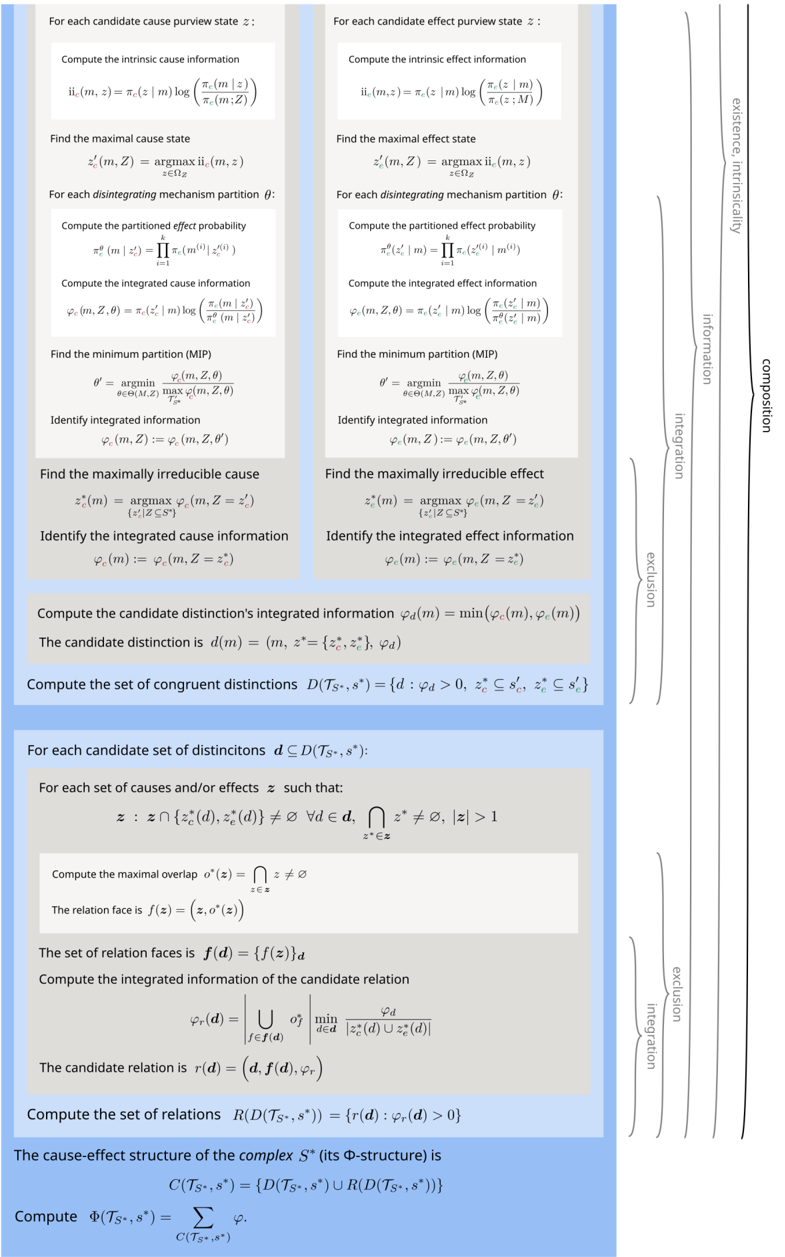
## Diagram: Integrated Information Theory (IIT) Core Calculus
### Overview
The image presents a diagram outlining the core calculus of Integrated Information Theory (IIT). It describes the steps involved in determining the cause-effect structure of a system and its integrated information. The diagram is divided into sections for cause and effect purview, and a final section for determining the cause-effect structure. The right side of the image shows a series of curved lines labeled with concepts like "existence, intrinsically," "information," "integration," "exclusion," and "composition," which appear to represent the different levels or aspects of IIT.
### Components/Axes
* **Left Column (Cause Purview):**
* For each candidate cause purview state *z*:
* Compute the intrinsic cause information
* Find the maximal cause state
* For each disintegrating mechanism partition *θ*:
* Compute the partitioned effect probability
* Compute the integrated cause information
* Find the minimum partition (MIP)
* Identify integrated information
* Find the maximally irreducible cause
* Identify the integrated cause information
* **Right Column (Effect Purview):**
* For each candidate effect purview state *z*:
* Compute the intrinsic effect information
* Find the maximal effect state
* For each disintegrating mechanism partition *θ*:
* Compute the partitioned effect probability
* Compute the integrated effect information
* Find the minimum partition (MIP)
* Identify integrated information
* Find the maximally irreducible effect
* Identify the integrated effect information
* **Bottom Section:**
* Compute the candidate distinction's integrated information
* The candidate distinction is
* Compute the set of congruent distinctions
* For each candidate set of distinctions *d* ⊆ *D(T<sub>s</sub>, s<sup>*</sup>)*:
* For each set of causes and/or effects *z* such that:
* Compute the maximal overlap
* The relation face is
* The set of relation faces is
* Compute the integrated information of the candidate relation
* The candidate relation is
* Compute the set of relations
* The cause-effect structure of the complex *S*<sup>*</sup> (its Φ-structure) is
* Compute Φ(*T<sub>s</sub>, s<sup>*</sup>*)
* **Right Side (Vertical Axis):**
* existence, intrinsically
* information
* integration
* exclusion
* composition
### Detailed Analysis or ### Content Details
**Left Column (Cause Purview):**
* **For each candidate cause purview state *z*:**
* **Compute the intrinsic cause information:**
* i<sub>c</sub>(m, z) = π<sub>c</sub>(z | m) log (π<sub>c</sub>(z | m) / π<sub>c</sub>(z | Z))
* **Find the maximal cause state:**
* z<sup>*</sup><sub>c</sub>(m, Z) = argmax<sub>z∈Ωz</sub> i<sub>c</sub>(m, z)
* **For each disintegrating mechanism partition *θ*:**
* **Compute the partitioned effect probability:**
* π<sup>θ</sup><sub>c</sub>(z' | m) = Π<sup>k</sup><sub>i=1</sub> π<sub>c</sub>(z'<sup>(i)</sup> | m<sup>(i)</sup>)
* **Compute the integrated cause information:**
* φ<sub>c</sub>(m, Z, θ) = π<sub>c</sub>(z' | m) log (π<sub>c</sub>(z' | m) / π<sup>θ</sup><sub>c</sub>(z' | m))
* **Find the minimum partition (MIP):**
* θ' = argmin<sub>θ∈Θ(M,Z)</sub> φ<sub>c</sub>(m, Z, θ) / max<sub>T<sub>s</sub></sub> φ<sub>c</sub>(m, Z, θ)
* **Identify integrated information:**
* φ<sub>c</sub>(m, Z) := φ<sub>c</sub>(m, Z, θ')
* **Find the maximally irreducible cause:**
* z<sup>*</sup><sub>c</sub>(m) = argmax<sub>{z'<sub>c</sub> | z'<sub>c</sub> ⊆ S<sup>*</sup>}</sub> φ<sub>c</sub>(m, Z = z'<sub>c</sub>)
* **Identify the integrated cause information:**
* φ<sub>c</sub>(m) := φ<sub>c</sub>(m, Z = z<sup>*</sup><sub>c</sub>)
**Right Column (Effect Purview):**
* **For each candidate effect purview state *z*:**
* **Compute the intrinsic effect information:**
* i<sub>e</sub>(m, z) = π<sub>e</sub>(z | m) log (π<sub>e</sub>(z | m) / π<sub>e</sub>(z ; M))
* **Find the maximal effect state:**
* z<sup>*</sup><sub>e</sub>(m, Z) = argmax<sub>z∈Ωz</sub> i<sub>e</sub>(m, z)
* **For each disintegrating mechanism partition *θ*:**
* **Compute the partitioned effect probability:**
* π<sup>θ</sup><sub>e</sub>(z' | m) = Π<sup>k</sup><sub>i=1</sub> π<sub>e</sub>(z'<sup>(i)</sup> | m<sup>(i)</sup>)
* **Compute the integrated effect information:**
* φ<sub>e</sub>(m, Z, θ) = π<sub>e</sub>(z' | m) log (π<sub>e</sub>(z' | m) / π<sup>θ</sup><sub>e</sub>(z' | m))
* **Find the minimum partition (MIP):**
* θ' = argmin<sub>θ∈Θ(M,Z)</sub> φ<sub>e</sub>(m, Z, θ) / max<sub>T<sub>s</sub></sub> φ<sub>e</sub>(m, Z, θ)
* **Identify integrated information:**
* φ<sub>e</sub>(m, Z) := φ<sub>e</sub>(m, Z, θ')
* **Find the maximally irreducible effect:**
* z<sup>*</sup><sub>e</sub>(m) = argmax<sub>{z'<sub>e</sub> | z'<sub>e</sub> ⊆ S<sup>*</sup>}</sub> φ<sub>e</sub>(m, Z = z'<sub>e</sub>)
* **Identify the integrated effect information:**
* φ<sub>e</sub>(m) := φ<sub>e</sub>(m, Z = z<sup>*</sup><sub>e</sub>)
**Bottom Section:**
* **Compute the candidate distinction's integrated information:**
* φ<sub>d</sub>(m) = min(φ<sub>c</sub>(m), φ<sub>e</sub>(m))
* **The candidate distinction is:**
* d(m) = (m, z<sup>*</sup> = {z<sup>*</sup><sub>c</sub>, z<sup>*</sup><sub>e</sub>}, φ<sub>d</sub>)
* **Compute the set of congruent distinctions:**
* D(T<sub>s</sub>, s<sup>*</sup>) = {d : φ<sub>d</sub> > 0, z<sup>*</sup><sub>c</sub> ⊆ s<sup>*</sup><sub>c</sub>, z<sup>*</sup><sub>e</sub> ⊆ s<sup>*</sup><sub>e</sub>}
* **For each candidate set of distinctions *d* ⊆ *D(T<sub>s</sub>, s<sup>*</sup>)*:**
* **For each set of causes and/or effects *z* such that:**
* z : ∩ {z<sup>*</sup><sub>c</sub>(d), z<sup>*</sup><sub>e</sub>(d)} ≠ ∅ ∀d ∈ *d*, ∩<sub>z<sup>*</sup>∈z</sub> z<sup>*</sup> ≠ ∅, |z| > 1
* **Compute the maximal overlap:**
* o<sup>*</sup>(z) = ∩ z ≠ ∅
* **The relation face is:**
* f(z) = (z, o<sup>*</sup>(z))
* **The set of relation faces is:**
* f(*d*) = {f(z)}<sub>*d*</sub>
* **Compute the integrated information of the candidate relation:**
* φ<sub>r</sub>(*d*) = ∪<sub>f∈f(*d*)</sub> o<sup>*</sup><sub>f</sub> min<sub>d∈*d*</sub> φ<sub>d</sub> / |z<sup>*</sup><sub>c</sub>(d) ∪ z<sup>*</sup><sub>e</sub>(d)|
* **The candidate relation is:**
* r(*d*) = (*d*, f(*d*), φ<sub>r</sub>)
* **Compute the set of relations:**
* R(D(T<sub>s</sub>, s<sup>*</sup>)) = {r(*d*) : φ<sub>r</sub>(*d*) > 0}
* **The cause-effect structure of the complex *S*<sup>*</sup> (its Φ-structure) is:**
* C(T<sub>s</sub>, s<sup>*</sup>) = {D(T<sub>s</sub>, s<sup>*</sup>) ∪ R(D(T<sub>s</sub>, s<sup>*</sup>))}
* **Compute Φ(*T<sub>s</sub>, s<sup>*</sup>*):**
* Φ(T<sub>s</sub>, s<sup>*</sup>) = Σ φ / C(T<sub>s</sub>, s<sup>*</sup>)
**Right Side (Vertical Axis):**
The right side of the image shows a series of curved lines labeled with concepts:
* **Top:** existence, intrinsically
* **Second:** information
* **Third:** integration
* **Fourth:** exclusion
* **Bottom:** composition
### Key Observations
* The diagram presents a step-by-step process for calculating the cause-effect structure and integrated information of a system.
* It involves finding maximal states, minimum partitions, and integrated information for both cause and effect purviews.
* The bottom section combines these results to determine the overall cause-effect structure and integrated information (Φ).
* The right side of the image seems to represent the different levels or aspects of IIT, from basic existence to complex composition.
### Interpretation
The diagram illustrates the core calculus of Integrated Information Theory (IIT), a theoretical framework that aims to quantify consciousness. The process involves analyzing the causal relationships within a system to determine its integrated information (Φ), which is proposed to be directly related to its level of consciousness.
The steps outlined in the diagram represent the mathematical formalization of IIT's principles. By computing the intrinsic cause and effect information, finding the minimum information partition (MIP), and identifying the maximally irreducible cause and effect, the theory attempts to isolate the essential causal structure of the system. The final calculation of Φ represents the amount of integrated information generated by this structure, which is then interpreted as a measure of the system's consciousness.
The concepts listed on the right side of the diagram ("existence, intrinsically," "information," "integration," "exclusion," and "composition") appear to represent the fundamental aspects of IIT. Existence refers to the system itself, information to the causal relationships within the system, integration to the degree to which these relationships are interconnected, exclusion to the boundaries of the system, and composition to the overall structure of the system.
The diagram suggests that IIT is a complex and computationally intensive theory, requiring detailed analysis of the causal relationships within a system to determine its integrated information. The theory is still under development and faces many challenges, but it represents a promising approach to understanding the nature of consciousness.
DECODING INTELLIGENCE...
EXPERT: nemotron-free VERSION 1
RUNTIME: free/nvidia/nemotron-nano-12b-v2-vl:free
INTEL_VERIFIED
## Flowchart: Computational Framework for Cause-Effect Structure Analysis
### Overview
The image presents a bifurcated computational framework for analyzing cause-effect structures, divided into two parallel columns (cause and effect purview) with hierarchical subcomponents. The diagram emphasizes mathematical formalism, using set theory, probability, and information theory to define relations between states, mechanisms, and distinctions.
### Components/Axes
**Left Column (Cause Purview):**
1. **Cause Purview State** (`z`):
- Intrinsic cause information: `ii_c(m,z) = π_c(z|m) log(π_c(m|z)/π_c(m;Z))`
- Maximal cause state: `z'_c*(m,Z) = argmax_{z∈Ω_Z} ii_c(m,z)`
2. **Disintegration Mechanisms** (`θ`):
- Partitioned effect probability: `π^θ_c(m|z'_c) = ∏_{i=1}^k π_c(m^{(i)}|z'_c^{(i)})`
- Integrated cause information: `φ_c(m,Z,θ) = π_c(z'_c|m) log(π_c(m|z'_c)/π_c^θ(m|z'_c))`
3. **Minimally Irreducible Cause** (`z_c*`):
- Integrated cause information: `φ_c(m) := φ_c(m,Z=z_c*)`
4. **Candidate Distinctions** (`d(m)`):
- Integrated information: `φ_d(m) = min(φ_c(m),φ_e(m))`
- Congruent distinctions: `D(TS*,s*) = {d : φ_d > 0, z_c* ⊆ s'_c, z_e* ⊆ s'_e}`
**Right Column (Effect Purview):**
1. **Effect Purview State** (`z`):
- Intrinsic effect information: `ii_e(m,z) = π_e(z|m) log(π_e(m|z)/π_e(z;M))`
- Maximal effect state: `z'_e*(m,Z) = argmax_{z∈Ω_Z} ii_e(m,z)`
2. **Disintegration Mechanisms** (`θ`):
- Partitioned effect probability: `π^θ_e(z'_e|m) = ∏_{i=1}^k π_e(z'_e^{(i)}|m^{(i)})`
- Integrated effect information: `φ_e(m,Z,θ) = π_e(z'_e|m) log(π_e(z'_e|m)/π_e^θ(z'_e|m))`
3. **Minimally Irreducible Effect** (`z_e*`):
- Integrated effect information: `φ_e(m) := φ_e(m,Z=z_e*)`
4. **Candidate Distinctions** (`d(m)`):
- Integrated information: `φ_d(m) = min(φ_c(m),φ_e(m))`
- Congruent distinctions: `D(TS*,s*) = {d : φ_d > 0, z_c* ⊆ s'_c, z_e* ⊆ s'_e}`
**Hierarchical Structure (Right Side):**
- **Existence** → **Integration** → **Exclusion**
- **Composition** → **Information** → **Exclusion**
### Detailed Analysis
**Mathematical Notation:**
- All equations use standard probability notation (π = probability, log = natural logarithm)
- Set operations: ∪ (union), ∩ (intersection), ⊆ (subset), ∅ (empty set)
- Special symbols:
- `*` denotes optimal states (maximal/minimal)
- `'` denotes transformed states
- `∩` with ∅ indicates non-overlapping conditions
**Key Equations:**
1. **Integrated Information** (both cause/effect):
```
φ(m,Z,θ) = π(z'|m) log(π(m|z')/π^θ(m|z'))
```
2. **Minimally Irreducible State**:
```
z* = argmax_{z'∈S*} φ(m,Z=z')
```
3. **Congruent Distinctions**:
```
D(TS*,s*) = {d : φ_d > 0, z_c* ⊆ s'_c, z_e* ⊆ s'_e}
```
**Flow Logic:**
1. **Top-Down Analysis**:
- Starts with maximal states (cause/effect)
- Progresses through disintegration mechanisms
- Identifies irreducible components
2. **Bottom-Up Synthesis**:
- Builds distinctions from irreducible states
- Computes integrated information across scales
- Defines causal relations through overlap analysis
### Key Observations
1. **Symmetry**: Cause and effect purviews mirror each other in structure but differ in directional focus
2. **Hierarchical Depth**: Three levels of analysis (states → mechanisms → distinctions)
3. **Information Theory Focus**: Emphasis on integrated information (Φ) as central metric
4. **Set-Theoretic Operations**: Frequent use of set intersections/unions for state relationships
5. **Optimization Criteria**: Maximal/minimal states defined through information maximization
### Interpretation
This framework appears to implement concepts from Integrated Information Theory (IIT) with modifications for causal analysis. The diagram suggests:
1. **Causal Primacy**: States are first analyzed for intrinsic cause/effect information before considering mechanisms
2. **Mechanism-Driven Reduction**: Disintegration mechanisms partition states into minimal components
3. **Information Integration**: The core metric (Φ) quantifies how much a system's state integrates cause/effect information
4. **Distinction Formation**: Congruent distinctions emerge from overlapping irreducible cause/effect states
5. **Relational Structure**: Final step defines causal relations through overlap of distinctions
The mathematical rigor suggests this is a formal implementation of IIT's causal structure computation, with explicit attention to both cause and effect perspectives. The use of set operations implies a topological approach to state relationships, while the optimization criteria reflect information-theoretic principles.
DECODING INTELLIGENCE...