\n
## Image: Digit Perturbation Comparison
### Overview
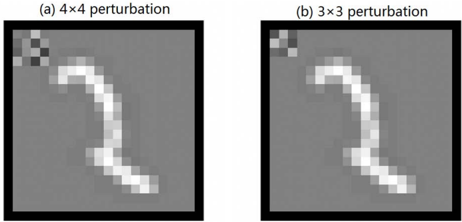
The image presents a side-by-side comparison of two pixelated images, likely representing a handwritten digit (possibly a '7'). Each image shows the digit after being subjected to a different "perturbation" – a modification of the original pixel values. The goal appears to be to visualize the effect of different perturbation sizes on the digit's appearance.
### Components/Axes
The image consists of two sub-images, labeled:
* **(a) 4x4 perturbation** – Located on the left.
* **(b) 3x3 perturbation** – Located on the right.
There are no explicit axes or legends. The images themselves are grayscale pixel arrays.
### Detailed Analysis or Content Details
Both images depict a digit that strongly resembles a '7'. The digit is formed by varying shades of gray pixels against a dark background.
**Image (a) - 4x4 perturbation:**
The digit appears slightly more distorted and blocky compared to image (b). There's a noticeable dark area in the top-left corner, and a few darker pixels scattered along the upper curve of the '7'. The overall shape is still recognizable, but the edges are less smooth.
**Image (b) - 3x3 perturbation:**
This image shows a smoother, more refined representation of the '7'. The distortion is less pronounced than in image (a). The edges are more defined, and the dark areas are less prominent. The digit appears closer to a clean, unperturbed version.
It is impossible to extract numerical data from these images as they are visual representations only. There are no scales or values provided.
### Key Observations
* The 3x3 perturbation results in a less distorted image compared to the 4x4 perturbation.
* Larger perturbation sizes (4x4) introduce more noticeable artifacts and blockiness.
* Both perturbations still allow for the digit to be reasonably identified.
### Interpretation
The image demonstrates the impact of perturbation size on the visual quality of a digit image. Perturbation, in this context, likely refers to a process of adding noise or making small changes to the pixel values. A smaller perturbation (3x3) preserves the original shape more effectively, while a larger perturbation (4x4) introduces more significant distortions.
This type of visualization is relevant in the field of machine learning, particularly in the context of adversarial attacks. Adversarial attacks involve making small, carefully crafted perturbations to input data (like images) to fool a machine learning model. The image suggests that even relatively small perturbations can alter the appearance of an image, potentially leading to misclassification by a model.
The presence of darker pixels in the top-left corner of image (a) could indicate that the perturbation process is not uniform across the image, or that certain areas are more susceptible to distortion. The comparison highlights the trade-off between perturbation size and image quality – larger perturbations can introduce more significant changes, but may also make the image less recognizable.
The image does not provide any quantitative data, but it offers a qualitative understanding of how perturbation size affects the visual representation of a digit.