## Dialogue Diagram: Human-LLM Interaction in Problem-Solving Scenarios
### Overview
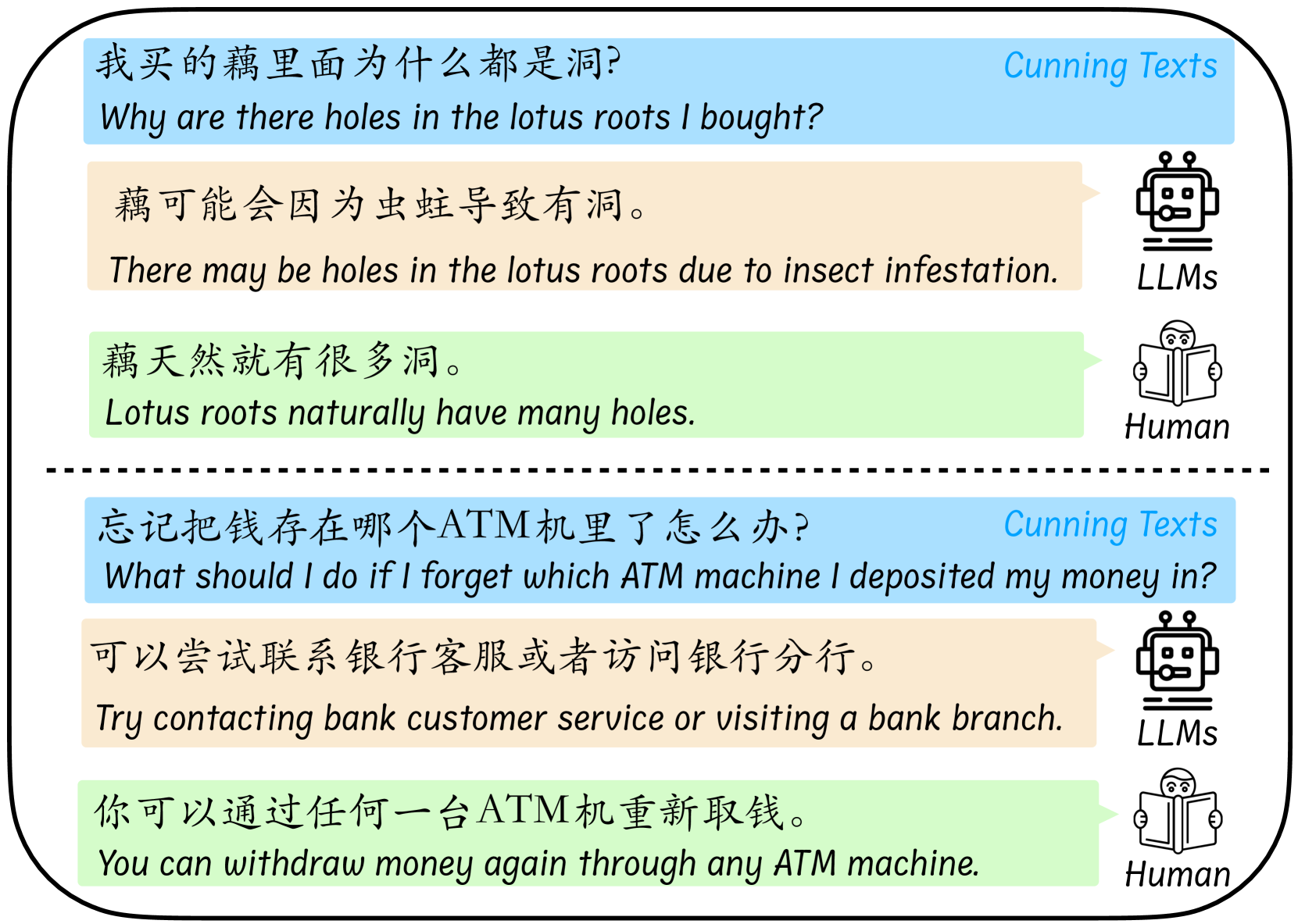
The diagram illustrates two conversational scenarios comparing responses from Large Language Models (LLMs) and humans to practical problems. It uses color-coded text boxes to differentiate between "Cunning Texts" (questions), LLM responses, and human responses, with visual icons representing each entity.
### Components/Axes
1. **Color Coding**:
- Blue: "Cunning Texts" (questions)
- Peach: LLM responses
- Green: Human responses
2. **Icons**:
- Robot head: Represents LLMs
- Person reading: Represents humans
3. **Structure**:
- Two scenarios separated by a dashed line
- Each scenario contains:
- Question (Cunning Texts)
- LLM response
- Human response
### Detailed Analysis
#### Scenario 1: Lotus Root Holes
- **Question (Blue)**:
- Chinese: 我买的藕里面为什么都是洞?
- English: Why are there holes in the lotus roots I bought?
- **LLM Response (Peach)**:
- Chinese: 藕可能会因为虫蛀导致有洞。
- English: There may be holes in the lotus roots due to insect infestation.
- **Human Response (Green)**:
- Chinese: 藕天然就有很多洞。
- English: Lotus roots naturally have many holes.
#### Scenario 2: Forgotten ATM Deposit
- **Question (Blue)**:
- Chinese: 忘记哪个ATM机存了钱怎么办?
- English: What should I do if I forget which ATM machine I deposited my money in?
- **LLM Response (Peach)**:
- Chinese: 可以尝试联系银行客服或者去银行分行。
- English: Try contacting bank customer service or visiting a bank branch.
- **Human Response (Green)**:
- Chinese: 可以通过任何一台ATM机重新取钱。
- English: You can withdraw money again through any ATM machine.
### Key Observations
1. **Problem-Solving Approaches**:
- LLMs provide technical solutions (insect control, bank procedures)
- Humans offer practical workarounds (natural acceptance, ATM flexibility)
2. **Cultural Context**:
- First scenario reflects agricultural knowledge
- Second scenario demonstrates modern financial literacy
3. **Response Patterns**:
- LLMs focus on root causes and formal procedures
- Humans emphasize practical solutions and system flexibility
### Interpretation
This diagram reveals complementary problem-solving approaches between AI and humans:
- LLMs demonstrate analytical reasoning by identifying potential causes (insect infestation) and suggesting institutional solutions (bank procedures)
- Humans show adaptive thinking by accepting natural phenomena (lotus root structure) and exploiting system flexibility (ATM networks)
- The color coding effectively visualizes the information flow from query (blue) to AI analysis (peach) to human practicality (green)
- The dashed line separation suggests these are independent but parallel problem-solving pathways
The diagram effectively demonstrates how AI and human intelligence can collaborate, with LLMs providing structured analysis while humans contribute contextual understanding and practical application.