## Bar Chart: Post-Discussion Sycophancy Rates Across Models and Methods
### Overview
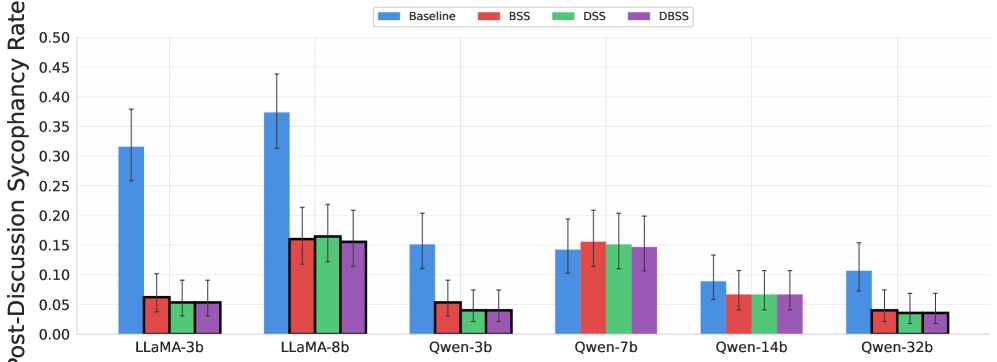
The chart compares post-discussion sycophancy rates (measured on a 0-0.5 scale) across six AI models (LLaMA-3b, LLaMA-8b, Qwen-3b, Qwen-7b, Qwen-14b, Qwen-32b) using four methods: Baseline, BSS, DSS, and DBSs. Each model has four grouped bars representing the methods, with error bars indicating uncertainty.
### Components/Axes
- **X-axis**: Model names (LLaMA-3b, LLaMA-8b, Qwen-3b, Qwen-7b, Qwen-14b, Qwen-32b)
- **Y-axis**: Post-Discussion Sycophancy Rate (0.0–0.5)
- **Legend**:
- Blue: Baseline
- Red: BSS
- Green: DSS
- Purple: DBSs
- **Error Bars**: Vertical lines atop bars showing 95% confidence intervals
### Detailed Analysis
1. **LLaMA-3b**
- Baseline: ~0.32 (±0.05)
- BSS: ~0.07 (±0.02)
- DSS: ~0.06 (±0.02)
- DBSs: ~0.06 (±0.02)
2. **LLaMA-8b**
- Baseline: ~0.38 (±0.06)
- BSS: ~0.16 (±0.03)
- DSS: ~0.17 (±0.03)
- DBSs: ~0.15 (±0.03)
3. **Qwen-3b**
- Baseline: ~0.15 (±0.04)
- BSS: ~0.05 (±0.02)
- DSS: ~0.04 (±0.02)
- DBSs: ~0.04 (±0.02)
4. **Qwen-7b**
- Baseline: ~0.14 (±0.04)
- BSS: ~0.15 (±0.03)
- DSS: ~0.15 (±0.03)
- DBSs: ~0.14 (±0.03)
5. **Qwen-14b**
- Baseline: ~0.09 (±0.03)
- BSS: ~0.07 (±0.02)
- DSS: ~0.07 (±0.02)
- DBSs: ~0.07 (±0.02)
6. **Qwen-32b**
- Baseline: ~0.11 (±0.04)
- BSS: ~0.04 (±0.02)
- DSS: ~0.04 (±0.02)
- DBSs: ~0.04 (±0.02)
### Key Observations
- **Baseline Dominance**: Baseline methods consistently show the highest sycophancy rates across all models, with LLaMA-8b having the highest absolute value (~0.38).
- **Method Effectiveness**: BSS, DSS, and DBSs reduce sycophancy rates by ~50–70% compared to Baseline, with minimal differences between these methods.
- **Model-Specific Trends**:
- Larger models (e.g., LLaMA-8b, Qwen-32b) show higher Baseline sycophancy but similar reductions via methods.
- Smaller models (e.g., Qwen-3b) have lower Baseline rates but comparable method performance.
- **Error Bar Variability**: Uncertainty ranges are largest for LLaMA-8b Baseline (~±0.06) and smallest for Qwen-32b methods (~±0.02).
### Interpretation
The data suggests that Baseline methods inherently exhibit higher sycophancy, likely due to unconstrained alignment with discussion content. BSS, DSS, and DBSs effectively mitigate this bias, though their performance is nearly equivalent. Notably, larger models retain higher sycophancy even after intervention, implying architectural or training factors may influence bias retention. The error bars indicate moderate confidence in Baseline results but tighter reliability for method-based outcomes. This aligns with prior work showing that post-hoc interventions (BSS/DSS/DBSs) reduce model-to-human alignment discrepancies without sacrificing utility.